Saturday, April 26, 2014

What will our prospective MEPs do to further our national identity! #Gaeilge


Some sample questions on the the Irish language to be put to candidates for the European Parliament have been suggested by Conradh na Gaeilge. They also include some points that these candidates should be aware of as the go seeking support next month!

www.toghchain2014.eu
In passing, it is of interest that the EU Parliament has an extensive site, which also gives recognition to all official languages.

The parliament is also very active on twitter, frequently tweeting in Irish @Europarl_GA.

Question 1
(a) If you are elected as a Member of the European Parliament, are you willing to speak Irish regularly and as common practice in Parliament? or

(b) If you are not comfortable with your own standard of Irish, will you improve upon your level of Irish by taking classes or a self-taught online course so as to ensure that you will have sufficient Irish to appropriately represent, the Irish speaking community especially, in the European Parliament?

Question 2

Are you willing to announce in public as part of your electoral campaign that you wish to have the derogation concerning the status of the Irish language in the European Union ended at the end of the year 2016? In order for that to happen, the Irish Government would need to inform the Council of the European Union, without delay, that it intends to propose the ending of the derogation at a formal meeting to be held in 2015.

Background:
  • Irish became an official language of the European Union on 1 January 2007.
  • A derogation was implemented regarding that status, initially for a period of 5 years until the end of 2011, and again until the end of 2016, so that not all of the legal documents which must be translated to the other official languages have to be made available in Irish. A shortage of Irish language experts was given as the reason. That shortage no longer exists.
  • In addition representatives from Ireland don’t have the same opportunity to use Irish in the European Union due to a lack of interpreters.
  • It is up to the Irish Government to officially submit a request to the European Union not to renew the derogation, and they need to take that decision soon if a recruitment campaign is to be properly administered between now and 2017
  • People are being employed by the EU at present (e.g. 10 posts for Irish-language lawyer linguists are to be filled in 2014). There will, however, be more than 180 additional jobs by 01/01/17 if the derogation is ended.
  • Election Notice in Maltese!
  • Maltese was adopted as an official language in 2004, and they were successful in removing the derogation relating to the language within 3 years. This was achieved by giving temporary contracts to many Maltese experts to facilitate them learning a third language while working in EU institutions. The third language is necessary to obtain a permanent job as a language expert. What additional benefits would arise for Ireland with the ending of the derogation on the status of Irish in the EU?
  • Irish would be on a par with each of the other 24 official languages in the European Union, including Maltese, Estonian and Latvian.
  • 183 high value jobs would be made available between now and 2017 (103 translators, 32 lawyer linguists, 42 secretaries and 6 unit heads) at no cost to the Government of Ireland.
  • There would be a long-term benefit on the influence of Ireland in the European Union, as a certain proportion of these people would go on to jobs with responsibility for policy areas in the European Union.
  • It would improve the status of Irish and the image of the language in the community in Ireland, especially amongst young people of school age and at third level.

Thursday, April 24, 2014

A future for Irish? Questions for local authority candidates!

Conradh na Gaeilge have suggested some sample questions on the future of the Gaeltacht and the Irish language to put to cadidates and some points that these candidates should be aware of as the go seeking support in the local elections next month!

QUESTION 1:
Do you choose a future for Irish?
Important notes below that are worth mentioning to the candidate before he/she answers the question:
  • It is a good idea to inform the candidate before they answer that action must be taken by them if they choose a future for Irish and that we will be back in touch with them about it 
  • We will publish and circulate amongst the Irish language community the names of the candidates that choose a future for Irish to acknowledge their support

QUESTION 2:
Are you willing to ensure service from the local authority in Irish, to the same standard of services in English, for the Irish language and Gaeltacht community? e.g. planning applications, housing services, etc..

Other notes:
  • In the South: Will you ensure that there is a condition inserted in to all contracts awarded by the local authority to suppliers of services to the authority that they must provide a service in Irish, e.g. refuse companies, service companies (like Dublin Bikes - no condition was inserted in to the contract and there is no service available to access a bike in Irish) or other.
  • In the North: Is the candidate willing to advocate publicly for an Irish Language Act to be enacted in the Westminster Parliament to establish a proper framework to develop the Irish language in the north and ensure that the local authority is promoting the language as laid out in the European Framework, for example with regard to bilingual signage in the borough council area
QUESTION 3:
Local question – e.g. about local signage, accommodation for gaelscoileanna or Irish language centres, local authority support for Irish community events, basic services and offices based in the Gaeltacht, etc..


Facts about the Irish language for candidates:

• Nearly 2 million people on the island of Ireland have some level of Irish

• According to statistics: 93% of the population in the south support the revival or preservation of the language (ESRI & NUI Maynooth for Michéal Mac Gréil, 2009); 35% support the use of Irish in the north and 53% support the provision of additional opportunities to learn Irish in the north (NI Omnibus Survey), 27% of the population in the south support Irish as the primary language of the state (Ipsos MRBI for the Irish Times)

• There are over 200 gaelscoil, between primary and secondary schools, on the island of Ireland

• The viability of Irish as a community language in the Gaeltacht is at risk (according to the Linguistic Study of the Use of Irish in the Gaeltacht, 2007)

• Irish has an economic value to the economy, e.g. it’s worth €6 million to the town / city that hosts the Oireachtas (annual Irish-medium festival); it’s worth over €136 million to the economy in Galway annually; the Irish summer colleges are worth over €20 million to the economy

• Irish offers additional benefits to its speakers/learners, e.g. It makes it easier to acquire a third and fourth language; there are cognitive benefits (i.e. thinking creatively, sensitivity to communication, problem solving); a better understanding of the heritage of the island, etc.

Thursday, April 17, 2014

10th report from Coimisinéar Teanga published!


Gaeilge
An Coimisinéir Teanga, Rónán Ó Domhnaill, published the Annual Report 2013 of the Office of An Coimisinéir Teanga this morning (17 April 2014).

This is the tenth annual report published by the Office. In those ten years over six thousand complaints have been raised with the Office in relation to language rights. Approximately 23% of those complaints related to Government Departments and Offices and 32% related to local authorities while the rest concerned a wide variety of state organisations.

Publishing the 2013 Report, Rónán Ó Domhnaill said: “Clearly the Office of An Coimisinéir Teanga has achieved a great deal in the last ten years with regard to protecting the language rights of Irish speakers. In that context I welcome the decision of the Government to reverse the plan to merge the Office of An Coimisinéir Teanga with the Office of the Ombudsman; this decision safeguards the independence of the Office.

"I am delighted to announce that the post of Director, Office of An Coimisinéir Teanga, at Principal Officer grade in the Civil Service, will be advertised shortly. This appointment will greatly enhance our ability to implement the aims of the Office in the coming years.”

Rónán Ó Domhnaill also recognised the achievements of the Report’s author and first Coimisinéir Teanga, Seán Ó Cuirreáin, in creating a space for the Irish language in public discourse and protecting language rights.

Complaints and investigations
In 2013, the Office of An Coimisinéir Teanga dealt with 775 cases of difficulties or  problems accessing state services through Irish. Most cases were resolved by means of informal negotiations with the relevant state bodies or by providing advice to the complainant.

A total of 13 formal investigations were carried out in 2013 and findings of breaches  of individual elements of language legislation were made against certain public  bodies. Two of the investigations concerned the Department of Education and Skills  and the issue of education through Irish in the Gaeltacht.

Language schemes 
98 language schemes (statutory language plans) covering a total of 184 public bodies were confirmed by the end of 2013; however, 72 of those 98 schemes had expired by  the end of that year. In the case of local authorities 94% of language schemes had  expired.

Perhaps the most incredible thing about this report is that all this detailed and precise work was carried out with a miserly budget of just over €500,000.00. Many Government bodies would do well to examine how this was accomplished.

The full version of the report in pdf form may be viewed here.

• Report from the Irish Times highlighting concerns voiced by Irish Language Organisations. (17/4/2014)
Ireland's English state (An Sionnach Fionn, 18/4/2014_

Sunday, April 6, 2014

A sensible and practical decision!

The Government has relented on its sudden decision of two years ago to merge the Office of the Coimisinéir Teanga and the the Office of the Ombudsman. "Following further consideration of the proposed amalgamation of the Office of An Coimisinéir Teanga with the Office of the Ombudsman, and having regard to the results of the public consultation process which indicated strong support for maintaining the Office of An Coimisinéir Teanga as a fully independent entity, the Government has decided not to proceed with the proposed amalgamation." (Statement from Minister of State Dinny McGinley 4/4/2014)

An Coimisinéir Teanga with the President!
The relief that this decision has engendered among the Gaeltacht and Irish speaking communities up and down the country is almost palpable. It is however interesting that the minister uses the phrase "fully independent entity" since he had always been at pains to state that the merge would not have effected this independence! Nonetheless the decision is to be welcomed!

Many commentators have also stated that although this may be regarded as such it is in reality hardly a victory since it merely restates the position of the Office as it was before the merge idea was launched!

An Coimisinéir Teanga, Rónán Ó Domhnaill, has welcomed the Government decision to reverse the plan to merge the Office of An Coimisinéir Teanga with the Office of the Ombudsman.

He said that it was a sensible and practical decision not to merge the two offices, commenting, "I welcome today's announcement. The Government decision protects the independence of the Office of An Coimisinéir Teanga and it puts an end to any uncertainty regarding the status of the Office in the future."

The most recent step in the amendment of the Official Languages Act 2003, i.e. the publication of the heads of bill, has also been noted by An Coimisinéir Teanga. An opportunity exists as the Bill is being brought before the Houses of the Oireachtas to take account of the commentary on the implementation of the Act issued by the Office of An Coimisinéir Teanga and to give due regard to the recommendations made in that report.

Mr Ó Domhnaill also said “There is an opportunity with this new Bill to strengthen language rights for Irish speakers both inside and outside the Gaeltacht. I believe that the best way this can be done is by implementing the recommendations of the Office of An Coimisinéir Teanga, which are based on 10 years of experience.”

An Coimisinéir Teanga looks forward to discussing the proposed legislation with the Department of Arts, Heritage & the Gaeltacht.

The Secratary of Conradh na Gaeilge, Julian de Spáinn, welcomed the decision not to merge the two offices. He reflected the general consensus (as voiced by the Coimisinéir Teanga) to ensure "that the focus now should be on strengthening the Official Languages Act to ensure adequate services for the Irish-speaking community”.

Saturday, March 29, 2014

British monarchy & EU more relevant to Irish speakers than State?

I find it interesting, and perhaps alarming, that in the last two days there have been two tweets in the National Language from the "Irish Foreign Ministry". Both are retweets one from the British Monarchy and the other from the European Parliament! All other, presumable generated from the Department itself are in English.


Only tweets in Irish by Irish Foreign 
Ministry were retweets from 
"out of town!"
Could this be further evidence of the “growing evidence that there is a strategy afoot to do away with what’s left of Irish in the public life of the county,” to quote the words of an Irish Civil Servant.

The newspapers are full of the resignation of the Garda Commissioner Callinan! Last February another Commissioner resigned because he believed "that the language is continuously being edged aside, pushed towards the margins of society and that includes much of the public sector." This received little publicity in the English language media. The French have a saying, "Plus ça change, plus c'est la même chose!"

Seán Ó Cuirreáin, who has been praised by the President of Ireland for his "integrity and intellectual honesty" and as "one of the most courteous people I have ever met!" found himself confronted with two possibilities.

"The choice I had was to stand aside from my appointment as Coimisinéir Teanga on principle to draw attention to these matters or to continue in my role and, consequently, to participate in a pretence."

As a man of integrity he took the honourable path as I think did the Garda Commissioner.

As a postscript to this posting it should be noted that a Department and Officer which was praised by the resigning Language Commissioner was that of the retired Garda Commissioner and the Garda Síochána. In a submission to the Oireachtas in December 2013, Commssioner Ó Cuirreáin said, "..I welcome the positive attitude of the Garda Commissioner and senior management to the implementation of the recommendations I made on foot of this case and hope that the systematic change being introduced will prevent the occurrence of similar incidents."


Saturday, March 22, 2014

Motions on Irish at the Fianna Fáil Árd Fheis!

These are the motions on the Irish Language and the Gaeltacht before the Fianna Fáil Árd Fheis. The picture shows the Irish Language page on the Fianna Fáil website! Am I the only person for whom the proverb "Physician, heal thyself!" suggests itself!

• That this Ard Fheis stands 100% with the Irish language and with all persons who want to use the Irish language in their everyday life.
Dingle Comhairle Ceantair, Kerry CDC; Related Motion: Donegal North East CDC 

• That this Ard Fheis condemns the Fine Gael/Labour government policy of the denigration of the Irish language by the reduction of teachers in small rural Gaelscoileanna and calls for the reversal of this policy immediately.
Navan West Comhairle Ceantair, Meath West CDC

• That this Ard Fheis calls on the Government to restore democratic elections to Údarás na Gaeltachta.
Ballybunion Cumann, Kerry CDC 

• That this Ard Fheis condemns the total lack of respect this Government has shown towards the Irish language since taking office and commends the actions taken by Seán Ó Cuirreáin in highlighting this matter.
Clogheen Cumann, Tipperary CDC 

• Dearbhaíonn an Ard Fheis seo tacaíocht ballraíocht Fhianna Fáil don ról an Comisinéir Teanga chun stádas an Ghaeilge agus Gaeilgeoirí a chosaint agus a neartú.
Corr na Móna, Gaillimhe Thiar CDC 

• Cáineann an Ard Fheis seo an easpa tacaíochta atá léirithe ag an Rialtas reatha don Straitéis 20 Bliain don Ghaeilge. Éilíonn an Ard Fheis seo cothromaíocht na Féinne le haghaidh saoránaigh a labhrann Gaeilge.
 An Chloch Bhreach, Gaillimhe Thiar CDC 

• Tá ballraíocht Fhianna Fáil tiomnaithe ar an Gaeilge a chur chun cinn i ngach gné d’obair an Phairtí, ón gCumann suas chuig an Ard Chomhairle, agus san Oireachtas agus sna Comhairlí Áitiúla.
Comhairle Ceantair Chonamara Tuaidh

Wednesday, March 12, 2014

President appoints Coimisinéir Teanga!

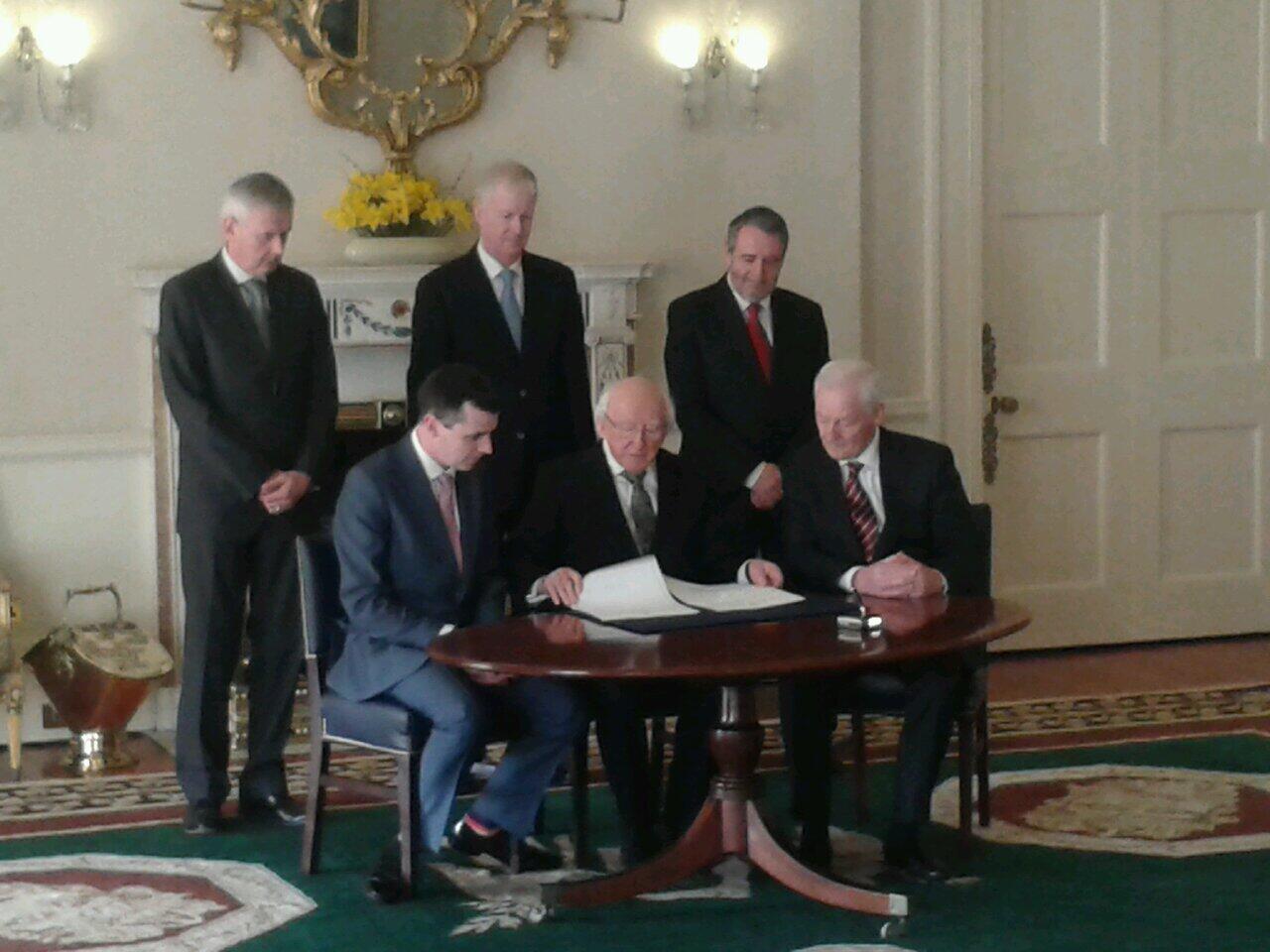
Rónán Ó Domhnaill was appointed today as An Coimisinéir Teanga by the President of Ireland, Michael D. Higgins.

Mr Ó Domhnaill said that it was an honour and a privilege to be appointed as the country’s second ever Coimisinéir Teanga.

Rónán Ó Domhnaill, Coimisinéir Teanga
"I'm delighted today to be appointed as An Coimisinéir Teanga and I am looking forward to taking up this important role," he continued. I intend to protect the linguistic rights of Irish speakers without fear or favour, and to fulfil my legislative responsibilities with vigour and enthusiasm. “

“I am under no illusions about the challenges that lie before me and the Office of An Coimisinéir Teanga over the coming years, but I strongly believe that these are challenges that are worth facing in the interests of the Irish language, the Irish language speaking community and the people of Ireland.”

Mr Ó Domhnaill paid special tribute to his predecessor, Seán Ó Cuirreáin.

“The help that Seán Ó Cuirreáin has provided since I was named as An Coimisinéir Teanga has been a great source of encouragement to me and I greatly appreciate the unqualified support he has given me. I am also grateful to the staff in the Office of An Coimisinéir Teanga for their warm welcome."

Certificate of appointment is signed!
 (Micheál Ó Leidhn, RnaG)
Mr Ó Domhnaill also thanked the Minister of State for the Gaeltacht, Dinny McGinley, and the Government for nominating him as An Coimisinéir Teanga. He thanked the Dáil and Seanad for accepting that nomination unanimously and the President of Ireland for appointing him officially this afternoon.

Rónán Ó Domhnaill is 38 years old. He is from An Cheathrú Rua in the Connemara Gaeltacht and spent seven years as Political Correspondent with Nuacht RTÉ/TG4 and as a member of RTÉ's Political Unit before being nominated as An Coimisinéir Teanga last month. He is married to journalist Irene Ní Nualláin and they have two children.

As reported in the Irish Times!
As reported in Irish Independent!
• Appointment of new Language Commissioner (Gaelport, 13/3/2014)