Saturday, March 29, 2014

British monarchy & EU more relevant to Irish speakers than State?

I find it interesting, and perhaps alarming, that in the last two days there have been two tweets in the National Language from the "Irish Foreign Ministry". Both are retweets one from the British Monarchy and the other from the European Parliament! All other, presumable generated from the Department itself are in English.


Only tweets in Irish by Irish Foreign 
Ministry were retweets from 
"out of town!"
Could this be further evidence of the “growing evidence that there is a strategy afoot to do away with what’s left of Irish in the public life of the county,” to quote the words of an Irish Civil Servant.

The newspapers are full of the resignation of the Garda Commissioner Callinan! Last February another Commissioner resigned because he believed "that the language is continuously being edged aside, pushed towards the margins of society and that includes much of the public sector." This received little publicity in the English language media. The French have a saying, "Plus ça change, plus c'est la même chose!"

Seán Ó Cuirreáin, who has been praised by the President of Ireland for his "integrity and intellectual honesty" and as "one of the most courteous people I have ever met!" found himself confronted with two possibilities.

"The choice I had was to stand aside from my appointment as Coimisinéir Teanga on principle to draw attention to these matters or to continue in my role and, consequently, to participate in a pretence."

As a man of integrity he took the honourable path as I think did the Garda Commissioner.

As a postscript to this posting it should be noted that a Department and Officer which was praised by the resigning Language Commissioner was that of the retired Garda Commissioner and the Garda Síochána. In a submission to the Oireachtas in December 2013, Commssioner Ó Cuirreáin said, "..I welcome the positive attitude of the Garda Commissioner and senior management to the implementation of the recommendations I made on foot of this case and hope that the systematic change being introduced will prevent the occurrence of similar incidents."


Saturday, March 22, 2014

Motions on Irish at the Fianna Fáil Árd Fheis!

These are the motions on the Irish Language and the Gaeltacht before the Fianna Fáil Árd Fheis. The picture shows the Irish Language page on the Fianna Fáil website! Am I the only person for whom the proverb "Physician, heal thyself!" suggests itself!

• That this Ard Fheis stands 100% with the Irish language and with all persons who want to use the Irish language in their everyday life.
Dingle Comhairle Ceantair, Kerry CDC; Related Motion: Donegal North East CDC 

• That this Ard Fheis condemns the Fine Gael/Labour government policy of the denigration of the Irish language by the reduction of teachers in small rural Gaelscoileanna and calls for the reversal of this policy immediately.
Navan West Comhairle Ceantair, Meath West CDC

• That this Ard Fheis calls on the Government to restore democratic elections to Údarás na Gaeltachta.
Ballybunion Cumann, Kerry CDC 

• That this Ard Fheis condemns the total lack of respect this Government has shown towards the Irish language since taking office and commends the actions taken by Seán Ó Cuirreáin in highlighting this matter.
Clogheen Cumann, Tipperary CDC 

• Dearbhaíonn an Ard Fheis seo tacaíocht ballraíocht Fhianna Fáil don ról an Comisinéir Teanga chun stádas an Ghaeilge agus Gaeilgeoirí a chosaint agus a neartú.
Corr na Móna, Gaillimhe Thiar CDC 

• Cáineann an Ard Fheis seo an easpa tacaíochta atá léirithe ag an Rialtas reatha don Straitéis 20 Bliain don Ghaeilge. Éilíonn an Ard Fheis seo cothromaíocht na Féinne le haghaidh saoránaigh a labhrann Gaeilge.
 An Chloch Bhreach, Gaillimhe Thiar CDC 

• Tá ballraíocht Fhianna Fáil tiomnaithe ar an Gaeilge a chur chun cinn i ngach gné d’obair an Phairtí, ón gCumann suas chuig an Ard Chomhairle, agus san Oireachtas agus sna Comhairlí Áitiúla.
Comhairle Ceantair Chonamara Tuaidh

Wednesday, March 12, 2014

President appoints Coimisinéir Teanga!

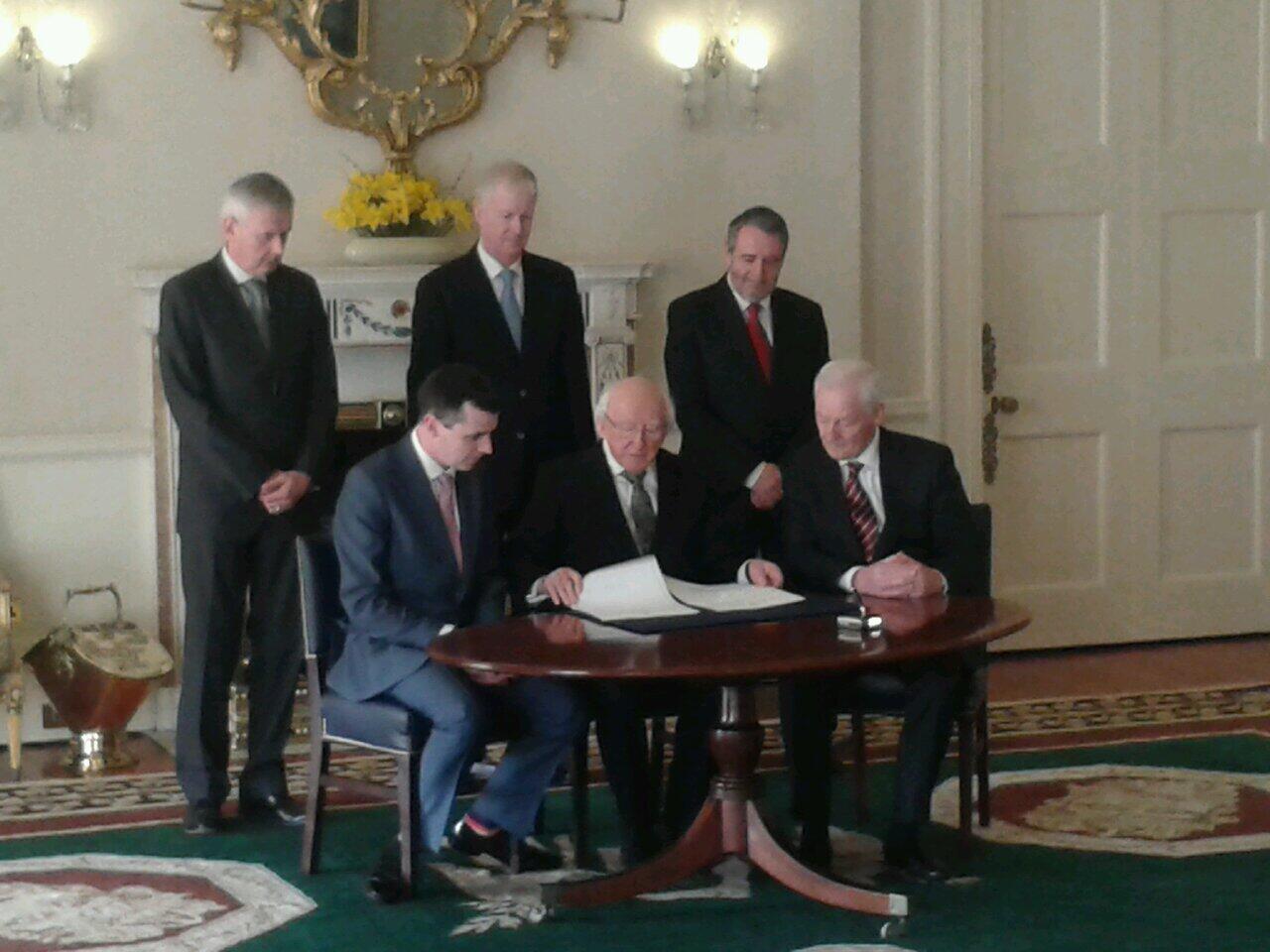
Rónán Ó Domhnaill was appointed today as An Coimisinéir Teanga by the President of Ireland, Michael D. Higgins.

Mr Ó Domhnaill said that it was an honour and a privilege to be appointed as the country’s second ever Coimisinéir Teanga.

Rónán Ó Domhnaill, Coimisinéir Teanga
"I'm delighted today to be appointed as An Coimisinéir Teanga and I am looking forward to taking up this important role," he continued. I intend to protect the linguistic rights of Irish speakers without fear or favour, and to fulfil my legislative responsibilities with vigour and enthusiasm. “

“I am under no illusions about the challenges that lie before me and the Office of An Coimisinéir Teanga over the coming years, but I strongly believe that these are challenges that are worth facing in the interests of the Irish language, the Irish language speaking community and the people of Ireland.”

Mr Ó Domhnaill paid special tribute to his predecessor, Seán Ó Cuirreáin.

“The help that Seán Ó Cuirreáin has provided since I was named as An Coimisinéir Teanga has been a great source of encouragement to me and I greatly appreciate the unqualified support he has given me. I am also grateful to the staff in the Office of An Coimisinéir Teanga for their warm welcome."

Certificate of appointment is signed!
 (Micheál Ó Leidhn, RnaG)
Mr Ó Domhnaill also thanked the Minister of State for the Gaeltacht, Dinny McGinley, and the Government for nominating him as An Coimisinéir Teanga. He thanked the Dáil and Seanad for accepting that nomination unanimously and the President of Ireland for appointing him officially this afternoon.

Rónán Ó Domhnaill is 38 years old. He is from An Cheathrú Rua in the Connemara Gaeltacht and spent seven years as Political Correspondent with Nuacht RTÉ/TG4 and as a member of RTÉ's Political Unit before being nominated as An Coimisinéir Teanga last month. He is married to journalist Irene Ní Nualláin and they have two children.

• As reported in the Irish Times!
• As reported in Irish Independent!
• Appointment of new Language Commissioner (Gaelport, 13/3/2014)

Minster plays fast and loose with the strategy!

It is such a pity that the Irish Times's Miriam Lord is ignorant of the National Language otherwise we might have had an entertaining not to say incisive account of the happenings in Áras an Uachtarán and two oireachtas committees during the week ending 7th March 2014.

On Wednesday two of these happenings occurred.

Thank you!
A delightful reception, hosted by the President of Ireland, Michael D Higgins, in honour of the resigning Language Commissioner, Seán Ó Cuirreáin, who had announced a short three months prior to that that he felt he had no option but to resign rather than collude in the pretense of the policy of the Government and Civil Administration.

The President gave a remarkable address (which contrasted markably from any understandable remarks from any Govenment minister) which supported the stand of Seán Ó Cuirreáin. He remarked that he had known Mr Ó Cuirreáin for many years and that he was among the most courteous of men he had ever known. "I would like to pay tribute this evening to Seán’s honesty, his intellectual integrity and to his steadfastness."

Echoing comments made by Seán Ó Cuirreáin to two Oireachtas Committees he said:  “Irish should never be seen as a thorn in the side of the administrative system."

He went on even more strongly “As President of Ireland, I wish to state that, not only am I dismayed, but that I am greatly concerned at the apparent low level of ability to fulfil the rights of citizens who wish to interact through Irish with the State and its agencies."

His address is so strong that at least one commentator wondered if he had crossed a constitutional border in expressing a view so at variance with the perceived policy of the Government. His address (in Irish) may be found here on the website of the President of Ireland.

Machiavellian obfuscation
In stark contrast to events in Áras an Uachtaráin the meeting in Committee Room 4 of the Oireachtas was more like a painful session at the dentist, of pulling obstinate teeth. In the first of two confrontations the Minister of State for the Gaeltacht displayed what might be described either complimentarily as a Machiavellian deviousness, not seen since the hay-day of the Grandfather of the Deputy from West Galway, or less admirably an exercise in lamentable, obdurate obfuscation. The Minster seemed unable to reply to a simple question with a simple answer. Indeed on more than one occasion we were entertained to a trip down memory lane and his own participation in various campaigns in his youth.

He was keen to point out that he was busy making a major contribution to the increased use of Irish in the civil service not seen for forty years. (He did not, nor did any one else, refer to the fact that the ills which caused up to 10,000 to march in Dublin, and 1000 in Conamara last month were in fact the direct result of a decision by a Fine Gael Minister of Finance in 1974!)

When people tried to pin him down on any particular problem raised by the Commissioner he maintained that he himself had no responsibility except for his own Department.

Mr Michael Kitt said the number of complaints to the Irish language commissioner was increasing, the complaints coming from across the State with 26% were from within the Gaeltacht.

The Minister told him it was “a good thing that complaints are coming in from the public because it shows the demand for Irish speakers”. However he did not say how these complaints could be satisfied.

The amalgamation of the Commisioner's office with that of the Ombudsman would mean that his Department would no longer be responsible for these reports but they would pass to the Minister for Public Expenditure and Reform.

When rights are not rights!
When asked whether language rights were human rights he seemed to maintain that these rights depended on the availability of funds. I suppose we could quote, mutas mutandis the author of Animal Farm, "Some rights are more equal than others!"

In the Dáil the following morning the claim was made, and not denied, that the rate of approval of Language Schemes, (Legally binding schemes submitted by Departments and public bodies advising what they were doing to implement Irish Language policy), would mean that twenty eight years would have come and gone before every body had submitted schemes.

On Thursday a second Oireachtas Committee had summoned the Minister. In fact only the Chairman, Sen Labhrás Ó Murchú, of this committee bothered to turn up though other Deptuties and Senators did. The members who missed the show - er sorry session - were An Teachta Micheál Mac Carthaigh, An Teachta Caoimhín Mac Unfraidh, An Teachta Peadar Tóibín, An Seanadóir Fiach Mac Conghaíl and An Seanadóir Cáit Uí Chátháin.

This was a meeting to examine progress on the famous 20 year Strategy about which the resigning Commissioner said, "Is the Strategy being implemented?  I don’t know.  And with all due respect to you as a subcommittee, I believe that you don’t know either as there is no independent audit or review being conducted on the implementation of the Strategy." The committee was a lesson in how to demolish a witness as Éamon Ó Cuív and Trevor Ó Clochartaigh with little assistance from Senator Briain Ó Domhnaill, examined how the 20 Year Strategy was not been implemented at all either in and how the government in effect has altered the all-party agreed document.

Government alters strategy without telling anyone!
The Minister of State again re-iterated that he had enough to be doing looking after his own Department than to be looking after what other Departments were doing. This outlook was in direct contrast to the impression that the questionnaires understanding of the Minister's responsibility with regard to the Strategy. Indeed even in his own Department, a Strategic Unit as mentioned in the Strategy, is not in place - a deep cause for concern for those in attendance. This was in direct contravention of the strategy "Planning and implementation of the Strategy will be directed from a Strategy Unit within that Department (of the Gaeltacht), with dedicated staff and the function of assigning duties and implementation roles to implementation agencies, as necessary."

Particular attention was drawn to the fact that there was no senior minister with responsibility as required by the document, "..a senior Minister and a Government Department (the Department of Community, Equality and Gaeltacht Affairs) with central responsibility for Irish language affairs.)" 

By the time the meeting ended there was nothing said that belied the feeling that the Government’s treatment of the Irish language was a deep deep cause for concern for all those who questioned the Minister.

A report on this meeting in the Irish Times: Leaked document shows reversal of Irish language obligations. (6/3/2014)


Tuesday, March 4, 2014

Answers from the minister?

Minister of State for the Gaeltacht, Dinny McGinley T.D., is to appear before two Oireachtas committees this week.

It was at a meeting of the Joint Committee on Public Service Oversight and Petitions last December that Seán Ó Cuirreáin announced his resignation from the role of Coimisinéir Teanga as a result of the lack of Government support for the Irish language. An Coimisinéir Teanga had been before the Committee to discuss his most recent annual report which was the cause of much controversy.

"A maligned ethnic minority!"
It was Ó Cuirreáin’s announcement of his resignation, the first by an European Ombudsman on a matter of principle which, although hardly reported by the English language media, created ripples in the Irish speaking communities which haven't as yet died down. Events like the extraordinary demonstration on the streets of Dublin, described by an Australian participant "As we walked down O’Connell Street the gravity of the situation really hit home. Irish speakers are marching for recognition and rights as if they are a maligned ethnic minority or indeed an oppressed indigenous people. It seems for many people that is what Irish speakers represent." Or the altogether more intimate gathering outside his office in the Conamara Gaeltacht when about a thousand people said good bye and thank you to him as he left office. Further events are planned in other centres.

Fudge, Farce, Falsehood!
Here are the words he spoke (in translation) to the committee concerning the renewal of the Acht Teanga - which has apparently been in course of preparation for nigh on two years:

"If...the use of Irish in dealing with Gaeltacht communities and ensuring an adequate Irish language capacity in public administration – are not addressed by the State when the legislation is being amended, I fear that the exercise will be seen as a fudge, a farce or a falsehood.

As we begin to regain our economic sovereignty, it would be a travesty if we were to lose our linguistic sovereignty – a cornerstone of our cultural identity, heritage and soul as a nation. I believe this to be a clear and present danger." (This full address may be found here 4/12/2013)

The implications of Ó Cuirreáin’s resignation and the findings detailed in the 2012 report remain controversial topics and many concerns have been raised since the fallout began in December. The Joint Committee will meet again this Wednesday, 5 March, at 4pm to discuss many of the issues raised following Ó Cuirreáin’s announcement and to put those issues to Minister of State, Dinny McGinley T.D. No one in the government has addressed his points other than the Minister for Education who stated flatly that the Government rejected them, though that attitude appears to have softened somewhat in remarks from Minister McGinley though without much definition.

Participate in a pretence!
A meeting of the Oireachtas Sub-Committee on the 20 Year Strategy for the Irish Language and Related Matters will also discuss the issues raised by Seán Ó Cuirreáin at a meeting on Thursday, 6 March, at 2.15pm. In his last address to the Sub-Committee in January, Seán Ó Cuirreáin detailed the marginalisation of the Irish language by state authorities and the implications for the Irish-speaking community as a result of this negative stance. This meeting crystalised the reasons why he considered he had little choice but to submit his resignation to the President.

"The choice I had was to stand aside from my appointment as Coimisinéir Teanga on principle to draw attention to these matters or to continue in my role and, consequently, to participate in a pretence." (This full address is available here! 23/1/2014)

Those implications will take centre stage at a meeting of the Oireachtas sub-committee on Thursday, 6 March, at 2.15pm, at which the Minister of State will also be in attendance.
It is thought that the Minister address these issues during the meeting  particularly:

  • The status of the 20 Year Strategy for the Irish Language
  • The inauguration of Rónán Ó Domhnaill as An Coimisinéir Teanga and the status of his Office - it is now almost two weeks since his nomination was approved by both houses.
  • Addressing the issues and ‘pretence’ raised by Seán Ó Cuirreáin
  • Irish within the state service and Government action to tackle inadequacy
  • The Heads of Bill regarding the Official Languages Act 2003

It is hoped that concerns raised by both Committees will be listened to by the Minister of State the meetings will be seen as an opportunity for the Minister of State to take recommendations on board.

Friday, February 14, 2014

Twenty first century assessment - no time for group think!

"...nobody trusts people to investigate themselves. It’s just not the way things are done any more.” Minister Leo Varadkar
"...little value or importance can be attached in reality to self-assessment." Retiring Coimisinéir Teanga, Seán Ó Cuirreáin

In his final address to the Oireachtas as Coimisinéir Teanga on 23rd of January 2014, Seán Ó Cuirreáin made the following point when discussing the states the 20 year strategy on Irish (2010-2030) published in December 2010.

Self assessment!
Dr Leo Varadker: "..nobody trusts
people to investigate themselves!"
"Is the Strategy being implemented? I don’t know. And with all due respect to you as a subcommittee, I believe that you don’t know either as there is no independent audit or review being conducted on the implementation of the Strategy.
It is self-assessment only and from the experience of my Office in auditing the language schemes of State bodies over the past 10 years, little value or importance can be attached in reality to self-assessment.
In any area of life, it is difficult to depend on any review by stakeholders with vested interests, but, on the other hand, research based evidence is of immense value. We have also learned a valuable lesson over the years – that there is a basis for the phrase “what gets measured gets done!”
Unless audits and independent assessments are carried out I don’t believe anyone can give any guarantees as to implementation."

Not the modern way!
Glancing through some old newspapers, prior to recycling, I came across this statement, which, although it is dealing with another matter, makes the same point with perhaps stronger emphasis. In talking about the matter of the quashing of traffic penalty points discussed earlier this year, Fine Gael Minister for Transport, Dr Leo Varadkar, criticised the handling of the affair.

A report in the Irish Times, (4th February 2014) states, "While the matter was the subject of investigations within the Garda, Mr (sic) Varadkar suggested that internal inquiries lack credibility." He is quoted directly as saying “It’s just the 21st century Ireland that we live in – nobody trusts people to investigate themselves. It’s just not the way things are done any more.”

One hopes that his forward thinking penetrates into the deepest recesses of the usually impenetrable bureaucracy that runs this country. A bureaucracy run by civil servants whose attitude to the language has moved up a notch or two from "passive inaction on their part ...to one of active undermining," to quote a retired former higher Civil Servant.

As Seán Ó Cuirreáin stated: "Groupthink has no place in matters as important as the survival of a language."

Wednesday, February 12, 2014

Irish as a foreign language!

"Language rights are permanent rights; they are not concessions or privileges granted at times of prosperity." Seán Ó Cuirreáin, Coimisinéir Teanga, 

Last December, largely ignored by the English speaking media, saw the shock announcement of the Coimisinéir Teanga (Language Commissioner) that he intended to resign during this month. This event and also his later eloquent testimony explaining his decision to an Oireachtas Committee galvanized not only what is dismissed loftily as the Irish speaking lobby, but also ignited a simmering rage in the ever-reducing Irish speaking communities (Gaeltacht) where Irish is still used as a community language.


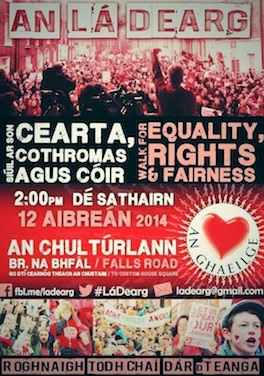
Another walk is being organised for the Northern Capital which will be entitled "An Lá Dearg" (The Red Day!).
This follows the successful "Lá Mór na Gaeilge" in Baile Átha Cliath on 15th February 2014 with up to 10,000 people, and the tribute to the resigning Language Commissioner, Seán Ó Cuirreáin in Conamara (23/2/2014) attended by up to a thousand people. 

Will you be with us?


A hastily arranged meeting in Dublin’s Liberty Hall gave expression to this anger and one of the results was the decision to hold a demonstration in Dublin on the 15th February 2014. Spontaneous meetings sprung up throughout the country, north, south, east, west to discuss how best to support this day and also to allow the expression of the feelings of those unable to attend the initial Liberty Hall meeting.

This writer attended the meeting in South Conamara, held in the historic Sean Scoil Sailearna, an old school building which has been imaginatively transformed into a wonderful theatre. Many grievances were aired but the one which made the greatest impact on me was the anger at the lack of understanding of the education needs of an Irish speaking area.

IAFL (Irish as a Foreign Language)
I was unaware just how unsuitable the uniform syllabus foisted on our schools is. Pupils in Rathfarnham, Carlow, An Spidéal or an Bun Beag have exactly the same linguistic programme. A pupils in an English speaking school in English speaking Dublin has a curriculum in Irish and in English which is exactly the same as a pupil in an Irish speaking school in Irish speaking Indreabhán. In other words the Irish curriculum is being taught as a foreign language even where it is the language of the community.

A study some years ago found that the schools in the Gaeltacht were excellent at teaching English but not Irish. Perhaps we have unearthed the reason why. This is understandable when one realizes that the Department of Education admits that only 1.5% of its personal have sufficient knowledge of Irish to conduct the business of administrating the educating the children of Ireland in what our constitution defines as the National Language.

Speak Irish among yourselves, but don’t speak it to us!
It does not help when one experiences that the state agencies, almost without exception, are unable to conduct business in the Gaeltacht in the language of the people. The Government have not  provided assurances to ensure that it will communicate in Irish with Gaeltacht communities without terms and conditions and that it will have adequate staff in public administration with proficiency in Irish to serve those excercising their constitutional right to deal in Irish with the state. In the words of the resigning Language Commisioner, '..the State sector is effectively saying to Gaeltacht communities: “Speak Irish among yourselves, but don’t speak it to us!”.'

The courageous decision of Seán ó Cuirreáin highlights the situation as he sees it after ten years, "The choice I had was to stand aside from my appointment as Coimisinéir Teanga on principle to draw attention to these matters or to continue in my role and, consequently, to participate in a pretence."

One is amazed at the unprecedented speed with which the Government has acted in appointing a successor to this position. The method of selection is of course clouded in secrecy, as is the wont of this "open" administration. The thought has occurred to more than one that it is an attempt to appease those who will be walking the streets of Dublin on Saturday. Certainly the appointment of Rónán Ó Domhnaill is universally welcomed. He appears to be a good choice but one wonders if he will have any greater success than his successor if securing the respect for his office in the ranks of the civil services where, in the words of one of their members, "passive inaction on their part now seems to have moved up a notch or two to one of active undermining."

If that is the case one wonders how long his term of office will last or will he too be forced to resign on principle?

Seán Ó Cuirreáin stated our choices succinctly: "We have two simple choices – to look back at Irish as our lost language or to move forward with it as a core part of our heritage and sovereignty."