Showing posts with label Education. Show all posts

Saturday, August 16, 2014

We are trained to be so!

Appointment of new Education Minister reminds us of historic address at founding of Sinn Féin.

Jan O'Sullivan,
Education Minister
Our Taoiseach in his wisdom has appointed a new Minister for Education who hopefully will have a better understanding of the heritage, not to say the psyche of the Irish nation. That she realises that she presides over a Department which fifty odd years did the bulk of its business through a language that today is understood by 1.5% of its officials. (2010 Report of Commissioner Teanga)

I recently came across a piece from the eminent surgeon Oliver St John Gogarty when he addressed the founding meeting of Sinn Féin. He made a fierce attack on the education system under the British in November 1905. He was echoing President Douglas Hyde twelve years earlier and impressed Arthur Griffith so much that he quoted extensively from the address in his paper, The United Irishman.

"Money was taken from the Irish people by forced taxation to supply the needs of Irish education. How was this Irish money used to educate Ireland? The language of Ireland was suppressed, the history of Ireland was ignored and mis-stated, the attention of Ireland was turned to a foreign country, the character and tradition of which was the direct contrary of the character of the Irish tradition. The focus of national life was set in London.

Oliver St John Gogarty
"Who was responsible for this? Ourselves! Yes, without either ignorance or apathy so preposterous and absurd a proposition as that a foreign nation could or should rightly educate another would not be tolerated for a moment. England dare not educate us as Irishmen: She would be raising up judges to denounce her and condemn. She taught us for her own purpose and we had taste of the result - narrowness in the primary schools, grinding in the Intermediate, and the final stages of education left unprovided with a university or any means of training either efficient or adequate for national life, with the result that we were dependent on England, for we were trained to be so."

Is the situation any better one hundred and ten years later? "The government (Dept of Education) taught us for her own purpose and we had taste of the result - narrowness in the primary schools, grinding in the Intermediate, and the final stages of education left unprovided ... leaving us with a dependance on English and English values, for we were trained to be so."  In other words we are trained and expected to acquiesce to the unspoken but clearly understood mantra “Speak Irish among yourselves, but don’t speak it to us!”.

Today we have a former Taoiseach positing that we would have been better off had we accepted the John Redmond compromise. When we have a present Taoiseach who considers Irish and the Gaeltachta as a museum exhibit - lumped as a tail-end to the lowly department of Arts & Heritage. Or to quote a contemporary speaker, "we merely have a sub-section which deals with the Irish language and Gaeltacht issues – a sub-section of a department which is large and diverse... And that sub-section is located far from the centre of power...it is at the bottom of the internal power chain within its own department; and that parent department is at the bottom of the power chain to which all the Government Departments belong, which means that it is difficult for it to have any significant impact on policy formulation or on the implementation of the policies of those other departments which have a central role in the implementation of the 20-Year Strategy for the Irish language...” (Five of the years of the 20 Year Strategy have already expired!)


The Taoiseach
If we had a government serious about the language there are many many things they could do without costing the taxpayer a cent. Our Taoiseach could speak it voluntarily in the Dáil and not merely because the leader of Sinn Féin uses it to ask a question. He could treat the people of the Gaeltacht (and the Islands) as real people and not as exhibits. He could decide that all state bodies and initiatives had names in Irish from their conception (How many people know what "The Gathering" was called in Irish?). He could employ people who are competent to deal with people in the National Language instead of forcing the use of English. He could have teachers trained correctly instead of the half hearted way the language is handled now.

Taoiseach, we use English with the State because you have not trained your bureaucracy (which should be our bureaucracy) to do anything else. And they they say there is no demand. "Language rights are permanent rights; they are not concessions or privileges granted at times of prosperity." (Seán Ó Cuirreáin).

Can any of us point to a politician who believes that?

Do we believe it ourselves?

Wednesday, February 12, 2014

Irish as a foreign language!

"Language rights are permanent rights; they are not concessions or privileges granted at times of prosperity." Seán Ó Cuirreáin, Coimisinéir Teanga, 

Last December, largely ignored by the English speaking media, saw the shock announcement of the Coimisinéir Teanga (Language Commissioner) that he intended to resign during this month. This event and also his later eloquent testimony explaining his decision to an Oireachtas Committee galvanized not only what is dismissed loftily as the Irish speaking lobby, but also ignited a simmering rage in the ever-reducing Irish speaking communities (Gaeltacht) where Irish is still used as a community language.


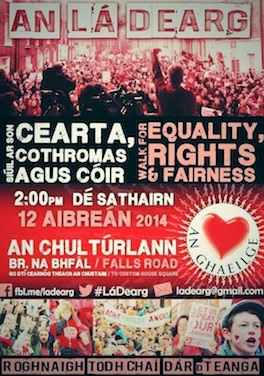
Another walk is being organised for the Northern Capital which will be entitled "An Lá Dearg" (The Red Day!).
This follows the successful "Lá Mór na Gaeilge" in Baile Átha Cliath on 15th February 2014 with up to 10,000 people, and the tribute to the resigning Language Commissioner, Seán Ó Cuirreáin in Conamara (23/2/2014) attended by up to a thousand people. 

Will you be with us?


A hastily arranged meeting in Dublin’s Liberty Hall gave expression to this anger and one of the results was the decision to hold a demonstration in Dublin on the 15th February 2014. Spontaneous meetings sprung up throughout the country, north, south, east, west to discuss how best to support this day and also to allow the expression of the feelings of those unable to attend the initial Liberty Hall meeting.

This writer attended the meeting in South Conamara, held in the historic Sean Scoil Sailearna, an old school building which has been imaginatively transformed into a wonderful theatre. Many grievances were aired but the one which made the greatest impact on me was the anger at the lack of understanding of the education needs of an Irish speaking area.

IAFL (Irish as a Foreign Language)
I was unaware just how unsuitable the uniform syllabus foisted on our schools is. Pupils in Rathfarnham, Carlow, An Spidéal or an Bun Beag have exactly the same linguistic programme. A pupils in an English speaking school in English speaking Dublin has a curriculum in Irish and in English which is exactly the same as a pupil in an Irish speaking school in Irish speaking Indreabhán. In other words the Irish curriculum is being taught as a foreign language even where it is the language of the community.

A study some years ago found that the schools in the Gaeltacht were excellent at teaching English but not Irish. Perhaps we have unearthed the reason why. This is understandable when one realizes that the Department of Education admits that only 1.5% of its personal have sufficient knowledge of Irish to conduct the business of administrating the educating the children of Ireland in what our constitution defines as the National Language.

Speak Irish among yourselves, but don’t speak it to us!
It does not help when one experiences that the state agencies, almost without exception, are unable to conduct business in the Gaeltacht in the language of the people. The Government have not  provided assurances to ensure that it will communicate in Irish with Gaeltacht communities without terms and conditions and that it will have adequate staff in public administration with proficiency in Irish to serve those excercising their constitutional right to deal in Irish with the state. In the words of the resigning Language Commisioner, '..the State sector is effectively saying to Gaeltacht communities: “Speak Irish among yourselves, but don’t speak it to us!”.'

The courageous decision of Seán ó Cuirreáin highlights the situation as he sees it after ten years, "The choice I had was to stand aside from my appointment as Coimisinéir Teanga on principle to draw attention to these matters or to continue in my role and, consequently, to participate in a pretence."

One is amazed at the unprecedented speed with which the Government has acted in appointing a successor to this position. The method of selection is of course clouded in secrecy, as is the wont of this "open" administration. The thought has occurred to more than one that it is an attempt to appease those who will be walking the streets of Dublin on Saturday. Certainly the appointment of Rónán Ó Domhnaill is universally welcomed. He appears to be a good choice but one wonders if he will have any greater success than his successor if securing the respect for his office in the ranks of the civil services where, in the words of one of their members, "passive inaction on their part now seems to have moved up a notch or two to one of active undermining."

If that is the case one wonders how long his term of office will last or will he too be forced to resign on principle?

Seán Ó Cuirreáin stated our choices succinctly: "We have two simple choices – to look back at Irish as our lost language or to move forward with it as a core part of our heritage and sovereignty."

Monday, May 13, 2013

The "B" spot - a new APP for parents and other learners!


For the past year Forbairt Naíonraí Teoranta, in conjunction with Annertech, have been developing an app called BunGhaeilge. This app will be based on the phrase book BunGhaeilge do Thuismitheoirí agus Feighlithe Leanaí – that was being published by ITE up until 2007 when FNT acquired the publishing rights. The app has been designed in accordance with the structure of the phrase book, that is separated into chapters by theme; ‘Morning time’, ‘The Naíonra’, ‘In the shop’, ‘In the Garden’ for example. Even though this book is aimed primarily at families who wish to use cúpla focal whilst going about their daily activities, FNT believe that this app is useful for all language learners, especially in helping with pronunciation.

App users will have the opportunity to listen to every phrase in the book and to repeat them. A standardised version of the app will be released at first, though FNT plan to release versions in all major dialects in the near future. BunGhaeilge will be available to download free of charge from the Android store from May 15th, and from the Apple store from the start of next month.

According to FNT Chief Executive Clíona Frost, ‘There’s a new resource available for anyone who wishes to use Irish as the everyday language in the family. This app, through the medium of new social media, provides a unique opportunity for the global community to come easily access the Irish language. This app demonstrates great progress in the promotion of the Irish Language.’

Geoff Gray, a parent who wishes to add to his Irish vocabulary store commented, “Finally there is a user friendly app, based on everyday Irish. I can use the app on the go when I’m out with my daughter and my use of Irish has greatly increased since I downloaded BunGhaeilge to my phone. Maith sibh FNT!”

Tuesday, October 30, 2012

The struggle against "Apartheid"

Many people have bridled at an article, "To see real educational apartheid, look no farther than your local Gaelscoil," which appeared recently under the byline of the Education Editor of the Irish Times, Seán Flynn.

Gaelscoileanna in Ireland
Apartheid
That there is a certain misunderstanding, not to say hostility, to Gaelscoileanna is clear from reading certain newspaper columnists. Nevertheless they have grown steadily since the sixties and seventies not always with the blessing of the Department of Education.  Indeed sometimes with their strong discouragement.  They have, I think it may be said, in all cases sprung from the desire of Parents rather than from any desire of the Government - of whatever complexion! Could their attitude be described as "Apartheid?"

The fact that many primary schools were "de facto" Gaelscoileanna up to the fifties tells it own story on Government encouragement. Because of lack of support, such as the lack of text books and lack of staff in the Department unable to transact business in any language other than English. Thus by the early sixties there were only one or two real Gaelscoileanna left.  "Apartheid?"

Struggle
Parents in various locations fought long, hard, dispiriting battles with the Department of Education before in many cases, after years of struggle managed to wring approval from a reluctant Department. My personal recollection is of the struggle to establish the school in Ballymun and how it did not grow from the work of the "Gaeilgeoir Establishment," but from "ordinary" parents in the tower blocks of Ballymun. Their school is a monument to their endurance as well as their idealism. Not my understanding of the term "Apartheid!"

Letters
There were two letters published following the article in the Irish Times. (Gaelscoileanna 'apartheid' 25/10/2012). Today, the following letter has appeared from the Acting CEO of Gaelscoileanna, the national, voluntary organisation  supporting the development of Irish-medium schools at primary and at post-primary level. Its stated aim is "to establish and sustain a high standard of Irish-medium education throughout the country as well as to develop and strengthen the Irish speaking community and culture"

Here is the text of her letter:

A chara,

The “To Be Honest” column by a parent (Education Today, October 23rd) was such a misrepresentation of Irish-medium schools that it cannot be allowed to go unchallenged. Its publication in the Education section of The Irish Times lends it an authority that is very damaging to the public perception of Irish-medium schools.

Irish-medium schools are united by their language ethos, but as diverse as any other arbitrary grouping of schools in every other way. A gaelscoil may operate under any patron body and may be denominational or not. Gaelscoileanna exist in every county in Ireland including Northern Ireland and they serve populations as diverse as their geographical locations; small towns, socially disadvantaged suburbs, rural communities, city centres or a “middle-class area of South Dublin” – wherever the local community has campaigned for a gaelscoil to be established.

Irish-medium schools are open to all pupils regardless of their linguistic and social background or their level of ability. They are as willing and well-equipped as any English-medium school to cater for all pupils’ educational needs. Communicating this to parents is made difficult when opinion pieces such as the aforementioned are published without information of substance on what an Irish-medium school is and how school enrolment policies work.

Parents and patrons alike have been calling for plurality and diversity in our education system for years. To have an inflammatory and misleading opinion piece about schools of a particular ethos published in the paper of record at a time when the Department of Education and Skills has committed to providing for parental choice in the form of the surveys on diversity of patronage runs counter to everything the education community has been working towards.

The column did not recognise that many Irish-medium schools face considerable challenges. More than a third of Irish-medium schools are without a permanent school building; 39 per cent of primary and 36 per cent of post-primary Irish-medium schools. Ten per cent of Irish-medium schools are recognised as DEIS schools by the Department of Education Skills and are focused on addressing and prioritising the educational needs of young people from disadvantaged communities. That the demand for new gaelscoileanna remains high in spite of the difficulties the established schools often face speaks volumes about how parents have faith in the immersion-education model and community-led education.

While it’s true that most of the parents who choose Irish-medium education for their children do not speak Irish themselves, it does a great disservice to the parents of the 45,000 children who are attending Irish-medium schools at present to assume that their decision to enrol their child in a gaelscoil was made for elitist reasons. It does an even greater disservice to those parents who have chosen Irish-medium education for their children despite having neither Irish nor English as a first language, parents who appreciate that their children will start school on an even footing with other pupils who will also be learning through a language that is new to most of them, in a school where linguistic diversity is truly valued.

The story of how Irish-medium schools have grown and are flourishing is one rooted in community spirit and a sense of common purpose and the schools deserve to be celebrated for all they have achieved.

Is mise,

NÓRA Ní LOINGSIGH,
Acting CEO,
GAELSCOILEANNA TEO,
Institiúid Oideachais Marino,
Ascaill Uí Ghríofa,
Baile Átha Cliath 9.

This Gaelscoil in Cabra learned that after seventeen years in prefabs the Department has plans at last to build a school for the over 200 pupils! 

Ross de Buitléir of Gaelscoil Bharra gives news of their new school building the thumbs-up 

Friday, March 16, 2012

"Thy sports are fled, and all thy charms withdrawn..."

I know what it is like to think small schools are a waste of money and that amalgamation is only sensible. I know what it is like to think that rural communities are parochial and need to be modernised and "get real".
Bríonglóid Ruairí Quinn!  - Ruairí Quin's Dream.
The most dangerous peril facing all the Gaeltacht Areas is the actions of the current Minister of Education, Rúairí Quinn, to close by amalgamation the priceless community treasure in these areas of the local school. This action will complete the work commenced in the statutes of Kilkenny in eliminating finally the use of Irish as a community language. However it also will have effects in the other areas of rural Ireland making them even more isolated than they are by sucking the life blood of the laughter of little children from them. A dead district!

If I may quote the poet,
"...Thy sports are fled, and all thy charms withdrawn; 
Amidst thy bowers the tyrant's hand is seen, 
And Desolation saddens all thy green: 
One only master grasps the whole domain, 
And half a tillage stints thy smiling plain. 
No more thy glassy brook reflects the day, 
But, choked with sedges, works its weedy way; 
Along thy glades, a solitary guest, 
The hollow-sounding bittern guards its nest; 
Amidst thy desert walks the lapwing flies, 
And tires their echoes with unvaried cries: 
Sunk are thy bowers in shapeless ruin all, 
And the long grass o'ertops the mouldering wall 
And, trembling, shrinking from the spoiler's hand, 
Far, far away thy children leave the land. "

 I have come across these two letters, addressed to our Public Representatives,  a real cri de coeur from a desperate primary school teacher (I have the name!) concerning the plight being visited by the anti-rural policies of this Government. The effects of these decisions of the urban-biased minister Ruairí Quinn will be particularly devastating in the Gaeltacht but in fact no rural area will be uneffected and they herald the further demise of our unique rural life. Will the Public Representatives pay any heed? Will the minister heed the cry of the rural students, "Éist Linn Ruairí Quinn!" or will he continue to reinforce the urbanisation of Ireland through the virtual elimination of the unique Irish rural and Gaeltacht  identity?

The first letter was written in January:

Dear Public Representative,
Change in pupil-teacher ratio in small schools
This will affect every school with an enrolment of 86 or less. 
The retention figures for small schools will be applied retrospectively to last September's enrolment figures and will mean that to keep your teacher, schools will have to have an enrolment of:


The idea is to force smaller schools to amalgamate or close, by making it more and more difficult to teach larger groups, with fewer teachers having to teach more classes. This, with all the attendant paperwork and preparation, coping with the special needs pupils in larger classes etc. will force many schools into a situation where closure or amalgamation is the only option.

It will also affect the GA support provision for the school, which will be based on the number of mainstream teachers.
A school with three teachers will be entitled to 15 hours, but when they lose a teacher, it goes down to 10. Pupils will lose out on support because of this.
This is an attack on rural Ireland. It seeks to discriminate against rural communities, because the majority of small schools are in rural and/or Gaeltacht communities.
It is also an attack on minority schools, such as non-Catholic schools. These also tend to be small schools.
It is with deep regret that I am contacting you on behalf of the children of rural Ireland, whose very futures are being dismantled by misguided and anti-rural policies being pursued by the current minister for education and others in the current administration. Below this e-mail, I have attached a copy of a letter I e-mailed to every school in Galway, Roscommon and Westmeath, outlining what the increase in Pupil:Teacher ratio will mean and asking them to attend a public meeting in Gullane's Hotel, Ballinasloe, Co. Galway on 20th January at 8.30pm


The people of rural Ireland are being discriminated against, in a very targetted and cynical way. Our way of life is being eroded by successive anti-rural measures. I will not go into these at present, as to do so would distract from the purpose of this e-mail.


However, these measures have culminated, recently, in a very cynical attempt by the minister for Education, to force small schools into amalgamation or closure, by raising the pupil-teacher ratio IN SMALL SCHOOLS ONLY. This will result in a loss of teachers, which will mean larger classes, greater numbers of class groupings having to be taught by one teacher (with all the attendant paperwork and preparation), larger numbers of special needs children in one classroom, and all the attendant difficulties which this will inflict on smaller schools.

The idea, of course, is to make it so impossible to teach in these circumstances, that the schools are forced into closure or amalgamation.


The McCarthy report recommended "rationalisation" ie. the closure or amalgamation of all schools with 100 pupils or less, starting with all schools of 50 or less, then moving on to the 100 or less schools.


The government knows this would cause uproar, so they want the request for amalgamation to come from the schools themselves.


Hence the sneaky, cowardly, cynical and discriminatory attack on small schools P:T ratios, in an attempt to force schools into an impossible choice.


They can try to carry on with fewer teachers, larger classes and more class groups, struggling with special needs - or they can go and ASK the minister for amalgamation - the very thing he is trying to achieve by the back door.


The new rules on the arrangements for learning support will further exascerbate the situation, as, when a school loses a teacher, they will also lose four or five hours of learning support as well, as the number of hours support is linked to the number of mainstream classroom teachers in the school.
I would have had more respect for the minister if he just came straight out and said he was closing all schools with 86 or less pupils and faced the outcry from the people in a straight and honest way!!!


At least then, the anti-rural bias in this administration would be seen for what it is, and people could fight it in every way possible, at least knowing what they are up against.
Instead, we have this sneaky, cowardly chipping away at everything which makes a rural community worth living in. They took away the post offices, the Garda Stations and now they want to remove the heart of every community - the local school.


This is not for the good of the children, but for the bottom line-cash, and Ms Merkel's opinion that the Irish people are unable to choose their own lifestyle, and should be shown the error of their ways.


"We haf vays of making you urbanise!"
Actually, Ms Merkel, and this spineless government, who are happy to do as they are told, we like our rural way of life! Others have come and gone, trying to make us fit into their mould and see things their way, and frankly, even Cromwell didn't manage to tame us, so what makes this government think they can change us?


In the words of the song "The strangers came and tried to teach us their ways, and they scorned us just for being what we are. But they might as well go chasing after moonbeams, or light a penny candle from a star".


Sadly, however, this doesn't just apply to outside forces like our "friends" in Europe, but to a government, so far removed from and out of touch with the realities of life in rural Ireland, that they are willing to rip the very heart out of rural communities. If this measure is not reversed, small schools which have been a feature of rural Ireland and of Ireland in general, for generations, and which have provided educational excellence for hundreds of years, will be a thing of the past.
Parents should have the right to have their child educated in their own community if that is their wish. I, personally, lived and worked and taught abroad for many years, but made the decision to come home to Ireland when we had children PRECISELY so that they could be brought up in a rural community and educated in a small school. I have first-hand experience of large schools and I made the choice that this is not what I wanted for my children. I believe I should be entitled to make that choice for myself and my family. I believe the right to make that choice should be a fundamental right for EVERY parent in the country. Large urban schools are fine for those who wish to attend them, but that model should not be forced on those who choose to live otherwise. If small schools disappear from our landscape, it will be a tragic loss to this country.


There is a further issue. I don't know if you have considered how discriminatory this measure is.
It only applies to small schools. This means that it applies mainly to rural schools and non-catholic schools. This is discrimination. It should be seen as such, and resisted by whatever means possible.
You will face a bitter fight if you try to implement the forced closure or amalgamation of small schools, by the back door or otherwise.


This attack on small schools and the rights of parents to bring up their children in Rural Ireland and have them educated in a local small school, must not be allowed to happen. Laws and decisions made by people who do not understand rural life and who do not respect our right to live in the countryside if we wish, should not be forced on us.


The second letter more recently (March 2012)

As many of you will know, because I contacted you either directly, or through networking, I have been campaigning strongly for this increased P:T ratio in small schools to be reversed. I feel passionately that the future of rural Ireland, our links to the past and our culture, the Gaeltacht, the islands and all that makes us unique in the world is at risk if we take the small school out of the system and force a homogenised, pasteurised, one-size-fits-all educational system onto our children. I say this, not out of any romantic notions, but as a former emigrant and as a person who grew up not appreciating my own education. 

You see, I know where Ruairi Quinn is coming from. 

I, myself, as a teenager, felt disdain for the "peasant" rural way of life which I felt I was forced to lead. I couldn't wait to get away and become really cosmopolitan and rich and live in a city somewhere with everything to hand. Like the characters I used to watch in Dallas and Dynasty, I wanted the fancy dresses and the cocktails and all the rest! I put myself through college, with the help of a grant, as we had no money. I worked three jobs. I studied morning and night, and I got my degree, found a flat and a good job and enjoyed the high life. I travelled and I moved to England. Was I happy? Yes, for a while. But I soon realised how hollow and empty it all was. 

I trained as a teacher in England and worked in several schools, both at secondary and primary level. All were large schools, some very large. I worked with children of all ages and all races, with and without special needs. They all had one thing in common - a fierce pride in their own culture and identity. I slowly began to see what was actually valuable and important in life. I began to look at my parents and see the sacrifices they had made so I could become "posh".  I also began to see that what I spent my teens looking down on, was actually what I wanted most for myself and any children I might be blessed with. I met my husband, got married, and when it came time to have children, we decided to move back, so they would be at the heart of their community, near their grandparents, and educated in a small rural school. 

I now have five beautiful children who are all in my lovely rural three-teacher school, except for one, who has moved on to the local, reasonably small, secondary school. I feel they are getting an excellent education as I am blessed with the finest team of dedicated teachers it has ever been my pleasure to work with. They lack nothing (except a GP room/ hall, which I would kill for, but then again, they have three acres and a playground with swings and slides, so I shouldn't complain), and are happy and well rounded, as are all my pupils, thank God. There are no bullying issues or social problems, like the ones I faced daily in England. No drugs,no knives, no obesity, no major problems. I have many with special needs, but they are accepted and supported by both teachers and their peers. 

Why am I telling you all this? Because  you see, I know what it is like to think small schools are a waste of money and that amalgamation is only sensible. I know what it is like to think that rural communities are parochial and need to be modernised and "get real". 

However, having seen all possible sides, sizes and levels of education in Ireland and abroad in my twenty plus years as a teacher, I now understand the jewel we have in our small schools and our tight knit small communities. 

I now understand that what makes us uniquely Irish and special, is something which must be protected at all costs. 

If this next batch of emigrants come back in a few years to raise their children in a rural area, close to their communities, as I did, along with many others, there is a good chance that if this government gets their way, they will not have a small school in their area for the children to come back to. Will they ever forgive us if we have let that happen without a whisper of protest? 

Those of you who advised against "divide and conquer" are absolutely right. In a modern Ireland there is a need for large schools, and highly populated areas need large, modern, well run schools. However, small schools are also modern and well run, and are also badly needed by their communities. 
It took me a while to realise it. We don't have the time to wait for Ruairi Quinn to see it. By the time he realises the importance of small schools (and DEIS schools for that matter), they could be consigned to the history books. 

We, the leaders in the education sector, MUST stand in his way, but we must do this together. "Divide and conquer" would be playing right into the hands of a short-sighted administration intent on selling off the family silver and ( if you'll pardon one more cliché) are quite willing to throw the baby out with the bathwater. 

I'm sure you are aware of the planned protest in Loughrea on Saturday 24th March at 2pm and the handing in of petitions to Ciaran Cannon's office at 3pm. I would appreciate anything you could do to promote and support this protest. If you have any connections with the GAA or the IFA who could be persuaded to come along and get involved, that would be great. 

We are also in the planning stage of a huge, nationwide rally, coordinating all of the various local groups which have sprung up all over the country. We hope to converge on Dublin from all parts of the country and cause maximum disruption, on all the various county roads on the way up, and then, once in the city, to  come in from as many different angles as possible, so as to ensure as many different areas are disrupted as possible. With Dublin at a standstill, it will be impossible for the media to ignore us, as they have done in the past. 

The date is not set yet, but it will be at least a couple of weeks, so we intend to use that time to plan the rally very carefully. 

I'm attaching the letter and petition I sent to all the schools I can reach. It lays out the purpose of the protest and there is a page to print off and fill with signatures. If you could help with getting signatures - maybe passing it on to your party members etc, it would also be a huge help. 

Rural Ireland is valuable, and worth saving. Our children are just as important as those born in a highly populated urban area. This discrimination must not be allowed to stand. 

YOU WERE ELECTED TO REPRESENT YOUR COMMUNITY-SO REPRESENT US!!! REPRESENT OUR CHILDREN!!! STAND UP AND FIGHT FOR THEIR FUTURE!!! 

Sunday, February 26, 2012

Éist linn, Ruairí Quinn! A deaf and misunderstanding minister?

The clouded vision of an Education Minister?

In a recent edition of Gaelscéal, the Irish newspaper, our attention was drawn to a piece written by the Irish Minister for Education, Ruairí Quinn. The Statement was in the Irish Times, "Laying radical foundations for the primary school system" (IT 25/10/2011) .

"This month, we celebrate the 180th anniversary of sustained quality education in the national school system which has served this country so well."

These are the National Schools which Edmund Ignatius Rice was so doubtful about when they were instituted in the 1830s and indeed the various Churches also had problems with the philosophy under which they were established. Indeed they were not universally accepted until well into the 1860s. That they were successful depends on what the observer thinks they were established to do. Obviously the current minister has his own ideas.

Reading for a Minister
President 1937-1945


Provisional President 1916


Historian 
I wonder if he has ever read the little pamphlet written some 50 years after the establishment of these schools by the first President of the current Republic? "The Necessity for De-Anglicising Ireland!"(INLS 25/11/1892).
"It has always been very curious to me how Irish sentiment sticks in this half-way house -- how it continues to apparently hate the English, and at the same time continues to imitate them; how it continues to clamour for recognition as a distinct nationality, and at the same time throws away with both hands what would make it so." he says!

Or has he read The Murder Machine (1/1/1916) from the pen of the President of the Provisional Government of Ireland, who decried the education system "..an education system which more wickedly does violence to the elementary human rights of Irish children..."

In our own day a comprehensive demographic study of the, by now peripheral, Irish speaking areas, demonstrated the "effectiveness" of the schools in those areas in fostering the use of English and the rapid decline of the use of Irish among the youth in those areas. (Report Summary in English may be found here!). A comprehensive analysis, district by district has been compiled by Donncha Ó hÉalaithe in Irish  (TG4 & Foinse 23/3/2010).

This decline of standards in Irish teaching in schools is hardly surprising when we realise that the Department is staffed by personnel of which only 1.5% (One point five percent) are capable of transacting any business in the national language of Ireland. (Report Coimisinéir Teanga pdf July 2011)

From 1366 the English had attempted to eliminate Irish. By the end of the eighteenth century it is estimated that in a population of approx 5 million people 3.5 million could speak Irish and less than half of those could speak both Irish and English.Certainly there were more speaking Irish then than there were say Danes speaking Danish at that time - approx 2 million at most. By the end of the nineteenth century the number of people who spoke Irish had had a cataclismic fall to 600,000.

This decline appears to have little benificial effect on the Irish economy. To quote the eminent historian Professor Joe Lee in his monumental study of Ireland in the 20th century. He speaks of dairy exports to Britain, "(in 1870) ...Denmark began to enter the dairying industry seriously.....The Danish performance easily eclipsed the Irish one. There were many reasons for this...abandoning their obscure language in favour of English was not one of them.." (Ireland 1912-1985 Page 663)  On the previouis page he states "...it is hardly going too far tio say that but for the loss of the language, there would be little discussion about identity in the republic. With language little else seems tio be required" Indeed all of us, not least a Government Minister would benefit from reading this particular chapter of Professor Lee's book.

Does a Minister for Education who has refused to say whether there is a right here to be educated in the National Language understand or even know the implications of his actions in this regard? Or, as the editorial of Gaelscéal asks, "Has he much more in accordance with the founders of the national schools than has been indicated by him so far?"

Wednesday, September 28, 2011

Yu Ming and language rights!


Every second-level school in Ireland is to be afforded the opportunity to teach their students about language rights in a new multi-media educational initiative developed by the Office of An Coimisinéir Teanga and launched in Galway recently by Gaeltacht Minister of State, Dinny McGinley TD.

Dinny McGinley TD
The initiative is aimed at giving students an insight into language rights generally and Irish language rights in particular, in the overall context of human rights. It involves a series of bilingual lessons and projects to be taught in the Junior Certificate course in Civil, Social and Political Education (CSPE) and includes a teacher’s manual, posters, task cards, a CD Rom and a DVD of video clips as well as online resources. Copies are currently being distributed to every second level school in Ireland.

The module deals with the advantages and challenges of multilingualism and explores the United Nations’ Universal Declaration of Human Rights. It includes the screening of the award winning short film Yu Ming Is Ainm Dom (My Name Is Yu Ming), the story of a young Chinese man who learns Irish in anticipation of his visit to Ireland but experiences communications difficulties initially until he finds himself a job as a barman in the Gaeltacht.

Images of Irish national identity compiled by Nuacht TG4/RTÉ with a soundtrack from The Coronas form part of a lesson on culture and nationality; a set of tasks cards is used in a lesson that asks students to explain elements of Irish society to a visiting Martian and a further lesson involves developing bilingual stationery and signage.

The initiative was tested as a ‘pilot project’ in a selection of 15 schools throughout Ireland last year and the resultant feedback used to perfect the material. It can be taught through Irish, through English or bilingually as suits individual schools, teachers or classes.

“More than anything else this project should ensure that students are given a context for their learning of Irish in schools and that they understand and respect the concept of language rights” according to An Coimisinéir Teanga, Seán Ó Cuirreáin.

He described it as “potentially the most important initiative undertaken by this Office since its establishment if it sees significant numbers of students each year being taught the importance of language rights.” He reminded students from Coláiste na Coiribe in Galway who were present at the launch that as custodians of the Irish language we in Ireland are guardians of an important and endangered aspect of world heritage.

Launching the project Gaeltacht Minister of State, Dinny McGinley TD, said that he hoped it would help students develop their sense of identity as citizens of a country which has two official languages as well as increasing their awareness of the importance of protecting and promoting our national language.

The educational resource on language rights is being distributed with the support of COGG, the Department of Education and Skills’ advisory council on Gaeltacht and gaelscoil education. Chief Executive of COGG, Muireann Ní Mhóráin, said she hoped teachers would make full use of the material which afforded them every opportunity to put awareness of language rights on the educational
agenda in a way which would be of enormous benefit to pupils.

The material was developed by a panel of CSPE teachers with assistance from a wide range of organisations including the Department of Education’s Professional Development Service for teachers, NUIG’s Acadamh na hOllscolaíochta Gaeilge, COGG, Nuacht TG4/RTÉ, and others.

Tuesday, August 30, 2011

Immersion in Co Donegal!


Three Gaeltacht primary schools in the Donegal Gaeltacht have just commenced the introduction of immersion education in junior enfants this year; Scoil Rann na Feirste, Scoil Dhoire Chonaire and Scoil Chaiseal na gCorr.  Basciallly under this system, the schools will delay the start of English language teaching until the senior enfants.  We congratulate the parents, Boards of Managements and teaching staff of these schools for taking this very positive step for the Irish language.

Great books for children at Futa Fata
It is very clear from international and national research on immersion education that not only does this system improve the acquisition of the minority language, in this case Irish, but also that it improves standards in both languages in senior classes.  Therefore, this system is to the benefit of all pupils and is recognised as international best practice for minority language medium schools such as Gaelscoileanna and Gaeltacht schools.

We thank Eagraíocht na Scoileanna Gaeltachta(Organisation of Gaeltacht Schools) and an Chomhairle um Oideachas Gaeltachta agus Gaelscolaíochta (the statutory advisory body for Gaeltacht schools and Gaelscoileanna) for organising a seminar on this topic for the teaching staff of Gaeltacht schools in Gaoth Dobhair earlier this Spring.  They also organised an information session for the Boards of Management and a training course for teachers in Irish language phonetics.  There are seven other primary schools in the Gaeltacht category A area in Donegal.  Some of these schools have yet to make a decision on immersion education but we hope that they will make the same decision as these three schools.

It is of critical importance to us as one of the strongest Gaeltacht communities in Ireland that we are prepared to take positive steps to demonstrate our committment to the conservation and development of the Irish language.  We have to acknowledge that there is a crisis in even the strongest Gaeltacht areas in terms of the lack of usage by young people of the Irish language in their normal everyday social interactions.  The introduction of immersion education in Gaeltacht schools in not the answer to all of these problems but it is definitely a step in the right direction and is to be welcomed.

Friday, July 8, 2011

Epoch making recognition for Gaeltacht schools

The Minister for Education, Ruairí Quinn, launched The National Literacy and Numeracy Strategy in Dublin today.  For the first time in the history iof the State, the Strategy formally recognises that Gaeltacht schools have specific requirements in relation to the national curriculum and that native Irish speakers and learners of Irish who attend Gaelscolieanna and Gaeltacht schools have distinct linguistic needs.   The full report is available on the Department of Education website in pdf format!

From the Irish language perspective, here are two of the most important passages:

Page12  This literacy and numeracy  strategy recognises that the learners in Irish-medium schools and settings have very varied learning needs and that they need to develop literacy skills in both Irish (as their first language or as the first language of the school) and in English.

page 50
  * Students in Irish-medium schools who learn through Irish, including pupils whose home language is Irish, have specific literacy needs that are not fully addressed in the current primary(and secondary p52) school curriculum. We need to address these specific needs by ensuring that the Irish L1* curriculum (for Irish-medium schools) provides for the development of literacy skills in a manner comparable to that provided for in the English curriculum, including the development of children's cognitive and higher-order thinking skills.

*Irish as L1 refers to the teaching of Irish as a first language or in Irish-medium schools. Irish as L2 refers to the teaching of Irish as a second language, i.e. the teaching of Irish in schools where the main language of instruction is English.

Many thanks to the various Irish language organisations who made representations to the Department of Education during the consultation process, including amongst others COGG,  Gaelscoileanna, Forbairt Naíonraí Teoranta, An Foras Patrúnachta and  Eagraíocht na Scoileanna Gaeltachta .

Thursday, February 24, 2011

Enda's reply!

The answer given by Enda Kenny to the student Francis Whelan on Pat Kenny's show on Irish as a core subject in the Leaving Cert:

"I love the language. What I want to say here is my whole thrust here is to strengthen the language and what I want to do is examine first of all the content of the curriculum and see if it is relevant for future needs. 

Secondly examine seriously the impact of the investment that we are making in the training of our teachers to teach the language. Language is about sounds, music, words, it should be something that should be loved and if it is by primary school children then they don't have a difficulty with it up along the line. 

At the other end Emma, and I will not, I will not introduce the abolition of compulsion until I have finished those assessments and finished them properly. At the other end I will increase the oral Irish marks to 50% which is of an advantage to the people who go to Gaeltacht areas and get that líofacht or blas and also look at the question of increased marks for those who take honours Irish or the ordinary level who intend to go on to third level. 

So far from weakening the language or doing it down, I actually want to strengthen it in the sense that there are hundreds of thousands  of people in this country who spent 12-13-14 years studying this language and cannot put 5 sentences together and we've had 60 years of defence behind compulsion. Irish people have always rejected compulsion. 

Its time for us to grow up on these matters and my belief is if we teach this properly, if we have a relevant curriculum , people love the language and they take it right through to leaving cert  and it becomes much more important for everybody. 

And I respect the views on both sides here Pat. TG4, RnaG, many of the language movements do great work but we should not hide behind the defence of something that has failed.

Wednesday, February 16, 2011

Independent support for Irish!

Independent candidates for the General Election 2011 expressed their support for the Irish language in a recent letter to the Editors of the national and regional press.

This follows a recent study on attitudes towards Irish as a school subject commissioned by Comhar na Múinteoirí Gaeilge, Conradh na Gaeilge, Gael Linn, Gaelscoileanna Teoranta and Comhdháil Náisiúnta na Gaeilge and carried out by MRBI/Ipsos.

The results of the study indicate support of 61% in favour of the retention of the Irish language as a core Leaving Certificate subject.

The independent candidates from constituencies across Ireland expressed their belief that all students are entitled to learn their national language. They pledged their full support for retention of the Irish language as one of the core subjects at Leaving Certificate level and for maintaining its current status as a minimum entry requirement to third level courses.

The 31 candidates who expressed their support for the Irish language include:

James Breen- Clare

Sarah Ferrigan-Clare

Pádraig O Sullivan- Cork North Central

Paul O Neill - Cork East

Mick Finn- Cork South Central

Diarmaid Ó Cadhla - Cork South Central

John Kearney -Cork  South West

Michael O Sullivan- Cork South West

Michael Healy Rae- Kerry South

John Dillon- Limerick

Séamus Sherlock-Limerick

Dr. Ben Nutty- Waterford

Eamon Walsh- Galway West

Catherine Connolly – Galway West

Mike Cubbard – Galway West

Noel Grealish - Galway West

Michael Kilcoyne- Mayo

Luke Ming Flanagan -  Roscommon/South Leitrim

John McDermott  - Roscommon/South Leitrim

Gabriel McSharry Sligo/North Leitrim

Cllr Seamus Treanor- Cavan/Monaghan

Caroline Forde – Cavan/Monaghan

Ian McGarvey – Donegal North East

Thomas Pringle- Donegal South West

Stephen McCahill- Donegal South West

Eugene Finnegan-Wicklow

Michael J Loftus- Dublin North West

Maureen O’Sullivan- Dublin Central

Christy Burke- Dublin Central

Cieran Perry- Dublin Central

Raymond Whitehead-Dublin South

Monday, February 14, 2011

Fine Gael and Irish!

Tá seo scriofa ar Gaeltacht21 anseo An t-aon pháirtí leis an bpolasaí!

Fine Gael is the only party with this Education policy :
"We believe that reinventing the way we teach Irish will encourage more students to study the language and engage with it beyond the school system. We believe compulsion has not fostered growth or commitment to the language. We will overhaul the curriculum at second level and we will critically examine the effect of current training methods of teachers to teach. Irish as an optional subject for Leaving Certificate will only apply following consultations on both matters."


Fine Gael is strongly committed to the development of the Irish language and the Gaeltacht regions. We recognise the value and cultural importance of our Irish tradition and heritage and we are determined to ensure the language and the Gaeltacht regions survive and prosper.


National Strategy:
We are supportive of many aspects of the twenty year strategy for the future of the Irish language and will deliver on the achievable goals and targets proposed.


Education:
Fine Gael supports the continued development of Gaelscoileanna and recognises the significant role the Gaelscoil movement has played in reviving the Irish language within and outside Gaeltacht areas. We will also work with Coláisí Samhraidh to attract greater numbers to the Gaeltacht.

We are committed to overhauling the way in which Irish is taught at primary and second levels of education, to ensure teachers are equipped with the right tools to instil a love of the language for all students and the curriculum is designed to inspire students to continue speaking the language after leaving school.

We believe that reinventing the way we teach Irish will encourage more students to study the language and engage with it beyond the school system. We believe compulsion has not fostered growth or commitment to the language. We will overhaul the curriculum at second level and we will critically examine the effect of current training methods of teachers to teach. Irish as an optional subject for Leaving Certificate will only apply following consultations on both matters.

We will allocate 50% of marks to oral Irish exams.

A study on a double curriculum to Leaving Cert will be investigated, one on the current system and a second in communicating Irish. The questions of extra points for third level entry will be investigated.

Fine Gael will double the proportion of Irish students sitting the Higher Level Leaving Certificate exam by 2018.


Job Creation in Gaeltacht Regions: 
Our NewERA and Working for Our Future plans will deliver new job creation prospects to Gaeltacht regions. We will invest in energy, broadband and water infrastructure, creating the modern infrastructure needed to attract and support new businesses and jobs. We will also strongly support the potential for jobs in tourism and marine activities.

National Proficiency Scale:
We will investigate the development of a national proficiency scale for the Irish language. This ten point scale would allow every citizen to have their competence assessed and use modern teaching methods and modern technology to gradually improve their proficiency at a pace that suits themselves.

Islands:
We are committed to sustaining communities on the islands and will work to improve access to vital services for the islands so that island communities have appropriate access to health care and other social services.


Official Languages Act:
Fine Gael will review the obligations under the Official Languages Act to ensure expenditure on the language is best targeted towards the development of the language.

Friday, February 4, 2011

Richie Ryan decision made language marginal

“An abject failure” is how An Coimisinéir Teanga (Irish Language Commissioner), Seán Ó Cuirreáin, described the ending nearly 40 years ago of the requirement for civil servants to have competence in Irish as well as English, when addressing a conference in Dublin on Wednesday.

Election Poster for Richie Ryan
Former Finance Minister, Richie Ryan TD, made knowledge of Irish optional for civil servants in 1974 when he told Dáil Éireann that his Government was “satisfied that by replacing the compulsion which did so much damage to the Irish language over the past half century with enthusiasm for the language, we will have people more readily disposed to use Irish.”

An Coimisinéir Teanga said that while Ryan’s assertion may have been wellintentioned, history had unfortunately shown it to be fundamentally flawed. The language had subsequently become marginal to the point of insignificance in the workings of many Government departments and agencies.

He cited the Department of Education and Skills, which recently revealed that only 1.5% of its administrative staff had sufficient competence in Irish to be able to provide service in that language. “That department is by no means unique and the absence of competence in Irish is common through most Government departments and agencies,” he said.

While not advocating a return to “compulsory Irish”, Mr. Ó Cuirreáin said some form of “half-way house” approach needed to be found if compulsory English was not to become the norm for the public in the conduct of all business with the State.

“The State invests heavily in the teaching of Irish and requires schoolchildren to study its official languages – a standard practice in other countries. Yet, it fails to adequately facilitate the subsequent use of Irish by those who have acquired it. Joined-up thinking is missing in the current approach”
he said.

Mr. Ó Cuirreáin said he hoped the new 20-Year Strategy for Irish launched by the Government with cross-party support would introduce fundamental reforms. He suggested that a modern, holistic, and structured approach was required to transform the teaching of Irish to such an extent that all students would acquire basic fluency through the education system. It would follow that those who had achieved such fluency should be facilitated in using the language with ease afterwards in their dealings with state organisations.

“This is a realistic and inspiring vision, and, in fact, the only way of getting value for money for the significant investment made in the teaching and promotion of Irish to ensure its long-term survival in the life of our nation” he said.

Wednesday, July 28, 2010

Joint Oireachtas Committee report

The report (see bottom of page) of the Joint Oireachtas Committee on Arts, Sport, Tourism, Community, Rural and Gaeltacht Affairs regarding the 20 Year Strategy for the Irish Language was launched Wednesday, 28 July 2010, and is now asking the Government to ensure that all recommendations of the report are approved and included in full. It was warmly welcomed by Conradh na Gaeilge.

They especially welcomed the significant number of recommendations made by the Conradh - and by the Gaeltacht and Irish-speaking community in general - that were included in the report of the Joint Oireachtas Committee, in particular the recommendations regarding the sustainability of the Irish language in the Gaeltacht; the Údarás retaining responsibility for job-creation and enterprise in the Gaeltacht; the central role of the voluntary Irish-language organisations in the implementation of the Strategy; the provision of a proper fully integrated and graded course for the Irish language in schools; and putting the responsibility for evaluating the Strategy under the Office of the Language Commissioner with the Taoiseach reporting to the Houses of the Oireachtas on the progress of the Strategy.

Press Release from Houses of the Oireachtas
(28/7/2010
Pádraig Mac Fhearghusa, President of Conradh na Gaeilge said: “Conradh na Gaeilge commends the Joint Oireachtas Committee for recognising the crisis in the Gaeltacht as the most urgent weakness to address in order to protect the Irish language, and for stressing the importance of sustaining the Gaeltacht by proposing to set out specific goals in the 20 Year Strategy for the Irish Language for increasing the number of native Irish speakers in the Gaeltacht.
“Conradh na Gaeilge also welcomes the Joint Committee’s recommendation that responsibility for infrastructure and economic development in the Gaeltacht should remain the main focus of Údarás na Gaeltachta/Gaeilge as it is under the 20 Year Strategy for the Irish Language, to ensure that the local economy continues to sustain the Gaeltacht areas.”


Julian de Spáinn, Conradh na Gaeilge General Secretary said: “It is imperative that the Government approves all the recommendations in the Joint Oireachtas Committee’s report in their entirety, that they are included in the final draft of the 20 Year Strategy for the Irish Language, and that cross-party agreement is fostered for the Strategy to ensure its value is appreciated and supported across the board in coming years.”

Conradh na Gaeilge believes that it is absolutely essential that Irish is taught effectively throughout our education system, and welcomes the proposal of the Joint Committee in the report on the 20 Year Strategy for the Irish Language that a proper fully integrated and graded course for the language be put into effect, to ensure continuity for students from pre-school to third level, in addition to trainee teachers and adult language learners. It is also very important that the Joint Committee has recognised the need to differentiate between the different linguistic development requirements of native Irish speakers and other capable students, and those whose first language is English, and Conradh na Gaeilge welcomes the proposal to include a more in-depth study of heritage and literature as part of as an additional Leaving Cert subject, Saíocht & Litríocht na Gaeilge.

The public have a vital part to play in the implementation of the Government’s 20 Year Strategy for the Irish Language and Conradh na Gaeilge welcomes the recognition in the Joint Committee’s report that the voluntary Irish-language organisations have a pivotal role in the future of the language. The Conradh looks forward to working with the Department of Community, Equality and Gaeltacht affairs and with the restructured Údarás in implementing the 20 Year Strategy for the Irish Language.

The full report, the appendix of which contains a translation in English, is available on the Oireachtas Website here. (pdf)

Saturday, July 24, 2010

Significent progress for Rathoat Gaelscoil

The 21st of July's open evening in Gaelscoil Ráth Tó was confirmation for the local community in Ratoath that the new school has a bright future ahead of it. A great crowd came to visit the new classroom in the Ratoath Community Centre and to meet the school’s teacher, Tricia Ní Mhaolagáin. Amongst those who gathered to wish the new school the best of luck was the boxer Bernard Dunne, the footballers Patrick O’Rourke and Caoimhín King (with the Delaney Cup in tow!) and the jockey Barry Geraghty, whose daughter is due to attend the school when it opens in September 2010.

There has been huge local interest in the new Gaelscoil. The school’s founding committee and GAELSCOILEANNA TEO. - the organisation which represents 138 Irish-medium primary schools - were very disappointed with the decision made by the Department of Education and Skills in relation to recognition for new schools for 2010. Ratoath had been included as one of the 9 areas identified in the Department of Education's plan for the provision of primary education where new schools were to be opened there in September 2010, but unfortunately Gaelscoil Ráth Tó was not granted recognition, in spite of the great demand for a new gaelscoil in the area. The school’s founding committee made the decision to open without the official recognition of the Department of Education and Skills, which means that the founding committee will be under some pressure to deliver an excellent standard of education to children in the area whose parents have chosen Irish-medium education for them.

Míchéal Ó Broin, the President of GAELSCOILEANNA TEO. has said that “the support that the local community and the public in general has given the founding committee shows that there is a real need for a gaelscoil in the area to facilitate the demand for Irish-medium education. The public has an increased awareness of the advantages of Irish-medium education in terms of the social, academic and communicative development of children. I’m very grateful to all of the Irish-medium schools who have been very generous with their donations; financial contributions, furniture, and more. I applaud the voluntary work that the members of this founding committee have dedicated themselves to for so long in order to make their vision a reality in Ratoath”.

The founding committee was very happy with the turn out at last night's event and its members are hopeful that it might increase enrolments for 2010, 2011 and subsequent years. They have received much support from Irish-language organisations, local politicians and businesses, the community in Ratoath and other Irish-medium schools around the country to help them to make the school a reality and the hearty celebrations in Gaelscoil Ráth Tó last night were evidence of that.

GAELSCOILEANNA TEO. is the national co-ordinating body for schools teaching through the medium of Irish. It helps parents and local groups to set up new schools and supports the established all-Irish schools. There are 169 primary schools and 38 secondary schools currently providing education through the medium of Irish.

Thursday, July 8, 2010

New Gaelcholáiste for Carrigaline

After two years of campaigning the people of Carrigaline have great cause for celebration, with the announcement that provisional recognition has been granted for the new Gaelcholáiste, (Irish) due to open its doors in 2012. The opening of this school will make it the biggest Irish campus of its kind, with an all-Irish primary and secondary school along with a school for children with special needs all on one site.

GAELSCOILEANNA TEO. welcome the Department's decision to purchase a 21 acre site for the school in Ballinrea, Carrigaline. The great news was received last weekend by the Gaelcholáiste's founding committee from local TD Michael McGrath.

Bláthnaid ní Ghréacháin, C.E.O. of the organisation stated that "this is a very positive decision that ensures that parents and children in Carrigaline and the surrounding areas will have the opportunity to avail of Irish-medium education. GAELSCOILEANNA TEO. would like to congratulate the founding committee on their achievement and the Department of Education and Skills on recognising the need and parents' demand for Irish-medium education".
The VEC has agreed to patron the Gaelcholáiste and there are plans to develop the site so that it will have the facility to cater for up to 700 students. Over 460 pupils have already been enrolled by their parents in the new school, according to the founding committee's chairman, Noel O'Regan, which confirms that Irish-medium education remains a very strong educational system of choice in the community.

Applications are welcome from parents of children attending both Irish and English speaking primary schools. Children coming from English speaking primary schools will be given extra help at the beginning of the school year if they require it. "We will do our best to ensure our Gaelcholáiste will be open to all children in the area finishing their primary education" said Mr. O'Regan.

On behalf of the founding committee Mr O'Regan thanked all those involved in the project to date including Batt O'Keeffe, TD (during his term as Minister for Education), Barry Cogan, former TD and Barra O'Briain, Chairman of Cork VEC.

Tuesday, May 4, 2010

No Gaeilge!


No need to understand much Irish to get the message here!

This is a short YouTube video from some students of OCBhÁC (Olscoil Chathair Bhaile Átha Cliath=DCU). They have mounted a campaign to have the language respected in their establishment and indeed within the Students' Union. See their spirited campaign facebook page is attracting attention too. Though mostly in Irish you still can get the student enthusiasm exuding through the comments...

The Students Union in DCU says in its constitution - available only in English states that it exists
"To represent all of its members on matters affecting their distinctive student experience. This is with regards to both their academic and extra-curricular education, as members of the University."

The fact that the University doesn't even have an Irish Language officer speaks volumes in a college that hosts one of the most progressive and modern Irish Language 3rd level range of courses and research under the banner of Fiontar. Among these is the important work on the the National Terminology Database for Irish in focal.ie and on the Placenames Database of Ireland in logainm.ie, and a national biography database in ainm.ie.

Is this commentator alone in thinking that the institute that hosts this important national research and yet does not think it important to provide a background that indicates at least some understanding of the importance of that language in the daily happenings of that institute, is somehow remiss in its responsibilities? The singular lack of enthusiasm in preparing it's statuatary plan for Irish (under the Language Act) the college authorities and indeed the student union highlights this at best mediocre approach.

Hope you enjoy the video!

More about this (in Irish) at An bhfuil an Ghaeilge feiceálach ar do champas?

Naíonra directors in demand

Intensive training courses for Naíonraí Directors at the end of May in Dublin.

As a result of a substantial increase in demand received for the Dianchúrsa (Intensive course) for Stiúrthóirí Naíonraí (Directors) this year, Forbairt Naíonraí Teo.(Bi-lingual site) is organising a further Dianchúrsa from the 24-28th May, which will run Monday to Friday between 9am-5pm. The course will take place in Dublin city centre. The Dianchúrsa provides the basic qualification required by FNT to work as a Naíonra Leader.

Those who wish to attend the Dianchúrsa will be required to sit an Irish language interview in order to assess their standard of Irish. The Irish language interviews will take place in Dublin on the 11th and 12th of May in the Marino Institute of Education (English), Griffith Avenue, Dublin 9.

This is a fundamental course, through the medium of Irish, which covers the management and running of a Naíonra. It is aimed at Naíonraí Assistants and anyone with fluent Irish who is interested in using the language with young children.

This course is mandatory for anyone who wishes to start a Naíonra under Forbairt Naíonraí Teo. Presently there are 156 naíonraí registered with Forbairt Naíonraí Teoranta, with over 3,500 children attending childcare services through Irish.

Clíona Frost, Chief Executive of FNT said, “I’m extremely pleased by this visible increase in demand for Naíonraí services. The effect that our established naíonraí have on the community, and the link that is being established with the gaelscoileanna throughout the country, highlights the growing strength of the Naíonra brand.”

“It’s clear that parents are now recognising the full advantages of the Total Early Immersion model by choosing pre-schooling entirely through Irish for their children.”

Forbairt Naíonraí Teoranta is working continuously with the other main Irish language voluntary organisations to promote the language, along with childcare and education through the medium of Irish, especially with regard to Total Early Immersion Education.

É seo as Gaeilge