Thursday, July 2, 2026

Problem, Right or Resource?

I first saw a critique of this book in the English Guardian Newspaper last month. I was immediately curious and wanted to know more. I saw it was to be published later that month so I went to Kenny's website to see if was listed. It was but there was a delay which was nit surprising as it was not due to be published until later that month. I ordered it and a week or so later it arrived in the post.

It is an intriguing book, and I knew after reading the introduction that it was not only an interesting read but I thought it was an important book. I brought it to the attention of one or two people interested in the language and hopefully they have read it too. Your attention is immediately grabbed by the first sentence, "Upstairs a language is dying..."

The author, Sophia Smith Galer, an award winning journalist in the area of technology, language and culture, is of Italian extraction based in London. She was inspired to write this book because her Grandmother (Nonna), spoke what she thought was a dialect of Italian and her mother spoke Italian but neither of them spoke in those languages to her. They spoke to her in English and she felt somehow dispossessed because of this.

Language can be looked at in three ways. Reading her thoughts I naturally, maybe inadvertantly, thought of the attitude and/or policies own governments and/or civil servant to our own unique language. 

Minority languages may be thought of as one of the following though not exclusively:

1. A nuisance or a problem.

2. A Right

3. A Resource

I thought of our situation in Ireland. Does the Irish government political or administrative, fall into any of these catagories? Certainly we can all point to cases where number one is paramount. Number two is a more recent heading here especially with the inauguration of the office of Coimisinéir Teanga. But where are the signs of our language been treated as a resource by the administration?

Of course the title of the book, "How to kill a language - Power, Resistance and the Race to Save Our Words,"* is what attracted me in the first place. The author lists various ways in which languages die or are killed. She calls it linguacide and the rest of the book list these with real examples from disparate parts of our world. What struck me was how little she referred to our own language struggle or that of our neighbouring countries, Cymru, Alba or Breizh.

The first one she lists is Emigration and is very personal to her own experience. Her Nana an immigrant into England spoke a language she called dielet but that had been replaced by Italian - the state language. On immigration the Italian was replaced by English and though the actual immigrants continued to use Italian among themselves the did not (in a way familair to us in Ireland) pass this knowledge to the next generation. In the author's own case though she could in many cases know what her elders were saying she was unable to speak it. Thus in one generation the knowledge and culture were if not lost certainly severely diluted.

She then proceeds in a further nine chapters to outline the various ways a language dies or is killed. "Letting a language die or not supporting its existance (is) covert language killing with similar results to overt language killing - perhaps a little like comparing manslaughter and murder." She lists various languages and places she has visited as examples of the various pressures on language.

  • Build - Oman
  • Occupy - Ukraine
  • Expel - Greece
  • Exploit - California
  • Criminalise - Iraq/Turky etc (Kurdish)
  • Shame - Peru (Kichwa)
  • Sanctify - Israel
  • Ignore - Ghana
  • Remember - Italy

Some of these we are aware of but many are languages we have perhaps not ever heard of nor do we regard many the languages against which they are struggling particularly aggressive. English we do know because of our history. But languages like Italian, Arabic, Turkish, Greek or Russian? Who knew?

This is a book that I found very stimulating not because it solves anty problems but because it help understand what is happening in the area of language and to a certtain extent it explains things that we can see happenin in the case of our own linguistic experience.


*HOW TO KILL A LANGUAGE: Power, Resistance and the Race to Save Our Words; Sophia Smith Galer; 2026; 
HarperCollins GB;
ISBN 978 0 00 872372 9 (Hardback)
ISBN 978 0 00 872373 6 (Paperback)

Thursday, May 9, 2024

Conspicuous disparity displayed by state & public companies.

The total number of complaints received by the Office increased by 6% in 2023 over 2022.

Leagan Gaeilge.
The positive effects of the new language legislation (Official Languages (Amendment) Act 2021) are evident from the significant increase in Irish language advertising by public bodies on various media (e.g. television, radio, social media). This follows a national awareness campaign conducted by the Office of An Coimisinéir Teanga on the new legislation.

Increase in number of complaints.
39% of the 634 complaints received by Oifig an Choimisinéara Teanga in 2023 concerned commitments made by public bodies in their statutory Language Schemes.

An Coimisinéir Teanga, Séamas Ó Concheanainn commented: “This very high level of complaints reflects the need for the introduction of the new Language Standards which will replace the Language Schemes system.”

It is the function of the Minister for Tourism, Culture, Arts, Gaeltacht, Sport and Media to give effect to the new language standards system under the Official Languages (Amendment) Act 2021.

Increase in complaints.
The total number of complaints received by the Office increased by 6% in 2023, representing 634 complaints compared to 600 in 2022. The number and nature of complaints received reflect the large gaps at present in public services through Irish. Amongst the more significant gaps is a shortage of staff with sufficient competence in Irish to deliver core public services, e.g. a high standard of telephone and counter service provision through Irish. There is also a conspicuous disparity between the provision of online interactive services to the public in English and the fragmented and sparse provision available in Irish.

Formal investigations into Galway County Council and An Post also highlighted those significant gaps in online services through Irish at present.

Advice service.
The number of cases where the Office has advised public bodies regarding their statutory language obligations has increased by 140 % over the past two years. Monitoring of 18 State Departments during 2023 showed a high degree of compliance regarding recorded oral announcements used on Departmental telephone systems.

The provision of State public service delivery in the Irish language requires reconceptualisation. Sufficient staff with competency in the Irish language is required to build trust and confidence in public services for the Irish-speaking community. Public service campuses/hubs are necessary in Gaeltacht Language Planning Areas, in Gaeltacht Service Towns within and outside the Gaeltacht, within Irish Language Networks, and in Irish language Centres in urban contexts. This approach would undoubtedly help overcome some of the significant challenges faced by the Irish language community in accessing high-quality public services in the Irish language daily.

“The National Plan for the provision of public services through the medium of the Irish language, which will be published later this year, is of particular importance,” added Séamas Ó Concheanainn. "The plan must provide a clear and specific pathway toward enhancing the quantity and quality of Irish-medium public services. A realistic, progressive, and phased approach to attaining the target of 20% of recruits with Irish to the public service by 2030 is crucial to tackling the significant gaps in public services through Irish.”


Wednesday, December 6, 2023

New Coimisinéir Teanga appointed to fill 9 month vacancy.

An Leagan Gaeilge

President Michael D. Higgins has today appointed Séamas Ó Concheanainn as Irish Language Commissioner (Coimisinéir Teanga). His nomination by Minister for Tourism, Culture, Arts, Gaeltacht, Sport and Media, Catherine Martin, having been accepted by the Houses of the Oireachtas, President Higgins presented Mr Ó Concheanainn with his Seal of Office at a ceremony at Áras an Uachtaráin today.

Séamas Ó Concheanainn
Séamas Ó Concheanainn succeeds Rónán Ó Domhnaill, who spent 9 years as Coimisinéir Teanga before being appointed among the Commissioners at Coimisiún na Meán in the Spring of this year.

“I look forward to the opportunity to make a significant contribution as Coimisinéir Teanga to improving the public services provided by public bodies through Irish to the Irish speaking community," said Mr Ó Concheanainn. "It is a welcome development that the amended language legislation (Official Languages (Amendment) Act, 2021) is currently coming into effect to strengthen the language rights of the Irish-speaking community. The new language legislation includes significant commitments such a National Plan setting out the public sector's (comprising more than 500 public bodies) approach, to ensuring that the language rights of the Irish-speaking community are met. It will be critical to have sufficient human resources with proficiency in Irish to deliver the new public services. A national effort will be required, including a central role for the Irish-medium higher-education sector in providing the qualified staff that public bodies will require for the realisation of the language rights prescribed in the amended legislation.”

The new Coimisinéir also spoke on the provisions that have already been commenced. “I greatly welcome the evident increase in Irish language advertising across all media platforms. Section 10A (Advertising by Public Bodies) places statutory responsibilities on Public Bodies to place a significant portion of their advertising through Irish. It is important that the Irish language is central as a discursive medium in the public sphere.”

A native of An Spidéal in County Galway Séamas Ó Concheanainn has spent three years working as Director of Oifig an Choimisinéara Teanga. Prior to that, he held the position of Director of Acadamh na hOllscolaíochta Gaeilge's Gaeltacht Centre in Carna, Co. Galway, where he had both academic and management responsibilities. Séamas has also been involved in various Irish language-based research topics, including Fios Físe, a national research project that aimed to measure the popularity of TG4 among the Irish-speaking community. He has a particular interest in language planning and community development and has volunteered with a wide range of organisations and community committees over the years.

This is the first time the position of An Coimisinéir Teanga has been filled following a public recruitment campaign. The appointment of An Coimisinéir Teanga is for a term of 6 years.


Wednesday, April 19, 2023

How fares our language?

Coimisinéir Teanga issues 2022 report.


In preparation for the Official Languages (Amendment) Act 2021 coming into effect, the Office (OCT) rolled out one of the most extensive awareness-raising programmes since its establishment. Over 2,100 participants attended webinars delivered by the Office in 2022, some of which were run in conjunction with the Department of Tourism, Culture, Arts, Gaeltacht, Sport and Media. Of particular note was the 81% increase, from 189 to 284, in the number of cases that OCT shared advice with public bodies regarding their obligations under the Act. A large portion of the increase in advisory cases related in particular to public bodies seeking advice on section 10A. (Advertising by Public Bodies) of the Official Languages (Amendment) Act 2021, which came into effect in October 2022.

Highlights 
❖ 81% increase in advice issued to public bodies in 2022
❖ 600 complaints received by OCT in 2022 – 25% from Co. Dublin
❖ Largest ever information campaign undertaken by OCT – more than 2,100 participants in online seminars.
❖ 5 investigations carried out in 2022 – 3 investigations relating to local authorities; the failure by the Health Service Executive to provide vaccine registration through Irish; and an investigation into Iarnród Éireann signage.
❖ Housing planning in the Gaeltacht and Iris

Advertising: Section 10A prescribes an obligation on public bodies that at least 20% of their advertising in any given year is placed through the medium of Irish and that at least 5% of the public body's annual advertising budget is also spent on Irish media. 

Complaints: The Office received 600 complaints in 2022 and although this figure is a decrease from the 727 complaints OCT received in 2021, it is comparable to the number of complaints received in recent years, e.g. 604 complaints in 2020. In addition, one in every five complaints came from the Gaeltacht, and one in every four complaints on a county basis came from County Dublin.

Investigations: Three of the five investigations completed in 2022 involved local authorities. One of those investigations concerned Offaly County Council. In order to complete this investigation, an Coimisinéir Teanga had to take the unusual step of invoking section 22(1) of the Act. Section 22(1) requires of any person from whom an Coimisinéir Teanga requests any information, to provide that information and where appropriate, may require the person to attend before him for the purpose of implementing his functions.

Another investigation revealed that the Health Service Executive (HSE) breached the statutory language duty prescribed in subsection 9 (2) of the Official Languages Act 2003. The breach arose as a result of the HSE implementing an online vaccine appointments service without due consideration for the language rights set out in subsection 9 (2) where the public have the right to communicate in writing, in Irish, with a public body.

During 2022 the Office also monitored the implementation of investigation recommendations in the case of 10 public bodies. Topics relating to housing planning in Gaeltacht areas and Irish language broadcasting were among the most significant issues monitored.

Planning in the Gaeltacht: The number of complaints that have arisen in recent years relating to planning matters in the Gaeltacht is noteworthy. Under section 10(2)(m) of the Planning and Development Act, 2000, planning authorities with Gaeltacht areas in their jurisdiction are required to set specific objectives in their County Development Plan for the protection of the linguistic and cultural heritage of the Gaeltacht including the promotion of Irish as the community language. 

Rónán Ó Domhnaill
Coimisinéir Teanga 2014-2023
An investigation in 2019 showed that Meath County Council failed to meet objectives set out in its County Development Plan regarding this obligation when processing and determining planning applications for housing developments in the Gaeltacht. Whilst Meath County Council is making a genuine effort to implement the recommendations of the investigation, this case highlights the need for clarification in the form of regulations for local authorities with Gaeltacht language planning areas under their aegis along with other cases relating to housing planning in the Gaeltacht brought to the Office’s attention in recent years. To that end, the new statutory guidelines expected to be issued by the Minister for Housing, Local Government and Heritage this year will be significant to ensure the implementation of section 10(2)(m) of the Planning and Development Act, 2000.

Broadcasting: As regards Irish language broadcasting, an investigation of RTÉ in 2018 showed that statutory duties relating to the provision of a comprehensive range of programming in the Irish and English languages on its broadcasting services were breached. There has been a significant increase in the number of hours broadcast in Irish on RTÉ television services since the investigation, and it is expected that this increase will continue, on an incremental basis, in the coming years. As a direct result of implementing the recommendations of this investigation, RTÉ has indicated that a television current affairs programme in the Irish language shall be broadcast on RTÉ 1 in 2023 for the first time in over twenty years.

Early this year (2023) the Coimisinéir Teanga, Rónán Ó Domhnaill, resigned to take up a position as Media Development Commissioner in the recently instituted Coimisiún na Meán.


Wednesday, June 15, 2022

20% complaints related to a lack of services through Irish during the pandemic.


The statutory duty to provide a service in Irish does not depend on the particular situation involved, the priorities or resources of the public body.

An Coimisinéir Teanga Rónán Ó Domhnaill has said that many people who contacted his office last year expressed serious disappointment that state services through Irish were often marginalised during the pandemic. One third of Covid-19 complaints concerned interactive services, such as booking a PCR Test or a vaccine appointment online, not being available in the first official language of the State.

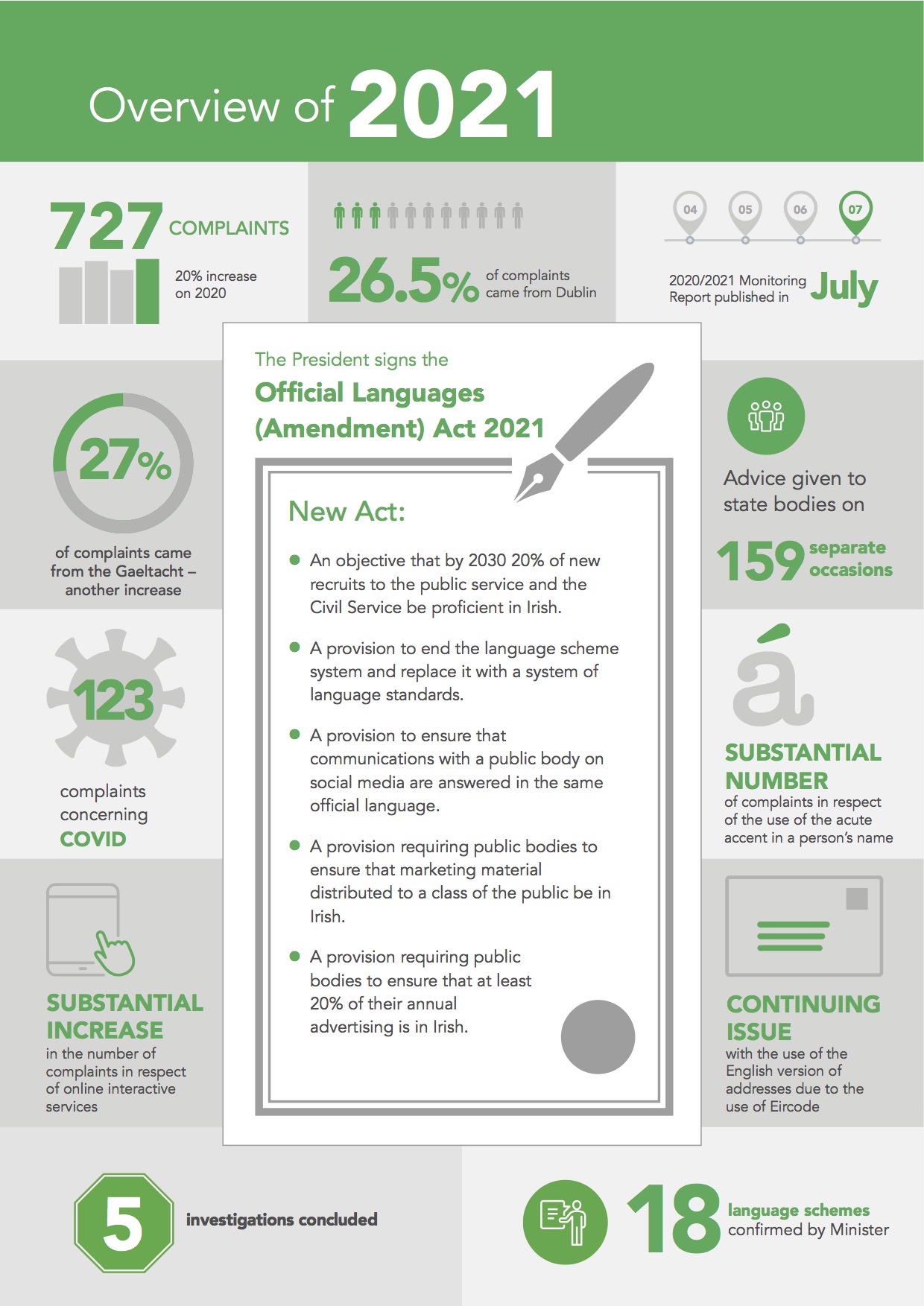
The Commisinéir said: “A total of 123 complaints were received this year related to the health crisis. Many of those complaints could not be investigated due to a lack of provision in legislation requiring satisfactory service through Irish. The matter highlights again the importance on giving effect to the provisions in new Official Languages Act which came into law late last year.

“My Office will be undertaking a substantial information and public awareness campaign later this year to emphasise the importance of the new legislative provisions to both the public and public bodies. If the various provisions of the new Act are properly implemented, the public shall benefit from the availablity of a wider range of services through Irish than heretofore.”

Some of the main provisions in the new Act include:

  • An objective that by 2030 20% of new recruits to the public service and Civil Service be proficient in Irish
  • A provision requiring public bodies to ensure that at least 20% of their annual advertising is in Irish
  • A provision to ensure communications with a public body on social media are answered in the same language.

The monitoring function of An Coimisinéir Teanga continued last year and is highlighted in the annual report. The monitoring included following-up on recommendations in previous investigations relating to public bodies such as the Department of Education, the Educational Research Centre and RTÉ

The Coimisinéir Teanga looks forward in due course to utilising a new function in the revised Official Languages Act which will enable him to monitor any enactments relating to the use of the Irish language, not just the Official Languages Act as is at present. 

Five formal investigations were concluded by the Office of An Coimisinéir Teanga in 2021. One investigation found that Meath County Council breached the Meath County Development Plan by not ensuring the linguistic heritage of the Gaeltacht there was protected when determining planning applications in Ráth Chairn.

Two other investigations related to Dún-Laoghaire-Rathdown County Council and their failure to appoint an Irish-language officer and their failure to ensure that a newsletter distributed throughout the area was available in Irish also.

A total of 727 complaints were made to the Office last year – a 20% increase on 2020. 27% of complaints came from Dublin, with a further 27% from Gaeltacht regions – a 4% increase on 2020.

@CeartaTeanga

Saturday, February 12, 2022

Trydar, Tweets or Giolcacha!

There is an interesting article in todays Guardian (Am I the only person who still thinks of it as the Manchester Guardian - like the Examiner I still think of it's original local affiliation?).

It is talking about an English speaking journalist who spent many years abroad serving the English press returning home and finding that his country has "reverted" to a truly respectful attitude to its own ancient heritage. There are some similarities perhaps to Ireland too.

I mostly follow the Irish language media, Raidío na Gaeltachta, TG4, Tuairisc, Meoin Eile and Nós and all too few print publications - no daily or weekly is published.

I do not follow the English Language media published in Ireland (The Irish media?) - though it is almost impossible to ignore it's smothering presence. Anyway back to the hillsides of Wales. The language there is respected. The Welsh Government tries to truly represent all the people. They even have two twitter accounts, @LlywodraethCym and @WelshGovernment.

Respect or?
What has Ireland got? 

@merrionstreet is an English Language presence with the odd tweet in Irish - mostly about Language issues though more recently some other topics have sneaked through. Even the President is @PresidentIRL and of late seems to have abandoned routine tweets in the National Language. The Taoiseach never tweets in Irish.

Even the Department with responsibility for the Gaeltacht - @DeptCulturelRL - is in English. Only one unlikely Government Department has the Irish name for its twitter handle - can you guess which?

Indeed the European Parliament with it's Irish twitter account seems to tweet more in this official language than the account of most if not all Government Departments or the Houses of the Oireachtas.

Only two State Bodies regularly publish bilingually on twitter (or at all), both based in the Gaeltacht - Udarás na Gaeltachta and the Coimisinéir Teanga. (Raidío na Gaeltachta and TG4 do mostly publish in Irish of course.) The only State Organisation that has both an Irish & English Language twitter account is The Central Statistic Office @POStaidrimh  and @CSOIreland. Who'll be next?

Even when a Government Department provides an Irish version of a release or policy or a consultation it rarely if ever publicises it. 

The article in the Guardian makes good and encouraging reading for those anxious to ensure the continuation (no not preservation!) of the original language of the Britons. It does however slip into some of the misconceptions people who speak Irish will recognise. It condescendingly describes Hew Edwards, long time anchor of BBC TV News, as an "evangelical Welsh speaker." We are used to this condescension in any obituaries or descriptions have we in Ireland seen, "Irish language enthusiast," "fluent Irish Speaker" "Inverterate Irish speaker" etc etc. I have heard Hew Edwards speak in Welsh on television once. It is his language. He is hardly an evangelist. Was Angela Merkel a language evangelist because she only spoke publicly in German?

A lot of people speak in Irish, my neighbours do, because it is the language of the place. It is their language. Few if any can be described as "evangelists" or even "enthusiasts." They speak Irish because it is their means of communication. Yet the state makes it virtually impossible for them to communicate indeed actually discourages it use. 

Recently I sense that Irish does seem to be more alive on line - like Welsh because of Raidío na Gaeltachta and TG4 but also I believe because of the influence of the Irish Speaking schools. There are other outlets too in radio, print and social media (and not all with State support).

It looks like there will be a long wait however for our Government to emulate the Welsh example. Maybe it's time for another commission or study group.


Monday, January 17, 2022

More than seven minutes and one hundred years!


During this time of centennial commemorations it is perhaps interesting to see just how advanced our country has advanced as a nation.

Shortly before his death and after he signed the treaty and taken Dublin Castle Collins oar as he signed himself, Mícheál Ó Coilean said, "We have now won the first victory... the biggest task will be the restoration of the language ... Irish will scarcely be our language in this generation, not even perhaps in the next. But until we have it again on our tongues and in our minds we are not free ..." (The Path to Freedom - published some months after his death in 1922).

There are those who feel that the low-key transfer of power in Dublin Castle marked the end of the struggle. Of course it was, as the "Big Fella" said "the first victory." There was more to be achieved.

Of course there are some good signs to be seen. The Oireachtas Committee on Irish & The Irish Speaking Communities, first established in 2016 under the intrepid Galway TD, Catherine Connolly (@catherinegalway) and continued in the current Oireachtas under Aenghus Ó Snodaigh (@aosnodaigh) has been doing real thoughtful work. Although initially contributions featured the usual encomiums to the language and hope the contributors loved it and tributes to its beauty it has now settled down to really important work and in no small measure has contributed to the debates in both ouses of the Oireachtas. 
The final measures in the recognition of our language as an official language of Europe should also help increase respect and its use in officialdom. Seán Kelly's works in trying to encourage its use in the Parliament is also meeting some success.
The treaty of accession to the European Community (now European Union) in 1973 was signed by the then Taoiseach in Irish.

Not least of these was the reconciliation with those who still felt a loyalty to the Westminster Parliament and and whose leader, Dublin man Edward Carson, expressed the year before as the New Northern Ireland was set up in 1921, "What a fool I was. I was only a puppet, and so was Ulster, and so was Ireland, in the political game that was to get the Conservative party into power.” (plus ça change!)  Many believe that the treaty of December 1921 set up Northern Ireland. This is not so. It was established by a Westminster Act of Parliament in May 1920 and the first session of the Northern Ireland Parliament was opened by King George V in June 1921 thus it was a entity at the time that the treaty negotiations commenced during Autumn 1921.

The other victory Collins looked forward to was the reversal of the policy of those who "destroyed our language, all but destroyed it, and in giving us their own they cursed us so that we have become its slaves."

Today, one hundred years on how has this task progressed. If we look at communications from the Irish Parliament in Leinster House - Houses og the Oireachtas - which tweets message for the most part in English as @OireachtasNews. (The European Parliament in contrast has an Irish label and tweets almost daily in Irish as @Europarl_GA with  the "Nuacht is déanaí de chuid na Parlaiminte.").

Uachtarán na hÉireann, Michael D Higgins, inexplicably tweets under the title @PresidentIRL has usually tweeted each message in Irish and in English (though this practise seems to have fallen into abeyance in the last few months).

The current Taoiseach (@MichealMartinTD) rarely tweets in Irish (the last time was 9th December), indeed he even expressed his sorrow at the death of Máire Mhac an tSaoi, the great poet in our language, not in the language of her poetry but in the language of the Bard of Avon.

The Government Departments rarely tweet anything in Irish - even the so-called Department of Culture (@DeptCulturelRL).

In a country that officially espouses bilingualism as a state policy no Government Department has a truly bi-lingual website. The only State organisations that have truly bilingual websites are Udarás na Gaeltachta and that of the Comisinéir Teanga.  Foras na Gaeilge,  which is a cross-border body, also mantains a bilingual website.

Not one elected political has a website that can be remotely be called bi-lingual. Thus no political party can truly be said to represent the Irish speaking community or the Gaeltacht Areas. (The same may be said for the websites of any of the Church groups including those which contain the largest Gaeltacht areas within their dioceses.

There is little sign of the slavery referred by Michael Collins being cast aside even as we commemorate him and his patriotism. The picture (from Journal.ie) at the top shows members of the army with covered mouths - unknowingly symbols of this slavery?

For my own part I will feel the the so-called language policy success is when I can renew my driving license or public service card without difficulty or question in what our constitution calls the National Language.

Thursday, December 23, 2021

Significant advancement of language rights.


An Coimisinéir Teanga welcomes enactmentof new Official Languages Bill but also stresses the importance of the full implementation of the Act.

Having considered the Official Languages (Amendment) Bill 2019, the President, Michael D Higgins, has signed the Bill and it has accordingly become law.

An Coimisinéir Teanga has said there has been significant progress as regards language rights as a result of the enactmentof a new Official Languages Act. Rónán Ó Domhnaill also said, however, that what’s most important now is that the Act is implemented as intended.

President signs Irish language rights legislation into law (Irish Times)
Official Languages Act (Amendment) 2021 signed by the President of Ireland (Dept of Culture Irl)
“The enactmentof this legislationcertainly signifies progress as regards language rights. The State must act in a practical and proactive way to give effect to the clear objective in the Act that by 2030 20% of new recruits to the public sector and to the Civil Service be proficient in Irish. It’s clear that the work of the Advisory Committee, to be established under the Act, and the National Plan for the Provision of State Services through Irish, which will have a statutory basis, will be critical in ensuring an increase of Irish speakers in the public service.”

Some of the provisions in the new legislation include:

  • An objective that by 2030 20% of new recruits to the public sector and the Civil Service be proficient in Irish.
  • Confirmation that a deadline will be set wherebyall State services in Gaeltacht regions will be available through Irish.
  • A new monitoring function for An Coimisinéir Teanga.
  • A provision to end the language scheme system and replace it with a system of language standards.
  • A provision to ensure that communications with a public body on social media are answered in the same language.
  • A provision requiringpublic bodies to ensure that marketing material distributed to a class of the public be in Irish.
  • A provision requiringpublic bodies to ensure that 20% of their annual advertising is in Irish.
  • A provision to ensure application forms are available in Irish.
  • A provision to ensure that the logos of public bodies are in Irish or in Irish and English.

Rónán Ó Domhnaill said that his Office will be advising the public regarding the strengthening of language rights as a result of the new legislation. His Office will also advise public bodies regarding their new statutory obligations. The provisions will take effect over time and this work must begin without delay, An Coimisinéir Teanga declared.

The Commisonéir's office is currently reviewing the website to take into account the amendments to the legislation arising from the new Act. It is hoped to conclude this review early in the New Year. In the interim, any question in respect of any specific provision of the new Act may be made directly with his office.

@PresidentIRL @Ceartateanga @OireachtasNews #AchtTeanga

Wednesday, August 4, 2021

"You are not on the system at all..."

A Kafkaesque tale from 21st century Ireland!

Ciarán Ó Feinneadha is a respectable accountant, steady, reliable and usually unflappable. Like all people who interact with the Irish state in the National Language he experiences a fair amount of difficulty if not downright obstruction.

The Irish Language home page of
the Dept of Social Protection
Things like computer problems with diacritics. Why this is a problem is difficult to understand since most languages do have diacretics to a far larger extent that Irish. We have the síne fada (or l'accent aigu of French) which often alters the meaning of a word or it's absence makes a word meaningless. Take the name of the country Éire. Without the síne fada this the word "eire" means burden or encumberance. The male name Seán (from Norman French "Jean") becomes "old" when spelt "sean". One would imagine that country would take account of its official language when specifying equipment. 

Finding personnel with the ability to actually communicate in the language is another difficulty. Another problem faced is the inability of people to accept the given name or surname. All people who use the Irish (and correct form) of their surname have experienced questioning, "What's that in English?" I usually reply "Track" or "Trace" which is really on trend nowadays. (See Tearma.ie!)

These are everyday problems for the Irish speaker trying to excercise his constitutional rights to using the National Language which is the Official Language of the state. ("Ós í an Ghaeilge an teanga náisiúnta is í an phríomhtheanga oifigiúil í." - Since Irish is the National Language it is the principal official language! Alt 8.1 Bunreacht na hÉireann). 

Naturally many people get tired of the incessant trouble they experience in dealing with the state and as often as not revert to English in order to save time and bother. No doubt the also contributes to the retreat of the Irish speaking areas and the so-called lack of demand for services in Irish that the civil servants report. If you want to read about some of these cases you could do worse than looks up any of the reports from the Coimisinéir Teanga since the institution of that office. 

But back to Ciarán.

An Scéal seo ar Gaeltacht21:
He tells us on his facebook page that he has refrained from speaking publicly on the matter of the frequent failings of the state (Dept of Health & HSE) to consider, let alone serve, Irish speakers in the current pandemic. He has shown remarkable constraint since the Coimisnéir Teanga says that no less than 20% of all complaints received in the office during 2020 were related to the pandemic. "One in five complaints I received this year related to the health crisis," his recently published report states (Page 6).

The straw that broke the camels back for Ciarán was another State Department entirely - the Department of Social Protection. He starts by listing three irritating occasions where the state failed to serve him as a user of the First Official language of the state during July 2020 alone. then he goes on:

Ciarán Ó Feinneadha
"I needed to get a Public Services Card and in order to obtain that the Department of Social Protection had to confirm my birth certificate electronically. 

"My parents baptized me Ciarán Ó Feinneadha. In my discussions with the local Office I was told “You are not on the system” and “you are not on the system at all”. So on the registration system for birth certificates by the Irish government there is no ‘Ciarán Ó Feinneadha’. They have translated my surname into an English surname they have created for me to file my real name in the system. I was told on three occasions that they have done this for everyone who has an Irish surname. 

"The correct Irish version is still on the certificate itself but they have translated all our Irish surnames into English (if it is English) and have filed us in that English version only. So when they tried to confirm my birth certificate I was asked what the English version of my name was and of course I refused to invent one because it doesn't exist - I'm kind of ashamed to claim WARRIOR of course. So the local office couldn't find me in the system without the corrupted "English" version of the name under which I was filed, which I or my parents have never used. 

INCREDIBLE!

"Both my parents have passed away in recent years and I feel that this is a personal insult to them as well as to me and to all Gaels. As well as being abusive and rude - it appears that their (the Department's) anti-Irishness has taken away all human understanding."

Comments on this on his page range from incandescent indignation to "well what do you expect?"

My own comment as a taxpayer to this state since 1966 and still suffering this kind of disrespect is a very weary indignation and very little surprise.

• A personal apology has been made to Ciarán but a statement to Tuairisc.ie leaves many questions unanswered. Conradh na Gaeilge is seeking a meeting and a trawl through the records to find out how many other cases like this may occur. (see Article 5/8/2021)

Tuesday, July 20, 2021

County council and Eircode lack of co-operation may lead to legal action. - Report

Monitoring Report 2020/21 of the Office of An Coimisinéir Teanga has been published.
Main Points: 

• No local authority examined was fully compliant with their commitments regarding websites and interactive services.
• A mixed level of compliance amongst Education & Training Boards was identified regarding statutory obligations under the Official Languages Act.
• An Coimisinéir Teanga has welcomed actions put in place by the Office of Public Works at heritage sites that received an unsatisfactory rating for their signage in last year’s Monitoring Report.
• A report is to be placed before the Houses of the Oireachtas due to a lack of implementation of recommendations from an investigation into Eircode.
 

The responsibilities on An Coimisinéir Teanga by the Houses of the Oireachtas include the monitoring of the implementation of the Official Languages Act. This aspect of his duties is central to the work the Office carries out as it gives the office holder the opportunity to monitor, off his own bat, the range of duties placed upon public bodies under the Official Languages Act. 

An Coimisinéir Teanga, Rónán Ó Domhnaill,  said that the Monitoring Report for 2020/2021 highlighted that some local authorities did not engage with his Office during the monitoring process and that he would be reminding them of their statutory obligation to cooperate with him when undertaking his functions.

“Under the Official Languages Act proceedings for an offence can be brought by An Coimisinéir Teanga in the event that the Commissioner is hindered or obstructed in the performance of his or her functions. That particular provision in the Act has never been used since the Office was established but in light of the lack of cooperation from some local authorities, I may have no option except to avail of this significant action soon.”

An Coimisinéir Teanga also expressed disappointment that monitoring work conducted by his Office found that recommendations relating to the use of Gaeltacht place names for the Eircode system were not satisfactorily implemented and that he would be laying a report on this matter before the Houses of the Oireachtas. said he hopes that when a new Language Bill is enacted that he will have the opportunity to monitor other enactments that relate to language matters instead of solely the Official Languages Act.

“With the enactment of a new Bill I should be able to engage in a more allencompassing monitoring process than is allowed at present under the Official Languages Act. This would enable me to monitor the implementation of language legislation that relates to education, broadcasting, planning and transport amongst many other areas”,

• The Monitoring Report can be found here on the Coimisinéir's website.


Tuesday, June 1, 2021

Language on condition...

"The statutory duty to provide a service in Irish does not depend on the particular situation involved, the priorities or resources of the public body."

The latest official report (Annual Report 2020)  from the Coimisnéir Teanga shows the impact of the coronovirus. Two things stood out. One was the 14% reduction in the number of complaints received in the office, probably a reflection of the lockdowns of different levels throughout the period covered. The second was the number of complaints relating to the pandemic displaying the disrespect or thoughtlessness by central and local arms of government. It certainly shows the urgency required in enacting a strong language act.

One in every five complaints made to Language Commissioner last year were Covid-related. 20% of all complaints raised by An Coimisinéir Teanga with public bodies during 2020 pertained to Covid-19. The majority of these cases concerned various means of communication with the public in English only, including information booklets, websites and advertising. Many of the complaints could not be formally investigated due to a lack of provision for Irish language services in the Official Languages Act, according to An Coimisinéir Teanga, Rónán Ó Domhnaill.

“The figures released in the annual report highlight that the more urgent and more important the service or information that the State is providing, the less likely it is that information will be provided in Irish. Many complainants who contacted my Office felt Irish speakers were being marginalised by the State at a time when bringing the public together in common purpose was required. The huge challenges facing the State in a time of Covid should not be underestimated but there should be no conflict between the grave national actions underway and obligations regarding language rights.” he said.

Rónán Ó Domhnaill added: “The complaints we received last year demonstrate yet again that the Official Languages Act needs to be strengthened to ensure a greater level of service through Irish from the State. It is hoped that a revised Official Languages Bill will begin to do just that when enacted.”

Four formal investigations were concluded by the Office of An Coimisinéir Teanga in 2020, two of which were Covid-related.

An investigation found that the Department of Education breached the Education Act when it decided to provide an online portal to enable students register for calculated grades in the Leaving Cert in English only.

Another investigation found that Galway City Council breached the Official Languages Act when erecting a large number of signs in English only which were in relation to Covid.

A total of 604 complaints were made to the Office last year – a 14% reduction on 2019. 33% of complaints came from Dublin, with a further 23% from Gaeltacht regions.


See also: 


Monday, April 26, 2021

"Our hearts are broken!"

Gaeilge

A report regarding the low number of Irish-speaking Gardaí in the Gaeltacht has been submitted to the Houses of the Oireachtas by An Coimisinéir Teanga.

It was decided to lay a Report before both Houses of the Oireachtas as the recommendations of an investigation carried out in 2011 had not been implemented by An Garda Síochána and An Coimisinéir Teanga was unable to undertake any additional measures to impress upon An Garda Síochána to do so.

‘It is now very clear that the investigation’s recommendations have not been implemented by An Garda Síochána. The number of Irish-speaking Gardaí who are on duty in the Gaeltacht is inadequate and as a result the Garda Síochána Act is being breached. It would be difficult to argue that a reasonable period of time has not elapsed since recommendations were made in a 2011 investigation. It now falls to the Houses of the Oireachtas to take whatever additional measures they deem appropriate.’ said Rónán Ó Domhnaill, Coimisinéir Teanga. In an interview this morning he stated that "their hearts were broken" trying to get the Garda Síochána to fulfill their legal obligation. 

The Commissioner of An Garda Síochána is under a statutory obligation to ensure that members of the force who are fluent in Irish are stationed in a district that includes a Gaeltacht area, as far as practicable. The law clearly states:  ‘The Garda Commissioner shall, to the extent practicable, ensure that members of the Garda Síochána stationed in a district that includes a Gaeltacht area are sufficiently competent in the Irish language to enable them to use it with facility in carrying out their duties.’  (Subsection 33(2) of the Garda Síochána Act 2005).

The investigation, which was completed in December 2011, found that An Garda Síochána did not comply with its statutory language obligations to station members of the force who are sufficiently proficient in Irish in the Donegal Gaeltacht.

A specific recommendation was made in the 2011 investigation that An Garda Síochána should examine staffing throughout the Gaeltacht to ensure compliance with the statutory language obligations pertaining to An Garda Síochána in the Garda Síochána Act 2005 and An Garda Síochána’s Language Scheme 2009-2012.

As a result of a monitoring process, it was ascertained that only 35 Irish-speaking Gardaí, out of a total of 95, are assigned to Gaeltacht stations. This is according to An Garda Síochána’s own self-assessment system.

@gardainfo @ceartateanga @OireachtasNews @DeptJusticeIRL


Friday, April 16, 2021

From Kilkenny to Dún na nGall.

"...if any English, or Irish living amongst the English, use the Irish language amongst themselves, cont-rary to the ordinance, and therof be attainted, his lands and tenements, if he have any, shall be seized into the hands of his immediate lord, until he shall come to one of the places of our lord the king, and find sufficient surety to adopt and use the English language, and then he shall have restitution of his said lands or tenements, his body shall be taken by any of the officers of our lord the king, and commited to the next gaol, there to remain until he, or some other in his name, shall find sufficient surety in the manner aforesaid..." 
Statutes of Kilkenny A.D. 1367

What a week for the Irish speaker!

1. Vaccination registration impossible for Irish speakers;
2. Circulars distributed to Naoinra's in English from the department of Children with the instruction to distribute it to parents;
3. Circulars issued in English only from the Department of the Gaeltacht;
4. Plans for rural rejuvination available in English only weeks after they were announced.
5. A Chinese Academic's application for citizenship rejected because it was submitted in Irish.
6. A circular issued by a company in Gaeltacht to its employees, sponsored by Udarás na Gaeltachta, stating that English is the only acceptable language in the workplace (since withdrawn);

No Gaeilge - No Gaeltacht!

And they are the only ones I can think of ... indeed, as was mentioned by one tweeter, the only department which seems ready to speak in Irish is that of the Revenue Commissioners. I wonder why?

And all this in the week when discussions are being held in the Dáil to strengthen and protect the language. And all but a few of the over 300 amendments being rejected by the Government.

One wonders how this is possible when the Taoiseach (@MichealMartinTD) belongs to a party (@fiannafailparty) with claims as one of its primary aims is "to restore the Irish Language as the spoken language of the people." One would imagine that the first step would be to ensure that the state would be able to serve those who use the language in their daily life especially the people of the Gaeltacht areas. How many Fianna Fáil TD and Senators use the National Language on twitter. I could count on one hand the number of tweets made by our Taoiseach.

Arguably the European Parliament (@Europarl_GA) makes more tweets in Irish per week than the Oireachtas (@OireachtasNews). Indeed Uachtarán na hÉireann offers an example that all arms of Government could follow - although it is a bit of a mystery as to how his twitter handle is @PresidentIRL.

One is tempted to ask (as indeed are many on twitter) against what - is the Irish State the greatest enemy of the Language that it is charged not only to protect but to encourage.

A reminder the Bunracht na hÉireann states (Article 8 #1)

Since the Irish language is the national language it is the first official language.


Saturday, February 20, 2021

A first in fifty years...

"...until we have it again on our tongues and in our minds we are not free.." (Michael Collins).

Something happened to me last week that has never happened before. A representative of the State initiated a conversation with me in Irish.

I was travelling to our local chemist in Ceathrú Rua and there was a Garda Checkpoint on the road. We were stopped and before we could say anything the cheerful Garda greeted us "Agus cé chaoi bhfuil sibh ar maidin?" I explained my errand and we went on our way. As I drove I felt strangely uplifted, even joyful.

Why?

Well I have been dealing with the state for over fifty years and always the first approach is a sort of confrontation. If I start in Irish there are various blank stares if it is in person and they go looking for "the person with Irish." Or on the phone "The person with Irish is not here..." or "...on her tea break!" In fact up to now if I have been stopped by a Garda on the road in the course of their duty they have always initiated the proceedings in English even in the Gaeltacht. Sometimes refusal to respond in English has resulted in frogmarching to the station. This attitude has lead unsurprisingly to the interaction between the state and those whose daily language is Irish, such as those who live in Gaeltacht Areas, to be in English with the inevitable and frequent claim by the civil service "There is no demand for it!"

I have even been told on more than one occasion by an employee of the State, the constitution of which states that Irish is the first official language, that I would get a better and more efficient service if I dealt with them in English. 

There have been some conversations recently discussing this on twitter and the on-line publication NÓS (Irish).  Indeed when somebody is served in Irish it is the occasion for some happy sharings on social media. This tells its own story. I have yet to see somebody rejoicing in the ability of any state service to provide a service through English.  

Hopefull the wrangling currently in progress in Leinster House as the new ten year delayed Language Bill will manage to sort out this particular problem. However looking at the Government's rejection of almost all of the recommendations of both the Coimisinéir Teanga and the Oireachtas Committee on the Irish Language, Gaeltacht and the Irish-speaking Community (Irish) not to mention those of Linguistic experts, language bodies and the ordinary Seán and Siobhán Citizen.

The Government - all Governments of whatever hue say they favour the advancement of the National Language. Ring up any Government and discover just how they have done in the 99 odd years of the State. The great Michael Collins said shortly before he died, "...the biggest task will be the restoration of the language. How can we express our most subtle thoughts and finest feelings in a foreign tongue? Irish will scarcely be our language in this generation, not even perhaps in the next. But until we have it again on our tongues and in our minds we are not free, and we will produce no immortal literature...."

The milk-watery efforts or indeed subtle hostility of some of his successors have in no small way contributed to the current situation.

I have quoted a Nigerian poet, John Ekwere, in this regard before and his words mutas mutandis perhaps reflect the situation.

    "Now no more the palefaced strangers
    With unhallowed feet
    The heritage of our fathers profane;

    Now no missioned benevolent despots
    Bull-doze an unwilling race;

    Now no more the foreign hawks
    On alien chickens prey -
    but we on us."


See also: National archive reveals shocking state cynicism! (4/9/2013)

Monday, October 12, 2020

Will 2030 be postponed as 1928 was?

Perusing the English language media this last week you might be forgiven for not knowing the the Government introduced the Official Languages bill in the Dáil on Thursday. This bill, promised for the past ten, if not more, years, is supposed to be the natural progression of the 2003 Act which established the Coimisinéir Teanga and various regulations to promote the use of Irish what after all is the National Language particularly in the public sector. 

Was that act a success? 

Judge for yourself. Note particularly that the first Coimisinéir, the much respected Seán Ó Cuirreáin, was left with no other choice but to resign from his role in ensuring the implementation of Irish language legislation. He said his decision was a result of the State's lack of commitment to the protection of Irish speakers' rights. He went on (in translation) to observe: "I fear that the exercise (Government's intentions in a long delayed new Language Act) will be seen as a fudge, a farce or a falsehood."

While the new bill does address some of the issues mentioned by Seán Ó Cuirreáin and his successor and many organisations and private citizens they are understandibly doubtful of the bona fides of the Government in bringing this bill forward. This is of course based on bitter experience from the actions of every Government of the state since 1928. 

Catherine Martin (Aire Gaeltachta 2020) Risteárd Ua Maolcatha, Aire Rialtas Áitiúil 1928) & Jack Chambers (Aire Stáit Ghaeltachta 2020)

Research, which possibly led to the aforementioned resignation, shows that "the Irish language policy of the Irish state from 1928 has been little more than an excercise in cynicism, deception and long fingering!" During that year the then Minister of Local Government & Health, Risteárd Ua Maolchatha, introduced Legal Instrument (No 23 0f 1928) which specified that any local or health authority employee with duties in the Gaeltacht (Irish speaking area) be given three years to learn sufficient Irish to be able to perform their duties in the local language. If they failed to do this they were to be let go. 

These provisions were never implemented. 

As a target date approached a new instrument was signed which postponed it for a further six or twelve months. In fact during the years between 1928 and 1966 this happened FIFTY FOUR (54) times. 

In 1974 the then Government enacted legislation which abolished the requirement of proficiency in the National Language for applicants to appointments in the civil service. The Taoiseach of the day fully understood what this would mean and wrote:  "..that the abolition of the requirement might cause some difficulties in regard to the Constitutional position of Irish as the first official language of the State and might lead to a situation where few civil servants would be able to conduct business in Irish with those members of the public who would wish and would be entitled to do so..." 

Oh how true!

The new act states that a fifth of new recruits to the civil service will have to be proficient in Irish from 2030 (IT). However there is a clause which allows the Minister to extend that date. One wonders how frequently will this be done. Fifty four times? It is little wonder the the General Secretary of Conradh na Gaeilge, Julian de Spáinn wearily says in todays Irish Times (Irish)  - "It is time for the Government parties to adhere and fulfill their promises (before the election)!"

One sign of hope was the number of speakers who addressed the introduction of the bill on Thursday. Twenty two deputies spoke over a period of several hours in a civilised, intelligent and useful debate. All parties and independent groups with the notable, and noted, exception of Fine Gael, the successor party of that which introduced the 1928 act. And the party whose minister removed the Irish language requirement in the civil service with the words, "...there will be no weakening of Irish in the civil service and there will be a greater desire to use it because of the ending of compulsion..." 

Tuesday, August 11, 2020

Monitoring report highlights Garda failure!

Prior to 2018 the majority of the Coimisinéir Teanga's monitoring was focused on language schemes. This was a sensible approach because these language schemes were the main mechanism used by the legislation to impose a legal obligation on public bodies to provide varied services in Irish. However by 2017 it became evident that it was a flawed system. No systematic or comprehensive development of services provided in Irish occurred as a result of this system.
Leagan Gaeilge

A litany of failures (Irish Times Editorial 13/8/2020)
For this reason the Coimisinéir used another of his powers given him by the Oireachtas. This allowed him to monitor, of his own accord, the range of duties placed upon public bodies under the Official Languages Act. His first report using this monitoring power led to the first Monitoring Report covering 2018. Now the report for 2019 is available and shows how state and public bodies are fulfilling their obligations under the law and constitution.

Only 35 Gardaí with Irish are stationed in Gaeltacht stations according to the organisation’s self-assessment system. That is out of a total of 99 Gardaí stationed in the Gaeltacht. An Coimisinéir Teanga, Rónán Ó Domhnaill, says that it is now clear that recommendations from an investigation concluded in 2011 on this issue have not been implemented as they should.

Overview of 2nd Monitoring Report
As he launched  the  2019 Monitoring Report today, An Coimisinéir Teanga said … "the likely outcome of this lack of progress will be the laying of a report on the issue before the Houses of the Oireachtas. This in accordance with the obligation placed upon me when recommendations of an investigation have not been implemented after a reasonable period of time. It would be difficult to argue that a reasonable period of time has not elapsed since an investigation in 2011 as regards An Garda Síochána complying with its obligations under the Garda Síochána Act in ensuring Gardaí with Irish are stationed in Gaeltacht areas, to the extent possible."

Signage 
The Monitoring Report for 2019 also shows that 75% of signs at 10 heritage sites examined were compliant with the legislative requirements, but that over 40% of signs at the four universities under the auspices of the National University of Ireland were in English only.

Local authority websites, language schemes of Education & Training Boards and the interactive services of the Revenue Commissioners were also examined as part of the audit.

Official Languages Bill
An Coimisinéir Teanga said he hoped that the strengthening of the Official Languages Bill, as committed to in the Programme for Government, would rectify the situation where he is unable to proactively monitor any provision to do with the status or use of an official language in other Acts of the Oireachtas such as the Education Act, the Planning and Development Act and the Broadcasting Act. At present the Commissioner may only deal with allegations of non-compliance in these areas through an investigation.

• See also his Monitoring Report 2018