The derogation on Irish usage in the European Union was mentioned recently in the Dáil. This was instituted when Irish was recognised as an official language of the Union some 10 years ago in order to allow facilities, translators etc to be instituted. This expires at the end of 2016.
Liadh Ní Riada'a frustration.
The effect of this derogation (the length of which is unprecidented in the European Union experience) was dramatically demonstrated when one of our members of the Europeam Parliment, Liadh Ní Riada was instructed to "Speak in another language...." at one of its meetings. Think of it, a member who from a Gaeltacht Area, whose mother tongue from the cradle it is, is forbidden from speaking in Irish, a recognised EU language, at an official parliamentary meeting. Earlier this year a crowded meeting in Dublin's historic Wynn's Hotel was addressed by Dr Professor P. B. Ó Laighin and MEP Liadh Ní Riada among others.
"I know that a decision in principle has been made
by the Government that the derogation will not be
ended by 31st December 2016 and that the derogation
will be renewed from the 1st January 2017."
Dr Ó Laighin is an acknowledged expert on language matters in the European Union. At that meeting he stated that there was little need for this derogation to be continued from the end of 2016. In trying to ascertain the attitude of the current Government he approached various branches of administration both in Europe and in Ireland. The EU sources all said that it was a matter solely for the Irish Government. When he approached the Government Departments he was frustrated and delayed again and again and was unable to get a clear response one way or another. (Indeed this writer was quite shocked at the discourtesy shown to such an esteemed expert in the field.) However from his experience and the talks that he did have with them he felt that he was able to make a statement on the matter. He put it up on the screen during his presentation. He stated baldly that "To my knowledge a decision in principle has been made by the Government .... that the derogation will be renewed from the 1st January 2017." He also stated that there were virtually no reasons any more for the continuation of this derogation. There are translators available, the vocabulary for technical and legal terms is more complete that that of some fully recognised languages and indeed the European institutions are more than prepared to accommodate Irish on equal terms to the other smaller languages like Maltese, Estonian, Latvian etc. Indeed Irish was reported in the Irish Times (13 Nov 2013) as the 14th biggest language in the EU terminology database. That Ireland and the Irish are ready for the ending of this derogation is without doubt. Indeed it is of great advantage to those whose mother or cradle language is Irish as things stand. Crucially many jobs require applicants to have at least a “thorough knowledge” of an official EU language and “satisfactory knowledge” of either English, French or German. Many third level courses are available such as Kings Inns. The law school offers a number of Irish language courses that are designed to help graduates secure lucrative translation jobs in Europe including some non-degree courses. (cf Article in The 42 13/6/2015). Government response?
The recent statement in response to a question in the Dáil - itself no paragon of virtue when it comes to facilitate the use of the National Language - elicited a response from the Minister of State for Gaeltacht Affairs, Joe McHugh TD which appears to confirm Dr Ó Laighin's assertion. (Source: Report in Irish from Seán Tadhg Ó Gairbhí in Tuairisc.ie 11 June 2015).
He said that an examination was been made by his department, the Taoiseach's Department and EU Institutions of the services at present provided in Irish and on “the potential to expand these services”.
In short, as in so many matters (and not only in the matter of the Language) the name of the game is obfuscation and pretence. The sort of thing that lead to the resignation in frustration of Seán Ó Cuirreáin,"The choice I had was to stand aside from my appointment as Coimisinéir Teanga on principle to draw attention to these matters or to continue in my role and, consequently, to participate in a pretence!" (to Oireachtas Committee 23 Jan 2014). He was the first Ombudsman to resign on a matter of principle in Ireland, and maybe in Europe, since the foundation of the state.
As many people have been saying of late there is little purpose in trying to rely on The Irish State in these matters. "There are stronger and more widespread forces in place (in the administration) who have little or no concern for the future of our national language." These are those, in the words of President Michael D Higgins, “for whom Irish was not half dead enough.” This is year 5 of the adopted 20 year scheme for Irish and this Government cannot point to any one of the recommendations that has been adopted - even those ones which would cost little or no money.
"As we begin to regain our economic sovereignty, it would be a travesty if we were to lose our linguistic sovereignty – a cornerstone of our cultural identity, heritage and soul as a nation. I believe this to be a clear and present danger." (Seán Ó Cuirreáin as he announces his resignation 6th December 2013).
It appears this belief is still valid some eighteen months later!
At 10.47 - 3 Jul'15 there were 340 Backers €50,410 donated & 52 Hours to go! Why not join 'em!
Here we are! How about a bit of uplifting news about Irish! And you, dear reader, have 28 days to make it happen!
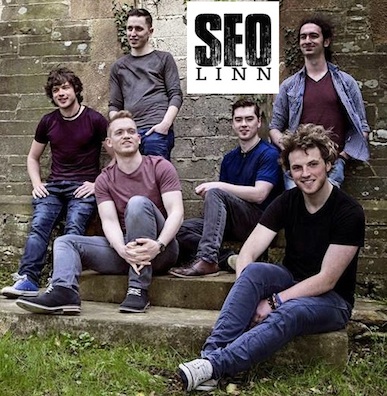
Seo Linn showing what they can do - let's show 'em what we can do!
One of the reasons I set up this site was to report on happenings concerning Irish and the Gaeltacht areas especially with regard to language rights. This are for the most part ignored by the English language media except of course when there appears to be bad news. This means of course that the Irish media has an disproportionate amount of reporting in this area. A case in point is the recent publication of Conchur Ó Giollagáin's report update by Údarás na Gaeltachta. The reports in English Language media concentrated entirely on the negative aspects of the report. "Irish will be dead in ten years!""The end of the Gaeltacht is nigh!" etc etc.
In passing
I wonder is that also what happens to these reports when, if ever, they cross a Government Minister's desk. Certainly the lack of adherence by the State to the advice the sought on language matters would lead one to that opinion. Indeed the situation lead the first Coimisinéir Teanga to state baldly. "I believe that the language is continuously being edged aside, pushed towards the margins of society and that includes much of the public sector. I would not support the premise that the fault lies primarily with politicians but it appears to me, notwithstanding those within the State sector who support the language, that there are stronger and more widespread forces in place who have little or no concern for the future of our national language."
In reading most of these press stories it is obvious that these writers have only superficially examined the actual report. There was in fact some good news contained in this report which was highlighted by writers in the Irish electronic media. (Unfortunately there is no Irish print media any more since this has been forced off the face of the earth by the actions of State bodies!)
Gripe over (until the next time!)
Enterprising initiative!
But that is not what I want to talk about now but rather a story of independence shown by a group of talented young men who apparently realise the futility of engaging state bodies or indeed political parties have taken a bold initiative. In the colourful phrase of the writer of the iGaeilge blog "cic sa tóin do chultúr na ndeontaisí" (A kick in the arse to grant culture!).
This enterprising group, which perform as Seo Linn, who electrified the 10,000 people who marched on Lá Mór na Gaeilge (See more pics on their Facebook page) have already proved themselves musically and now want to share their expertese in music and language to the wider audience that the know are out there. They have achieved an incredible 4.6million viewings of one of their live performances in the Conamara Irish College, Coláiste Lurgan on YouTube. (Take a look - the words are included - and sing along!) They have performed on television and before President Michael D Higgins.
The inspiring thing about this initiative is that it ignores the usual well trodden paths used by Irish Language organisations braving the dispiriting, soul destroying and interminable bureaucracy seeking grants for their initiatives. Those who are lucky enough to be successful receive this largesse but often bound up with conditions that often times render the initiative ineffective. Without the grant of course the venture falls. A small coterie of enterprises have tried this "modh díreach" of start-up with reasonable success before now. This is an exciting one and worthy of our support!
So what are they planning?
They are going directly to the public with a request for €50,000. They have definite proposals they have a date when the initiative is a success or, God forbid, a failure. We'll know by the end of the month.
Let them speak for themselves: "Seo Linn are asking YOU for help. We know that we are on the path to generating a new kind of Irish music, one that has the potential to portray the Irish language in a progressive, relevant light. We want to make Irish available. "We have thought long and hard about this and our biggest challenge right now is to raise this money. Our hard work over the past two years has gotten us to this point and we are ready to take on a new challenge! We are confident that we will overcome any obstacles that may appear in our way."
So what practically do the intend to do with this money? They outline three practical objectives.
Set up a Company that will provide music WORKSHOPS with the Irish language - These will incorporate the various elements of music production and performance into a polished, tried-and-tested workshop that teenagers will really enjoy.
Record and publicise an original ALBUM - We have so much music in our unique brand that we want to share with you. An album of our work would give life to Irish language music in Ireland and abroad along with providing us with the opportunity to expand our horizons as a band and progress up the ladder as recording artists.
TOUR - a crucial part of every band's road to success is touring and gigging. We want to bring our music all over the world and provide the show that gets people talking. Our unifying of the old and new of our cultural identity is an aspect to our show that doesn't go unnoticed and we pride ourselves on ensuring that everyone enjoys the experience.
"As you can see, we have a long, tough road ahead that every single one of us is relishing! With your help, we can make our dream a reality and do something that has never been done before. We have something to offer.. and this is our chance! Go raibh míle maith agaibh."
Click here to support us!
I see that they have over 9,000 followers on their facebook page, If each of those contributed €10 they will have exceeded their target handsomely.
As I write this article only 78 have backed them contributing amounts from €10 to €1000 (Yes €1000) and there are 28 days left to achieve the target. (Since we started writing about an hour ago it has risen to 82!)
When I first saw this I thought "Nah! not possible!" But then I saw the figure grow to €4000 in the first day and almost double on the second and I now believe it is eminently achievable!
Is you want to read what Tuairisc.ie has written about this and view another video. €50,000 ag teastáil ó Seo Linn dá dtogra Kickstarter!(Irish) And take a view of this unforgetable appearance on the Late Late Show.
‘Declaration setting out the means for the conversion of the Irish and the elimination of the Irish language’
When Government agency, Foras na Gaeilge made a decision which finally destroyed the Irish daily and weekly newspapers they were superceded by a service on-line, Tuairisc.ie. This enterprise although excellent in its own way does not really replace the print media and indeed in many areas of the Gaeltacht it is not available at all due to lamentable internet availability.
Today their reporter, Maitiú Ó Coimín, has an interesting story (Irish) on decision to repeal a Cromwellian law the aims of which, some might say, the Government has been (inadvertently?) pursuing assiduously since its election four years ago. (There are even some who might say that the Government is also assiduously pursuing its proscriptions on Popish doctrine too but who am I to judge?)
Pic: Tuairisc.ie
This law is aimed at the "conversion of the Irish and the elimination of the Irish language!" It states baldly, ‘Persons between eleven and twenty must speak and use English only within a year. All under twelve must be taught English....Children to learn the catechism in English. No Irish to be spoken’
The correspondent maintains that the policy at that time failed because of a lack of state resources. Is it not ironic that the policy is now succeeding ostensibly be cause of lack of state resources but perhaps more because of the existence within the state bureaucracy of "stronger and more widespread forces ... who have little or no concern for the future of our national language." (Seán Ó Cuirreáin, 23/1/2014) Those for whom "Irish is not half dead enough!"
Can anyone deny today in 2015 that, even in the Gaeltacht, Irish speaking areas, persons between eleven and twenty are obliged to speak English, especially to the State and that, according to a recent study, those under twelve are already more fluent in English than their own language.
Repealing this law may be right but in looking at the state of Ireland today perhaps it could be viewed as an exercise in crass hypocracy. • Maitiú Ó Coimín has been nominated for Réalt Óg na Bliana (Young Star of the Year) in the Oireachtas Communications Competition this year. He has been with Tuairisc.ie since it was set up last October and is a very prolific contributor ever since with interesting items like the one reported here. This is how to vote for him: Text: GRADAM105 To: 57003 (Within the Irish Telephone Area) or 60999 (within the British Telephone Area - N. Ireland or Gt Britain)
Only two local authorities compliant with state regulations.
An Coimisinéir Teanga
Rónán Ó Domhnaill
An Coimisinéir Teanga has reported the Department of Education and Skills to the Houses of the Oireachtas because it has failed to fulfil its obligations under the Education Act 1998. Rónán Ó Domhnaill said that the recommendations made as part of a statutory investigation were not satisfactorily implemented. The investigation revealed that an attempt was made to compel a Gaeltacht school into accepting the relocation of a teacher from a redeployment panel even though the school authorities and the teachers in question felt that the teachers had insufficient Irish to carry out their work in that language.
Referring to the case at the launch of his Annual Report (pdf), An Coimisinéir Teanga said “This is the first time that I have sent a case to the Houses of the Oireachtas, and the issue involved could not be more important. The Department of Education and Skills has not put a system in place which ensures that teachers teaching in Gaeltacht Schools and Gaelscoileanna are fluent in the Irish Language. I simply cannot accept that.”
94% of local authorities breaking law!
As part of the Office’s compliance activities in 2014, an audit was carried out on the level of compliance by local authorities with their obligation to have bilingual recorded oral announcements. Only two local authorities, Donegal and Laois, were found to have recorded messages in compliance with the regulations at public phone numbers. “This demonstrates the widespread lack of care for the language by the State generally; if local authorities aren’t complying with their language obligations, what hope does a citizen have in getting the proper service from the State generally?”
During 2014, An Coimisinéir Teanga instigated seven statutory investigations, and he issued a final report in respect of the Health Service Executive, Dublin Bus and the Railway Procurement Agency. “Generally, the investigations are as a result of a lack of awareness amongst public bodies of the most basic aspects of language legislation in Ireland.”
The original Irish release and the launching address of the Coimisinéir Teanga may be found here.
Below are some keypoints and background from the report! The report itself is here pdf format may be found here. It is bilingual in both Irish & English.
Complaints and Investigations The Office of An Coimisinéir Teanga handled 709 new complaints during 2014, a 1% increase on 2013 (702). 88 complaint files were open at the end of 2014 in comparison with 72 at the end of 2013. The Office operates an informal resolution process as the first step of its investigative process which means that the majority of cases are resolved by discussing the matter with public bodies or by giving advice to citizens. 7 statutory investigations were instigated by the Coimisinéir during 2014 and a final report was issued in relation to the Health Service Executive, the Railway Procurement Agency and Dublin Bus. Full details of these cases are available on pages 29-43 of the Annual Report (pdf).
Language Schemes At the end of 2014, 99 language schemes were confirmed, which covered 113 public bodies. 53 of those 99 schemes were in place for longer than three years – the period of time by which public bodies are supposed to confirm a new scheme with the Minister. Although the number of schemes being confirmed by the Minister did increase, the average time that a scheme had lapsed also increased, from 32 months to 50 months. The Coimisinéir’s attitude in relation to language schemes has been set out clearly in speeches he has given to Oireachtas Committees and at public events, and in the statement he gave at the launch (Irish).
Report to the Houses of the Oireachtas In the event that the Coimisinéir makes recommendations in a statutory investigation and that those recommendations are not implemented satisfactorily, the Coimisinéir may report this to the Houses of the Oireachtas. The Coimisinéir decided to send a report of this nature because he was not satisfied that recommendations made in an investigation of the Department of Education and Skills had been implemented. Further information is available on page 40-45 of the 2013 Annual Report (pdf).
Audit of Recorded Oral Announcements Under the regulations made under section 9(1) of the Official Languages Act 2003 (S.I. 391 of 2008) any recorded message at a public phone number in use by a public body, i.e. main number or section number, must be in Irish and in English. During 2014 the Office carried out an audit of recorded oral announcements in use by local authorities, and a very low level of compliance was found. A review is underway at present which has revealed a certain amount of improvement.
Court Case On 20 February 2015 in the High Court, Judge Colm Mac Eochaidh refused the appeal being sought by the Revenue Commissioners on a decision by An Coimisinéir Teanga in a case which involved section 9(3) of the Official Languages Act 2003. An Coimisinéir Teanga welcomed the decision at the time and said “The most important thing for me as Coimisinéir is that citizens’ language rights are protected. I believe that today’s decision protects those rights.” Details of the case may be found on pages 49-54 of the 2013 Annual Report (pdf)
The Stormont Administration has been inviting submissions prior to enacting an Irish Act (Acht Gaeilge). Various interested parties and the general public have submitted ideas and reccomendations over the last few months.
The end of the period is this evening and if you have not submitted your ideas directly to the relevent Department at consultations@dcalni.gov.uk before 17.00 This evening (5/52015).
However a "quick method" has been institued by Conradh na Gaeilge roughly based on their their own submissions and this may be used right now if you wish- Provisions for an Irish Language Act - It only takes a minute or two.
Yesterday was Lá na Gaeilge - the Day of Irish - in the Dáil. One day in which Irish was to be the medium in which the business was to be conducted in the National Language.
Of course not all of our public representatives are comfortable in speaking or understanding that language and for that purpose a translation service is apparently available. Deputy Mick Wallace put a question in English to the Taoiseach and the Taoiseach answered in Irish only to be interrupted by the questionnaire asking that he respond in English. The Taoiseach, amidst some uproar, suggested that the Deputy use the headphones to get a clear idea of his reply. This proved a little difficult as headphones did not appear to be readily available at every deputy's seat however he did manage to find one close by and things moved forward. Perhaps the Taoiseach could have been a trifle less confrontational or patronising in his responses especially as Deputy Wallace was apologetic about his linguistic shortcomings. Indeed there are those who accused him of using it for political purposes. The MEP Ming Flanagan tweeted sensibly "it should never used as a weapon. It should be used to express!"
"Cuir ort na cluaisíní!"
This incident caused a flurry of excitement and not a little abuse on social media. If I may quote one of the less insulting ones, "Enda Kenny's actions in the Dail today regarding the Irish Language towards Mick Wallace were downright ignorant." Perhaps they were but the uproar on social media at the afrontry of the Taoiseach responding to a question in English in the National Language will be viewed with a somewhat jaundiced eye by any Irish Speaker be they from the Gaeltacht or otherwise who has to deal with the state. Another tweet may illustrate this point: "Our leaders should be speaking it everyday and not once a year. There's room for both languages."
Only three weeks ago I received a reply to a written query in the National Language to the Chairman of an Oireachtas in English. The irony is that at the base of this letter was the legend, "Cuirfear fáilte roimh chomhfhreagras i nGaeilge!" (Correspondance in Irish will be welcome!). This is by no means a unique experience. The Office of the Comisinéir Teanga is inundated with hundreds of examples of such "ignorance" each year.
Cathal MacCoille of Morning Ireland remarked on a radio programme yesterday evening that he had attended the Sinn Féin Ard Fheis over the weekend in Derry and that a simultaneous translation system was available, and in use, for all a delegates throughout the event. He lamented that the Dáil, with a much smaller number of Deputies did not seem to be able to manage that. That is a matter for house keeping. I wonder is that an area for the Ceann Chomhairle's staff to sort out? He further remarked that no one in the European Parliament or at EU meetings seems to have any problem in donning these headphones as translations are available in all (except one) of the working languages.
I live in an Irish speaking area. I shop, have my car serviced, attend Church Services, attend local parish meetings, buy my medicines etc all through Irish. I live in a district where parents with children with chronic medical conditions are advised and encouraged to change the language of the family so that the State does not have to provide the requisite on-going treatment in the child's own language.
When I have to deal with the state I am constantly put on the long finger, "The person with Irish is off sick today!" or "on her lunch break!" I MUST use English, no translation service provided!
I see little understanding of mine or of those encountered daily by anyone endevouring to use our National Language in dealing with the manderins of state! Perhaps this incident will help in the understanding of this daily problem for the Irish speaking citizens in their own country.
Is Sinn Féin representative's stance diminished by the discomfort caused by the attitude of her party?
The slapping down of an elected representative of the Irish People in a forum of the European Union received little or no coverage in the English Language media in Ireland. It is only now receiving some coverage in the world press.
Because of the actions of the Irish government the Irish Language, as an official working language of the Union, has been derogued since 2007. There may have been some justification in the earlier part of this period as there was arguably a shortage of suitably qualified interpreters though there are many qualified translaters who have been working the bureaucracy in Brussels and elsewhere since 1973. The situation is much improved now and interpreters are now readily available should the Government decide to lift the derogation.
Adressing an International Conference on Language Rights recently Dr Professor P. B. Ó Laighin, a renowned expert on European Language Rights, following his meeting with representatives of the Taoiseach Enda Kenny stated: "To my knowledge a decision in principle has been made by the Government .... that the derogation will be renewed from the 1st January 2017." (my translation)
One of the elected members of the European Parliament vowed that she would speak only Irish at the institutions and meetings of the assembly for the first half of March 2015 (1st to 17th March 2015 which is called, perhaps euphamistially, Seachtain na Gaeilge - the Week of Irish!). Her first opportunity was on 2nd March 2015. During a joint meeting of Budgets and Economic and Monetary Affairs committees on March 2 Representative Liadh Ní Riada (Sinn Féin spoke in Irish - her native language and mother tongue - and this is what happened (this video last about 1 minute)
Though the chair of the meeting (who I believe was French and normally uses his own language officially translated for those whose French is not up to scratch) refers to a "decision of the Bureau" it is in fact a decision requested by the Irish Government and agreed by the other members of the union. Thus it is a matter for the Irish Government and the Taoiseach to decide in this matter. Sign the petion requesting this to happen!
A professional poll last month found that 70 percent of people in Ireland favoured the provision of all public services in Irish. But the Government is still inactive. Well might Seán Ó Cuirreáin, (the Coimisinéir Teanga who resigned in frustration at the lack of leadership from the present government) say: "... tick-tock, Tempus fugit and if, as is said in Irish, 'God’s mills grind slowly' it appears the wheels of the state turn more slowly still, particularly in the case of the language..." (23 January 2014 Translation the Coimisinéir's Office).
Perhaps another irony is the stance of the Party so well represented by this courageous woman. When I go to their website I am confronted with the Queen's English and even if I click the very difficult to find "Gaeilge" button, (See if you can find it!), there is little if no change except the headings which (when they work) lead to mish match of material which eventually leads on to more English pages. Press releases from Sinn Féin are general monolingualy Queen's English except the refer to Irish, the Gaeltacht or they are issued by the Senator from Galway West.
Maybe I am being a bit harsh and indeed in comparison with the other main parties north and south they are streets ahead. But if they wish to lead the Irish People they must respect its language and history and ethos. Look at their conduct in the houses of the Oireachtas. Yes they use the occasional phrases in Irish but evan the members whose mother tongue is Irish never (to my knowledge) use Irish in the house to discuss items other that Gaeltacht or Irish Language issues. Has Pearse Doherty (a Gaeltacht man) ever spoken at length on finance in Irish in the house? Newcomer, Galways West's Senator Trevor Ó Clochartaigh does use Irish frequently but generally speaking he retreats into English? (The same criticism may be levelled at say Fianna Fáil's Éamon Ó Cuív who has not, to my knowledge, ever made a speech in Irish to the house on his Agriculture Brief!).
In the North too they are regarded with some misgivings especially their actions or lack of actions on Foras na Gaeilge when they permitted that organisation to kill the only daily newspaer in Irish and the withdrawal of funds from some vibrant organisations.
In the recent Ard Fheis of the party held in the City of that great Irishman, Colmcille, a member, Dáithí Mac a'Bhaird, spoke of movingly and passionatly of his discomfort as an Irish speaker in the Sinn Féin party.
Never the less we must acknowledge the enthusiasm of those who do espouse and understand the cause. Listen to Trevor Ó Clochartaigh at the same Ard Fheis:
"'Live horse and get grass' is most likely the government's philosophy in relation to Irish. The danger is that the Irish language horse is on its deathbed because of the injustices met upon it by Enda Kenny and his friends.
“Fine Gael and the Labour have continually attacked the Irish language since they came into power. Seán Ó Cuirreáin, the Language Commissioner resigned from his position becuase of the lack of support for his work. The Official Languages Act is being amended in such a way that it is being completely weakened inasmuch as the government can get away with it.
“Heather Humphreys chose 'Google Translate' when she was launching the programme for the 1916 commemorations, reasoning that Irish has little role to play in such an event.
“Éamon Ó Cuiv and Fianna Fáil decimated the Údarás na Gaeltachta budget and Dinny McGinley followed suit. He ended direct elections to the bord to make sure that nobody could publicly condemn either the work of the organisation or government policies.
“Joe McHugh is a 'nice guy' who is making a good personal effort, but in relation to government policies regarding the Irish language – 'you can't make a silk purse out of a sow's ear'!
“The 20 Year Strategy for the Irish Language is not functioning and there is a crisis in Gaeltacht regions in terms of young people being able to speak the language.
“But it was heartening to see 10,000 people on the streets and they 'Red with Anger'. The Minister Carál Ní Chuilinn is highlighting the substantial investment and political drive Sinn Féin has regarding for our native language. There are other elected representatives who are promoting Irish at every level.
“It goes without saying that Irish speaking communities and the Gaeltacht would be better off with Sinn Féin in government.
“We have to tackle the hostility the civil service has in relation to the language. We have to introduce recruitment quotas so that services in Irish can become available.
“We have to strengthen and broaden the Languages Act. The Language Commissioner should also have a stronger role in overseeing the 20 Year Strategy for the Irish Language.
“Full status for Irish has to be granted in the European Union.
“There has to be a government in Dublin that will impress upon Westminister and on unionists that the promise to implement the Languages Act in the six counties must be fulfilled.
“Sinn Féin will stand with the Irish language community, if the Irish language community stands with Sinn Féin.” (Translation Sinn Féin)
Yes everything strikes a note with us but perhaps it would be more believable if the Party showed us what they could do in the areas it has control over, their speakers in the Dáil, Seanad, Northern Assembly, County Councils, their website, their public pronouncements as Gaeilge etc.
But back to Liadh Ní Riada talking about the wonderfu but so far fruitless "Lá Mór na Gaeilge" in Dublin a year ago. "What was wonderful was you could hear Irish spoken everywhere on the streets of our capital. And then you start thinking, 'My God, once upon a time this country spoke Irish all over. It is all because we were colonised and the last thing that you do in stamping out somebody's identity is crush their language."
If I may mangle an old saying, "One MEP never made a summer!"
Fógraíocht ag Comhlachtaí Poiblí (Alt10a).
-
*€20 milliún nach mór an tsuim a chaith comhlachtaí poiblí in 2024 ar
fhógraíocht i nGaeilge faoi Acht na dTeangacha Oifigiúla.*
I dtuarascáil atá Oifig an...
Ten Minutes
-
A place of soft extremes.Gentle strum of guitar some days;Low
conversationMuted coughsFlickering eyesFixed stares.One day the wild clang
of a bellBrings al...
Slán Abhaile
-
Slán Abhaile – Goodbye Slán Abhaile means ‘goodbye’ but it literally means
‘safe home,’ which I think is pretty fitting for today’s blog! 5 months ago
I ...
Slán Abhaile
-
Slán Abhaile – Goodbye Slán Abhaile means ‘goodbye’ but it literally means
‘safe home,’ which I think is pretty fitting for today’s blog! 5 months ago
I ...
Dearmad glan déanta agam den bhlag seo!
-
Is iomaí rud a tharla ón uair dheireanach gur scríobh mé aon rud anseo!
A lot has happend since I last wrote anything here!
Tá mórán le cloisteáil as an iri...
In Defens
-
Last night one of the Blether Region's Northern Ireland Facebook pals
linked to an article reporting John Swinney's defence of Scottish Gaelic.
...
Wicklow Irish
-
The baronies of Wicklow, 1900. Click to zoom. (Source: Wikimedia Commons)
*Updated: 19 September 2022 (reference to nineteenth century Irish
speaking)*
...
Congrats to director Tom Collins
-
Having interviewed Tom Collins recently about An Bronntanas and previously
about Kings, I know what a hardworking, conscientious film director he is
so I...
An gCreidfeá?!
-
Tá an 25ú heagrán (ó uair a athbheochana) de An Gael ar fáil! Bíonn fáilte
roimh scríbhneoirí úra i gcónaí, dar ndóigh. Is iomaí duine a scríobh
dúinn c...
Ballybán: chronique d’une fin annoncée
-
[image: Maire de Ballyban]
*Les protestants de Ballybán, dont sa première dame au centre, participent
désormais aux festivités de la Saint-Patrick... un ...
New Project
-
Here at Diaga Language we’re involved in setting up a new community group
in Inis Eoghain, Dún na nGall which will be orientated at promoting the
Irish Lan...
Why I bothered to learn Irish
-
I was born and raised in Australia and I came to Ireland and began learning
Irish in my thirties. I consider myself to be extremely lucky to have had
the o...




.jpg)


