Showing posts with label Údarás na Gaeltachta. Show all posts

Wednesday, October 21, 2015

Still here but in danger!

I disagree with the tenor of Colm Ó Giollagáin's article in todays Independent, "There is no denying the clear threats to future of Irish". I think he is reading far too much into what Rónán Mac Con Iomaire wrote in his earlier piece, "Irish and the Gaeltacht - they haven't gone away, you know". Certainly I did not read it as a condemnation, still less as a refutation of the Údarás Report, rather was it a refutation of the gleeful interpretation of this report in some parts of the English language media here in Ireland. I hardly think he deserves this vituperative response!

Of course there is no denying that the real problem outside observers face is the fact that the "Authorities" have treated these reports with nothing little short of contempt. Studies which he and his collaborator undertook in good faith are not only ingnored but are delayed in publication or even worse are only published in part. Is it possible to come to any other conclusion but that this is because the forces referred to by the President as those "for whom the language is not half dead enough," are pulling the strings?

Yesterday we saw an Oireachtas Committee discussing this latest study without having at least one of the authors present. Mr Ó Giollagáin is reported on tuairisc.ie as saying that he was not invited, and that he did not even know of the meeting until that morning. Yet at the meeting it was claimed that he had been invited, by telephone, but was unavailable on the day. Is that the way to treat an eminent academic? It begs the question as to how these meeting are organised and exactly how relevant is a examination by the Oireachtas of a scientific study if they don't actually engage with the authors in a professional way? (Meeting as reported on in Irish Times 21/10/2015)

Scientific studies are just that, scientific studies. Perhaps we sometimes read these more as opinions, like an article by Kevin Myres say, rather than conclusions reached after the measurement of certain parameters and identification of facts. This takes study, examination ourselves of the parameters and verification ourselves of the modus operandi used in the study. Too often we look at the catchy headline "The end is nigh!" and attack accordingly. In addition reports like this are held back or only released in part by the "Authorities" who requested them.

Indeed the treatment of Dr. Ó Giollagáin's expertese in the area of language planning has been largely ignored by those charged with that responsibility. A cursary reading of the reports of the Coimisinéir Teanga over that last ten years will show just how little planning comes into anything Government decides in matters of language. Indeed their lack of adherence to the implimentation of the 20 Year Strategy, the all Party agreed plan,  demonstrates eloquently the policy "Speak Irish among yourselves but speak English to us!"

I do think that Colm Ó Giollagáin is correct in its last paragraph. "Those in positions of influence will not be treated kindly by history if the trajectory towards the dominance of English in the Gaeltacht - and the extirpation of Irish as a social and cultural entity - is allowed to continue unabated, despite official protestations." 

Compare with the last words of Seán Ó Cuirreáin to the Houses of the Oireachtas before he left office (in translation): "But I would say to you with certainty here today in the Houses of the Oireachtas, that it is with heavy hearts that the people of the Gaeltacht and the Irish speaking community in general will approach the centenary of the 1916 Rising in two years time if our national language is to be merely a symbolic language, and rather than being an integral part of our culture and heritage, that it is pushed aside, marginalised and left in the in the halfpenny place in the life of this nation." (Address to Oireachtas Sub Committee 23/1/2014)


Since this item was published Dr Ó Giollagáin has written to the Director General of RTÉ as reported in this article in Tuairisc.ie.  (20/10/2015)

Saturday, June 6, 2015

"Let's do this!" - Invest in Identity! @SeoLinn Please RT (& help kick ass to grant culture!) #cicsatóin

At 10.47 - 3 Jul'15 there were 340 Backers 
€50,410 donated & 52 Hours to go!
Why not join 'em!

Here we are! How about a bit of uplifting news about Irish! And you, dear reader, have 28 days to make it happen!
Seo LInn ag Lá Mór na Geailge
Seo Linn showing what they can do - let's show 'em what we can do!
One of the reasons I set up this site was to report on happenings concerning Irish and the Gaeltacht areas especially with regard to language rights. This are for the most part ignored by the English language media except of course when there appears to be bad news. This means of course that the Irish media has an disproportionate amount of reporting in this area. A case in point is the recent publication of Conchur Ó Giollagáin's report update by Údarás na Gaeltachta. The reports in English Language media concentrated entirely on the negative aspects of the report. "Irish will be dead in ten years!" "The end of the Gaeltacht is nigh!" etc etc.

In passing 
I wonder is that also what happens to these reports when, if ever, they cross a Government Minister's desk. Certainly the lack of adherence by the State to the advice the sought on language matters would lead one to that opinion. Indeed the situation lead the first Coimisinéir Teanga to state baldly.

"I believe that the language is continuously being edged aside, pushed towards the margins of society and that includes much of the public sector. I would not support the premise that the fault lies primarily with politicians but it appears to me, notwithstanding those within the State sector who support the language, that there are stronger and more widespread forces in place who have little or no concern for the future of our national language." 
In reading most of these press stories it is obvious that these writers have only superficially examined the actual report. There was in fact some good news contained in this report which was highlighted by writers in the Irish electronic media. (Unfortunately there is no Irish print media any more since this has been forced off the face of the earth by the actions of State bodies!)
Gripe over (until the next time!)

Enterprising initiative!
But that is not what I want to talk about now but rather a story of independence shown by a group of talented young men who apparently realise the futility of engaging state bodies or indeed political parties have taken a bold initiative. In the colourful phrase of the writer of the iGaeilge blog "cic sa tóin do chultúr na ndeontaisí" (A kick in the arse to grant culture!).

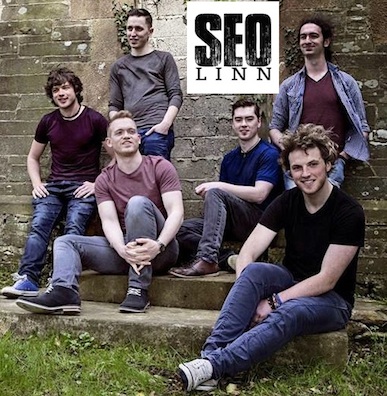
This enterprising group, which perform as Seo Linn, who electrified the 10,000 people who marched on Lá Mór na Gaeilge (See more pics on their Facebook page) have already proved themselves musically and now want to share their expertese in music and language to the wider audience that the know are out there. They have achieved an incredible 4.6million viewings of one of their live performances in the Conamara Irish College, Coláiste Lurgan on YouTube. (Take a look - the words are included - and sing along!) They have performed on television and before President Michael D Higgins.

The inspiring thing about this initiative is that it ignores the usual well trodden paths used by Irish Language organisations braving the dispiriting, soul destroying and interminable bureaucracy seeking grants for their initiatives. Those who are lucky enough to be successful receive this largesse but often bound up with conditions that often times render the initiative ineffective. Without the grant of course the venture falls. A small coterie of enterprises have tried this "modh díreach" of start-up with reasonable success before now. This is an exciting one and worthy of our support!

So what are they planning?
They are going directly to the public with a request for €50,000. They have definite proposals they have a date when the initiative is a success or, God forbid, a failure. We'll know by the end of the month.

Let them speak for themselves: "Seo Linn are asking YOU for help. We know that we are on the path to generating a new kind of Irish music, one that has the potential to portray the Irish language in a progressive, relevant light. We want to make Irish available.

"We have thought long and hard about this and our biggest challenge right now is to raise this money. Our hard work over the past two years has gotten us to this point and we are ready to take on a new challenge! We are confident that we will overcome any obstacles that may appear in our way."

So what practically do the intend to do with this money? They outline three practical objectives.
  1. Set up a Company that will provide music WORKSHOPS with the Irish language - These will incorporate the various elements of music production and performance into a polished, tried-and-tested workshop that teenagers will really enjoy.
  2. Record and publicise an original ALBUM - We have so much music in our unique brand that we want to share with you. An album of our work would give life to Irish language music in Ireland and abroad along with providing us with the opportunity to expand our horizons as a band and progress up the ladder as recording artists.
  3. TOUR - a crucial part of every band's road to success is touring and gigging. We want to bring our music all over the world and provide the show that gets people talking. Our unifying of the old and new of our cultural identity is an aspect to our show that doesn't go unnoticed and we pride ourselves on ensuring that everyone enjoys the experience.
"As you can see, we have a long, tough road ahead that every single one of us is relishing! With your help, we can make our dream a reality and do something that has never been done before. We have something to offer.. and this is our chance! Go raibh míle maith agaibh."

Tacaigh le Seo Linn!
Click here to support us!
I see that they have over 9,000 followers on their facebook page, If each of those contributed €10 they will have exceeded their target handsomely.

As I write this article only 78 have backed them contributing amounts from €10 to €1000 (Yes €1000) and there are 28 days left to achieve the target. (Since we started writing about an hour ago it has risen to 82!)


When I first saw this I thought "Nah! not possible!" But then I saw the figure grow to €4000 in the first day and almost double on the second and I now believe it is eminently achievable!

In the words of the famous Buxton Water advert, Lets do this!"

Seo Linn

Is you want to read what Tuairisc.ie has written about this and view another video.
€50,000 ag teastáil ó Seo Linn dá dtogra Kickstarter!(Irish)

And take a view of this unforgetable appearance on the Late Late Show.

Sunday, December 14, 2014

Putting the Gael into G-Mail!

Google has been a remarkable friend of the Irish language. From quite early on their search engine has had an Irish language version.

More recently it has provided a sometimes ridiculed translation facility. Among the Irish speaking community the facility offered by Google Translate's facility is sometimes unfairly criticised. The criticism should more properly be directed towards those who use it as a lazy way out,  rather than the remarkable technological achievement it does in fact represent. As somebody who uses it occasionally (not only for it's Irish section but also French, Italian, German and Portuguese) it is best used as a guide and a certain basic knowledge of the language is essential in using the facility. Thus somebody who wishes to say "rest" will know that "an cuid eile" (the other part) is not the same as "suaimhneas" (repose). Rest has at least two meanings in English.

Pic: Tuairisc.ie
Last week the Google organisation added a wonderful support system for the Irish Language. They launched the Irish version of GMail.

There are several interesting things which came to mind as I switched my own Gmail account to my own language!

Bottom up
First is that this was, like the others, a Google initiative. I understand that a Professor in St Louis approached them last year (2013) and asked if they were interested. They replied in the affirmative and a group of volunteers from Ireland, the US and elswhere, gathered and worked in association with the technical people in Google and in an incredibly short time a useable, accurate and user-friendly mail service was unveiled in less than 24 months.

This article in the business section of The Journal.ie describes how to change the working language of your g-mail account: Want to use Gmail as Gaeilge? Now you can!

Another example of this type of voluntary internet intervention is the availability of the Firefox browser in Irish - again quietly and with little state involvement, or the quiet evolving of facebook. And for more volunteer input just take a look at Vicipéid (Wikipedia as Gaeilge!).

Top down?
The second in this is the absence of any comment good bad indifferent, let alone encouraging, from the establishment on this launch. Indeed with one exception I have seen no comment for any member of the Seanad or the Dáil. One tweet commenting on this silence that because there was little or no Government input they were not willing to praise or give credence to such a initiative.

Compare and contrast with the launch of Microsoft as Gaeilge, which, I understand did have Government involvement and thus an extraordinary circus was organised with Government participation. Maybe you don't remember the hoopla: "A country-wide partnership was put in place and it included working closely with Foras na Gaeilge, DCU, NUI Maynooth, eTeams and EGTeo. The Irish speaking community was also invited to contribute to the community glossary, a foundational reference for all technical terms. Commencing in June 2004, the project took over 12 months to complete and involved the translation of over 600,000 terms in Irish, before being made available free to download. The programme was distributed free to all 4,000 primary and secondary schools and in 2006, An Taoiseach announced that due to its success, Irish language versions of Windows Vista and 2007 Office would also be made available." Was the Taoiseach at the launch of Gael Mail? Was the new Minister of State for Gaeltacht Affairs?

Also contrast the attitude of the Welsh government which supported the G-mail initiative in their own language.

Perhaps it is yet another example of the urge to control and centralise that seems to have been emphasised in Government since the exit of the Celtic Tiger.

Abolition of the democratic input in Údarás na Gaeltachta and it's gradual financial strangulation (finances reduced from around €20m to €6m), the attempted emasculation of the Office of the Comisinéir Teanga, the complete destruction of print media in Irish, the attempted decimation of the voluntary language organisations, the withdrawal of Gaeltacht family grants, the forcing through of a Gaeltacht Act without the consensual agreement of the parties in the Oireachtas for the first time in the history of the State, the appointment of a minister for Gaeltacht Affairs unable to converse in the language, the inexorable retreat on the obligations arising from the 2003 Language Act and every sign that the new Language Act will further weaken the position of the language that State organs claim to love, respect and declare a policy of encouraging. And more recently we learn the Nursery School movement for the naoinraí throghout the country is being disbanded (Gaeilge). All with little or no real public consultation.

Add to that the simple reluctance of many state entities and quangos to recognise  a letter with a diacritic mark. This is considered to be a different letter from its unmarked equivalent, and words that are supposed to have diacritic marks and don’t are considered to be misspelled. Thus they cannot recognise names or surnames with such accents. Ó Riain becomes "î Riain" and Éamon becomes "ƒamon" or Ciarán, "Ciar‡n". It cost nothing to have the software corrected to recognise this but does CIE and others care to do it?  (see Why The Internet Hates My Name (It’s The Accent Marks) for an understanding of why this is so.)


Dearg le Fearg
So what does this show?

More and more people are beginning to realise that the political system is failing the historic Irish nation and its people. In February 7000 to 10000 marched in Dublin. In March upwards of 1000 marched in Conamara, 5000 to 7000 in Belfast and various smaller protests occured elsewhere, and not only in Ireland, demanding action on Irish. No real response.

We have seen this in other demonstrations on other causes all being met more or less with the same incomprehension of the powers-that-be. The message "This is Ireland, we speak Irish, get over it!" has been sadly lost among the 97% of the Government who are unable to serve those of us who speak the national language - the European language in longest continuous use as a vernacular. The Government's message continues to be: "Speak Irish to each other but don't speak it to us!" (cf: The State attitude to the National Language & its speakers!)

Google, Mozilla (Firefox) & facebook are commercial organisations which value our ancient lan and are prepared to use it.

Let us thank them and use what they offer.


Monday, November 24, 2014

Irish? No good news? Don't you believe it!

Somebody asked the other day on twitter if there are any good news stories about Irish these days. We are so used to the bad, the attempted emasculation of the Coimisinéir Teanga's powers, total lack of understanding of the importance of the language to the national psyche among the State apparatchiks which eventually led to the resignation of the Commisinéir, closure of schools in the Gaeltacht, ending of subsidies in language institutions, withdrawal of subsidies against professional advice in print publications etc etc.

Dispair
It is difficult indeed to find anywhere where there is good news on this front and the lack of reporting (or maybe knowledge) of the good stories is having a detrimental effect on all those who love and speak the language especially in the areas where it has been spoken for over 2000 years, long before English was a baby!

It was little wonder that the resigning Comisinéir, Seán Ó Cuirreáin, stated as he left office (in translation), "Never before have I seen in over 30 years’ experience - as a journalist or language commissioner - morale and confidence so low. Despite the enormous goodwill of the vast majority of the people of this country, the language continues to drift further to the margins of society including within much of the public sector - " He also refered to the "sinister forces" in our State structures, for whom, to quote the words of President Michael D Higgins, "Irish was not half dead enough.” To be fair to Seán he did point out that there had been some advances in the position of the language in his period in that office.

The gallant few
We sometimes forget perhaps that there is a small faithful group, many times isolated and folorn within their work place who yet understand the importance of "Gaelachas" which many of us are allowing - if not willing it -  to slide into oblivion. These, who may truly be called "servants of the nation," feel isolated and abandoned too by those who fight for language rights as they are lumped in with those referred to by President Higgins.

Why am I writing this. Well earlier this month I read an article by Concubhar Ó Liatháin, regarded by some, if not many, as a bit of a curmudgeon, in the "Seachtain" (Itself something of a good story, an Irish newspaper, unsupported by Government Grant). His article certainly gave me a certain sense of optimism and I hope it will do the same for you.

This article headed Language and "sean-nós" (the term uses for traditional style unaccompanied solo singing - or dancing - mostly in Irish) are safe with the new generation. The author relates his visit to Oireachtas na Gaeilge (another good news story ignored by and large in the English Language media). This annual festival is a great chance to mix and renew friendships not only with well known faces in the Irish language sector but also those less known and unsung. During the week in Killarney he met a friend who works in the Gaeltacht Department and he spoke about the frustrations he and his colleagues feel from the indifference in the media for the good news of the development of the language in the Gaeltacht.

This was news to me, used as we all are to the doom and gloom, impending disaster, and finally end of the Gaeltacht in the next 20 years. I have been hearing this since the nineteen sixties when I first started to care about such things. My interest was aroused.

A hopeful sign
If I may give my own poor translation of Conchubhar's article he continued: "He (the civil servant) that since the opening of the Family Centre in Indreabhán in Conamara a substantial percentage increase of young children presenting for primary scholing in the area with Irish.

"'A survey was conducted back in 1973 on Children speaking at the schoolyard gates. According to this survey 30% of the children in the districts covered, could be counted as native Irish speakers. Today, in the same districts, this figure is 65% outside of the school yard.' said my authoritative friend...

"According to the authorities of the schools in the district where the Cois Fharraige Family Centre is situated, an improvement beyond imagination has occured in the use of the language in the area. One of these centres is being opened in Baile an Fheirtéaraigh next January and again investment of €3 milliom from Roinn na Gaeltachta and Údarás na Gaeltachta.

"Although certain advances are happening, there are many battles which my companion and his camrades are fighting with the Departments and with other Government Departments yet to be won..."

Problems continue!
He goes on to talk about lack of understaing shown by Minister Noel Dempsey (Local Government) in the past and even the new Minister Joe McHugh stating that the erection of a new industry in the Gaeltacht should not merit a language impact study (see on  You Tube). The Department of Education has had a similar attitude to providing an curriculum recognising proficiency in Irish in the Gaeltacht areas.

As I'm writing this news has been reported of the Secretary of the Department of Education has launched of yet another of the interminable reports on the language. This talks of the abilty of primary school in English exceeding that of that in Irish. Hardly surprising since the curriculum in their school is the same for Dalkey in Co Dublin as it is in Ros Muc in the heart of the Conamara Gaeltacht! This has been reported negatively in some circles but of course it is not necessarily a bad thing. One wonders what the result of such a study mutatis mutandis in another part of Ireland would unearth. One wonders also if it will join the multiplicity of Irish Language reports and studies gathering dust deep in the dusty cavernous cellars of some Government Department!

But back to the article in "Seachtain!"

Pól Ó Ceannabháin
"I was present myself where there was a grand crowd of boys and girls under 12 years competing with each other in the Sean-Nós Singing Competition at the Killarney Oireachtas. THe adjudicator, Pól Ó Ceannabháin, was absolutly correct when he remarked that they were a source of pride and hope. The future of sean-nós and Irish are safe in the next generation.

"As they say in certain part of the north, No surrender!, no surrender to dispair!"

And always remember the old chestnut. It always makes stope me up short! 
"Did you know that the last surviving speaker of Irish hasn't been born yet" 

Thursday, January 23, 2014

Floccinaucinihilipilification! The State attitude to the National Language & its speakers!

"The choice I had was to stand aside from my appointment as Coimisinéir Teanga on principle to draw attention to these matters or to continue in my role and, consequently, to participate in a pretence". (Seán Ó Cuirreáin)

This is a translation of the remarks made by Seán Ó Cuirreáin to the Oireachtas Sub-Committee on the 20-Year Strategy for the Irish Language on Thursday 23rd January 2014.In light of what he is saying here is it not significent that no member of either Government party, Fine Gael or Labour, thought it worthwhile to attend?

We have taken our title from a letter which propitiously appeared in the Irish Times that morning (and reproduced in the box below right) with a new old word for "the action or habit of estimating as worthless!" The use of such a word to describe the States attitude to the National language and those who use it regardless of where they are is I think justified in light of words of the first Comisinéir Teanga before his resignation takes effect!

This translation has been edited lightly, breaking certain paragraphs to allow for ease of reading and puting in some headings which do not appear in the official translation.This is available in pdf format on the website of the Office of the Coimisinéir Teanga!

The text in its original language may be found here in html format! 
Irish language ‘being driven to margins of society!' (Irish Times, 24/1/2014)
‘Irish language policy risks being seen as a sham’ (Irish Examiner 24/1/2014)
Gross Insult to dedicated servant (Irish Examiner 28/1/2014)


<<
I would like to thank you for your invitation here today. When I addressed another joint committee of the Houses of the Oireachtas at the beginning of last month, I hadn’t expected to be back here today and it’s an honour and a privilege to have received your invitation. I announced here at the beginning of December that I had decided to stand aside from the position of Coimisinéir Teanga in a
month’s time, on 23rd February, when I will have completed 10 years in that capacity. I would like to take this opportunity to thank all of those people who have contacted me in the meantime; I appreciate very much all of the messages of goodwill which I received locally, nationally and internationally.
A Letter in the Irish Times 23rd Jan 2014
Sir, – The longest word in the English language, writes Patsy McGarry (In a Word, Time Out, January 20th) is antidisestablishmentarianism, unrivalled. It has 28 letters. But it does not appear in my admittedly ancient Shorter Oxford English Dictionary (1955). What does appear is the word that used to delight us as children: floccinaucinihilipilification. It has 29 letters. Dating from 1741, it means the action or habit of estimating as worthless. – Yours, etc,
HILARY WAKEMAN,
Skeagh,
Schull, Co Cork.


Reasons for Resignation
Before I focus on the theme for discussion today – the 20-year Strategy for the Irish language – I would like to mention the main reason that I decided to resign as Coimisinéir Teanga. I had, in essence, come to the firm belief that in the two years which remained in my term of office, there would be little else that I could personally achieve in relation to language rights for Irish speakers and Gaeltacht communities.

Marginalisation of Irish
I believe that the language is continuously being edged aside, pushed towards the margins of society and that includes much of the public sector. I would not support the premise that the fault lies primarily with politicians but it appears to me, notwithstanding those within the State sector who support the language, that there are stronger and more widespread forces in place who have little or no concern for the future of our national language. 

Some progress has been made over the past 10 years since the introduction of the Official Languages Act – particularly in the use of Irish on public signage, in stationery and in publications. There is a greater awareness of language rights and our Office supports this. The neglect in promoting the language scheme element of the Act has resulted in severe restrictions on the progress which might have been made.

• I believe there is no possibility that the new system being introduced to increase the number of civil servants fluent in Irish will succeed.  A commitment that State service through Irish be provided in Gaeltacht areas without terms and conditions is not forthcoming  and consequently, the practice will persist where the State sector is effectively saying to Gaeltacht communities: “Speak Irish among yourselves, but don’t speak it to us!”.

• More than two years have elapsed since a review of the Official Languages Act began, yet at this stage, the very first step in amending the legislation – the publication of ‘heads of a bill’ has not been taken. A new deadline was announced last week for the publication of the amendments – before summer.

• A decision to merge the functions of my  Office with the Office of the Ombudsman was made without reference to me or to the then  Ombudsman, yet again more than two years later, no details are available publicly of the  proposed new arrangement or how it is thought it might work.  It was announced last week that the merger will happen by next September. 

• I believe that the Office was never given adequate resources to fully perform its statutory  obligations in a satisfactory manner. 

• For those who believe in language rights for Gaeltacht communities and for Irish speakers in general this is a time of great uncertainty. I have always held the opinion that the support required for the Irish language within this country’s public service should not and could not be viewed as an optional extra. Language rights are permanent rights; they are not concessions or privileges granted at
times of prosperity.

• If the State cannot provide assurances, when the language legislation is being amended, that it will ensure that it can communicate in Irish with Gaeltacht communities without terms and conditions and that it will have adequate staff in public administration with proficiency in Irish, then I believe that its policy will be viewed as a sham.

• The choice I had was to stand aside from my appointment as Coimisinéir Teanga on principle to draw attention to these matters or to continue in my role and, consequently, to participate in a pretence.  I am absolutely certain that I made the correct decision.  The process of appointing a new commissioner has now begun and I would like to extend my best wishes to whoever is appointed as my successor.

The Strategy (The 20 Year strategy for the Irish Language published 2009)
I understand that as a subcommittee you have a particular focus on the 20-Year Strategy for the Irish language and that you wish me to direct some of my comments today to that matter.

I played an active part in the preparation of the Strategy – I published recommendations on the subject and I met with the group of international experts established to advise on the drafting of the Strategy.

I stated – when launching Ard-Fheis Chonradh na Gaeilge in 2008 – that the implementation of the strategy could be amongst the most important actions for the future of the language since the foundation of the State.  I also gave a very clear warning at the time: “It is important that we do not forget that any strategy is worthless unless it is implemented.  The agreement and publication of the strategy must be a starting point on a new journey and not the destination.”

The following year, I stated that it was necessary to begin the implementation of the strategy effectively and without delay, and,  if that were not to happen, and if it were to be treated in the same manner as countless other commendable reports, then it would be preferable to discard it immediately to avoid further cynicism.  I stated at that time that actions in accordance with the commitments were required rather than empty promises.

So, is the Strategy being implemented?  I don’t know.  And with all due respect to you as a subcommittee, I believe that you don’t know either as there is no independent audit or review being conducted on the implementation of the Strategy.

It is self-assessment only and from the experience of my Office in auditing the language schemes of State bodies over the past 10 years, little value or importance can be attached in reality to self-assessment.

In any area of life, it is difficult to depend on any review by stakeholders with vested interests, but, on the other hand, research based evidence is of immense value. We have also learned a valuable lesson over the years – that there is a basis for the phrase “what gets measured gets done!” Unless audits and independent assessments are carried out I don’t believe anyone can give any guarantees as to implementation.

Expert opinion
But a person may have an opinion: here is an opinion from an expert. Seosamh Mac Donnacha from the National University of Ireland, Galway, was (with Conchúr Ó Giollagáin) one of the authors of “The Comprehensive Linguistic Study of the Use of Irish in the Gaeltacht” - research work which prompted the Strategy.

Speaking at Tóstal na Gaeilge last year, he said that the 20-Year Strategy for the Irish Language no longer existed. “I am aware that we have a document which we call The 20-Year Strategy for the Irish Language 2010-2030. But a document and a Strategy are not one and the same. We do not have a live Strategy that is being implemented in a consistent systematic manner...” (trans.)

Dr John Walsh, another expert, had the following to say in this month’s edition of the magazine Comhar: “The 20-Year Strategy is now like a corpse and the Irish language is more marginalised than ever in the Civil Service.”(trans.)

“A dead document”
Seosamh Mac Donnacha described the Strategy as ‘a dead document’ and he also said that the Department of the Gaeltacht no longer exists – “we merely have a sub-section which deals with the Irish language and Gaeltacht issues – a sub-section of a department which is large and diverse... And that sub-section is located far from the centre of power (in Na Forbacha, Conamara); it is at the bottom of the internal power chain within its own department; and that parent department is at the bottom of the power chain to which all the Government Departments belong, which means that it is difficult for it to have any significant impact on policy formulation or on the implementation of the policies of those other departments which have a central role in the implementation of the 20-Year Strategy for the Irish language...” (trans.)

The core issue for him is that a sub-section which is operating in those circumstances could not protect or preserve what is left of the Gaeltacht, and that we are only fooling ourselves if we think it could.

It is a pessimistic assessment, but unfortunately, I am very aware that many in the Gaeltacht communities and Irish speakers in general share that view. The writer, Seosamh Mac Grianna, once said that the truth is "not just bitter but savage which is why it is avoided."

I firmly believe that if this debate is to succeed, it must be based on the truth, the whole truth and nothing but the truth. I have no wish to be negative about this, but I believe that the starting point must always be based on reality rather than on a presumption based on unfounded hope. Groupthink has no place in matters as important as the survival of a language.

Based on census figures from 2002, it was argued in 2007 that the Irish language would survive no more than 15-20 years as the predominant community language in the strongest Gaeltacht areas that remained. Of course, it will survive as a language, and the last native Irish speaker has not yet been born. But that in no way equates to its survival as the predominant community language, handed down in an unbroken chain, from generation to generation. As someone who cares about the future of the language and the Gaeltacht and as a person who has spent the most of his life living in the Gaeltacht, it doesn’t appear to me that significant actions or worthwhile, practical steps have been taken on the ground to address the scale of the language emergency in the Gaeltacht since that very clear warning was given seven years ago.

Tick-Tock
"Economic planning would not be left to such local communities nor would they be given responsibility to decide locally on matters concern housing, roads or the environment.  But when it comes to the language, well, that’s another story!"
A new Gaeltacht Act has been enacted, although the welcome it received could hardly be said to have resounded through the hills and glens of the Gaeltacht. It changed the structure of the board of Údarás na Gaeltachta and, in conjunction with the Údarás and Foras na Gaeilge, placed liability for language planning on Gaeltacht communities who never sought that responsibility. Economic planning would not be left to such local communities nor would they be given responsibility to decide locally on matters concern housing, roads or the environment.  But when it comes to the language, well, that’s another story!

Certain areas have been chosen and more will be chosen to prepare language plans; they will be given two years to prepare the plans and seven years to implement them. Meanwhile tick-tock, Tempus fugit and if, as is said in Irish, “God’s mills grind slowly” it appears the wheels of the state turn more slowly still, particularly in the case of the language.

When I see the sorry state of the system put in place to develop language plans or language schemes in State bodies because of ineffective implementation, it is unfortunately very difficult for me to have any confidence in the new language planning system envisaged in the Gaeltacht Act.

Indeed, I very much doubt if those who are officially responsible for directing the implementation of the Strategy and the language planning initiative, truly believe, in their heart of hearts, that there is any realistic hope that these policies will in fact succeed or bear fruit. And, certainly, if those charged with that responsibility don’t believe in it, then surely there is little reason for anybody else to have any faith in it either: no social legislation can be effectively implemented unless the public in general has confidence in it and supports it.

The Act and the Strategy
With regard to the Irish language in the State sector, I recently read an article by a retired senior civil servant who said, in his opinion, that there was “growing evidence that there is a strategy afoot to do away with what’s left of Irish in the public life of the county.” Seán Mag Leannáin spent 15 years as a principal officer in the civil service until he retired in December 2009. He said:

“The civil service establishment...are almost 100 per cent united in their view of Irish as an irritating thorn in the administration. The mandarins know there isn’t political consensus on the issue and they calculate that even to open a public debate on Irish would be to accord it a status it doesn’t deserve – far better to ignore it as if it didn’t exist and to starve the Official Languages Act of the resources to implement it. Let the whole thing wither on the vine...”

"It reminds me of a phrase used by our President Michael D Higgins, speaking at the biennial Tóstal na Gaeilge conference in Galway in 2010, when he referred to those 'for whom Irish was not half dead enough.'”
Furthermore he had this to say; “When the Official Languages Act was passed over 10 years ago the top civil servants adopted a minimalist, wait-and-see approach. They knew that without their active support the new legislation was never going to have much effect. But what started as passive inaction on their part now seems to have moved up a notch or two to one of active undermining.

It reminds me of a phrase used by our President Michael D Higgins, speaking at the biennial Tóstal na Gaeilge conference in Galway in 2010, when he referred to those “for whom Irish was not half dead enough.”


What an interesting perspective from a courageous man who was at the centre of the state sector.

A commitment was made in the Strategy that a system would be put in place whereby the number of staff in the public service who could conduct their business in Irish would be increased. I have already referred to this new system that is to be put in place on a pilot basis. Perhaps it is simply enough to say that research carried out on our behalf found that, based on official figures from the Department of Education and Skills, it would take this new system, if implemented fully and positively, about 28 years to double the percentage of administrative staff in that department with fluency in Irish, from 1.5% to 3%.

It was further promised on page 45 of the Strategy that language schemes would, in future, specify positions within State bodies where ability in Irish would be required. The Strategy was published in December 2010 – more than three years ago. A total of 26 new language schemes have been confirmed over those past three years but, to date, not even one position in one language scheme has been specified as one where ability in Irish was required!
"10 of these (16) officers who have responsibility for the language coordination in Government departments don’t actually have Irish themselves."

I should also point out that Government departments have nominated Irish language officers or other officials responsible for language affairs to implement the Official Languages Act and to liaise with my Office. These are all talented people who diligently carry out their responsibilities, nonetheless only six out of the 16 officers in question actually have Irish; in other words, 10 of these officers who have responsibility for the language coordination in Government departments don’t actually have Irish themselves.

A series of plans and policies were announced to reform and modernise the public sector last week; as far as I am aware, the words ‘language’ ‘Irish’ or ‘Gaeltacht’  were not mentioned once in these documents.

Education
The Strategy for the Irish language places great emphasis on the place of Irish in the education system and I welcome the decision of the Department of Education and Skills to review the provision of education in the Gaeltacht.


 Two cases
However, I am particularly concerned about this issue in the light of that Department’s attitude as reflected in two education related investigations carried out by my Office recently.

1. In one case, a Gaeltacht primary school complained to me that it had been directed by the Department of Education to appoint a teacher from a panel of surplus teachers although neither the teachers themselves, nor the school authority in question, believed that any of the available teachers had sufficient Irish to teach in a Gaeltacht school.

The following is a random sample of emails sent by the teachers on the panel to the school authorities:
  • “...With respect to you, your principal and your pupils, I feel that my standard of Irish would not reach the requirement needed for a Gaeltacht school and Gaeltacht life in general...
  • “... To tell the truth, I am rather worried because you are a Gaelscoil and there are native speakers attending the school.”(trans).
  • “I am sorry....I do not have sufficient Irish to work in the Gaeltacht.”(trans).
  • “Unfortunately I don’t think I would be the best person for the job and I’m sure there’s someone on the panel with more experience in Gaelscoileanna and fluency with Irish than I have.”
"Undoubtedly however, the root of our problem is that we have never made an adequate connection between the learning of Irish and its subsequent use. The State requires students to learn the languages but often the same State denies or obstructs the use of Irish by those people in their dealings with the State."
In spite of that – and despite the fact that some of the pupils would have better Irish than the teachers themselves in this situation – the Department put forward legal and practical arguments to say that there was no need for special arrangements for the Gaeltacht and that every primary school teacher in the country was qualified to teach in a Gaeltacht school. However, I found, as a result of that investigation, that certain provisions of the Education Acts were breached in this case and I made recommendations in line with that finding.

2. In another case, the Department of Education and Skills again put forward legal and practical arguments as to why it was not obliged to provide the option of studying the subjects of the curriculum through Irish up to Leaving Certificate level to students in one of the strongest Gaeltacht regions remaining in Co. Donegal. The school in question has an Irish language stream up to Junior Certificate level but few students opt for this as they would have to change their language of learning from Irish to English for the two final and most important years, the years of the Leaving Certificate.  The investigation by my Office found that the refusal of the Department of Education to provide education through Irish to Gaeltacht students breached its own statutory obligations and in this case also I made recommendations to remedy the situation.

I suspect that you will, in light of this, understand my concern about the educational element of the Strategy.

Undoubtedly however, the root of our problem is that we have never made an adequate connection between the learning of Irish and its subsequent use. The State requires students to learn the languages but often the same State denies or obstructs the use of Irish by those people in their dealings with the State.  There is a disconnect and a failure of joined up thinking there.

Stakeholders
I have referred already to the absence of any independent monitoring of the 20-Year Strategy for the Irish language. Efforts are being made for some time now to have the Irish language and Gaeltacht communities recognised officially as stakeholders by affording them a role in directing  the implementation of the 20-Year Strategy. However, for whatever reason, the State sector has  refused to concede to that proposal. I find this difficult to understand as I once again recall that social legislation cannot be effectively implemented without the confidence and support of the public in general.   

We do hear a lot of buzzwords about interdepartmental committees, bi-lateral talks and implementation plans, but do these amount to positive practical action?

This reminds me of the latest story brought to light by the journalist Breandán Delap from the files of the National Archive released under the 30 year rule. He discovered official documents concerning The Four Year Action Plan for the Irish Language, published in 1983, by the state organisation, Bord na Gaeilge. This was a substantial and significant document in which targets were identified in respect of every aspect of the State sector. However, when the political and civil service inputs had been taken into account all that remained of that ambitious plan were proposals to establish a framework of committees to make recommendations with regard to the use of Irish in public life.

This reminded the journalist of Séamus Mallon’s wry comment concerning the Good Friday Agreement as being “Sunningdale for slow learners.” Plus ça change, plus c'est la même chose. 
How unfortunate it would be if the same fate were to befall the 20-Year Strategy for the Irish language!

As I prepared to address you here today, I recalled statements made by two of our heroes who passed way in the last year, may they rest in peace – Nelson Mandela who said “If you talk to a man in a language he understands, that goes to his head. If you talk to him in his language, that goes to his heart.”

And Seamus Heaney, who said “Not to learn Irish is to miss the opportunity of understanding what life in this country has meant and could mean in a better future.  It is to cut oneself off from ways of being at home. If we regard self-understanding, mutual understanding, imaginative enhancement, cultural diversity and a tolerant political atmosphere as desirable attainments, we should remember that knowledge of the Irish language is an essential element in their realisation.”

Choices!
We have two simple choices – to look back at Irish as our lost language or forward with it as a core part of our heritage and sovereignty.

But I would say to you with certainty here today in the Houses of the Oireachtas, that it is with heavy hearts that the people of the Gaeltacht and the Irish speaking community in general will approach the centenary of the 1916 Rising in two years time if our national language is to be merely a symbolic language, and rather than being an integral part of our culture and heritage, that it is pushed aside, marginalised and left in the in the halfpenny place in the life of this nation.

Thank you for your invitation to address you today.
>>
The last heartbreaking paragraph in its original language is in given below. It is indeed tragic that these are the words that the first Ombudsmanin Ireland, Europe and perhaps the world to resign on a matter of principle leaves us as a parting message to legislature!


Thursday, January 31, 2013

The dictatorship of fear!

"Guth na Gaeltachta curtha ina thost!" (Guth na Gaeltachta silenced!)

This is yesterday's headline in this week's Gaelscéal, one of the Irish newspapers published each week. It indicates that members of Guth na Gaeltachta, the Donegal Gaeltacht based organisation set up in alarm at the direction of State policy towards our language was taking following the publication of the report of An Bórd Snip Nua, were now fearful of speaking publicly because of the threatening attitude being adopted by the Department of Arts, Heritage and the Gaeltacht.

This stems particularly from the letter sent, in English, to one of the members, employed by the Department, not in the Gaeltacht section but in the Heritage section, as a gardener, advising him that his terms of employment could be compromised if he continued speaking against Government policy on the Gaeltacht, that they could be construed as breaking the terms of his employment. We mentioned this in a blog, Bullying from Govenment, in July 2012.

Naturally Guth na Gaeltachta spoke out against this threat at the time. The Junior Minister, to whom responsibility for the Gaeltacht has been devolved, Dinny McGinley, stated that he had no responsibility over civil service procedures!  It appears that the Civil Service operates without impunity. (In a case brought eventually to the Oireachtas by the Comisinéir Teanga the Civil Service "defended" its position on incorrectly implementing its own policy for recruitment. "This is the way we've always done it, therefore it is the correct way!" Sir Humphery could not have said it better!)  Since that time Guth na Gaeltachta has been remarkably silent and normally vociferous spokespeople, not all of whom are Department employees, are unwilling to make any comments, good bad on indifferent, "on advice."

One wonders where this will stop. I have come across one old-age-pensioner who is now afraid to voice his opinion on the Language he has loved and  for which he has fought all his life, because he now depends on a state pension and is afraid he will loose it. What about employees of the Department of Education or third level institution who owe their funding to the state? On the radio last evening it emerged that language planning experts in Galway University had been moved "sideways" from the Language Planning Department. This is the Department which will be in greater demand by Gaeltacht parishes if the policy forced through the Oireachtas by this government last year is to be implemented!

This attitude falls in with the dictatorial way in which this Fine Gael/Labour Government is ramming through policy, much of it not really thought through, and instilling fear on one sort or another not only into the Gaeltacht people, but also people in other areas , especially rural people. One merely has to mention the fear gripping so many people with the closure today of one hundred rural Garda stations - eight in the Donegal Gaeltacht. Or the threatening behaviour of the Minister of the Environment Phil Hogan on the issues of so-called "Household Tax" and rural effluent treatment. How he has cut-back funding to local authorities because he says that people in their area had not paid this charge, the collection of which was in fact not the responsibility of the local authority!  Look at the enforced mergings of the National Library and National Archives; National Museum and National Gallery; Comisinéir Teanga and Ombudsman; the the ramming through of the Gaeltacht Bill which removes the democratic authenticity of Údarás na Gaeltachta are all indications of a dictatorial bureaucracy. It is interesting in this context to look at what our present President Michael D Higgins has said on "institutional inadequacy,"(The President, the bureaucracy and the language! 5/11/2012)

 Yesterday a person came to my door by mistake looking for an elderly neighbour. He was from an organisation which provides alarms specifically for the elderly living alone and afraid of incursions by person or persons unknown. An indication of the fear gripping rural Ireland?

The exclusive story in Gaelscéal (Irish)
Martin Niemöller, was a Luthern Theologian in Germany during the war. This is somethig he said which has perhaps some little relevence here.

First they came for the communists,
and I didn't speak out because I wasn't a communist.

Then they came for the socialists,
and I didn't speak out because I wasn't a socialist.

Then they came for the trade unionists,
and I didn't speak out because I wasn't a trade unionist.

Then they came for me,
and there was no one left to speak for me.


Have they come for Guth na Gaeltachta?


Monday, November 5, 2012

The President, the bureaucracy and the language!

" I find it shocking the ease with which authoritarianism emerges and the expressions of authoritarianism….." Michael D Higgins, President of Ireland

In a recent interview the President of Ireland made the following comments:

The President of Ireland
Dúbhghlás de hÍde 1938-1945
Michael D Higgins 2011-
"I think that one needs to address….institutional inadequacy. How is a legislative proposal initiated and where does it come from? How is it processed and is it processed with participation? How is it administered? I’ve seen advocacy groups work for 20 years on getting as far as a piece of legislation but then the implementation of the legislation is frustrated by a whole set of bureaucratic blocks.

"And there is a very serious bureaucratic problem in this country…a very serious problem of hierarchy. It’s very fine to ask public servants to be flexible but there is a hierarchical structure there. There are still many elements of patriarchy and what I think is extraordinary to me at this stage of my life looking back on it after nearly a half a century as a sociologist, I find it shocking the ease with which authoritarianism emerges and the expressions of authoritarianism…..I spoke about it recently to a very senior person, about where people are almost waiting for their authoritarian moment…(in the bureaucracy)

"Yes, oh yes. In many cases therefore it is sometimes quite difficult to be original, to be flexible, to be very human. It is nearly impossible to be vulnerable. Because the culture of never being caught with a mistake just completely stymies real development.

"When a country is recovering, and I think it is, from what it has been plunged into by a false model of a speculative economy, you find people are very flexible and innovative and creative. And also people value the warmth of relationships. I find that again in relation to groups I’ve visited, receptions I’ve had here....."

Language and bureaucracy!
A very good example, and there are dozens, perhaps hundreds, of this, not to put too fine a point on it, obfuscation, is the management of Government policy on the Irish Language.

Take last Thursday's confirmation by the Government of Minister Brendan Howlin's decision in November 2011 to amalgamate the Office of Coimisinéir Teanga with that of the Ombudsman. This document (issued in English only at the time) excited strong and hostile comment and, as far as I can see, no favourable comment.

The press release from the Department that handles Gaeltacht affairs, (downgraded itself by this Government from a community department to a culture and arts department) purports to clarify the matter.

But does it?

This is what it says:

"An Coimisinéir Teanga (Irish Language Commissioner): The Office of An Coimisinéir Teanga is to be merged with the Office of the Ombudsman. A statutorily appointed Coimisinéir Teanga, based in the Gaeltacht, will continue to independently exercise existing powers under the Official Languages Act."

Later on it "clarifies" what this means in practice in a note for editors:

"An Coimisinéir Teanga (Irish Language Commissioner)
• The Office of An Coimisinéir Teanga is to merge with the Office of the Ombudsman.
• The statutory powers and functions of An Coimisinéir Teanga under the Official Languages Act 2003 will transfer to the Ombudsman and will be delegated to An Coimisinéir Teanga under the amending legislation.
• An Coimisinéir Teanga will continue to be statutorily appointed and exercise independent powers under the Official Languages Act 2003 and will also continue to be based in the Gaeltacht."

Hostile Policies
Fine Gael/Labour Coalition Governments have an unenviable reputation when it comes to the Irish Language and its recognition in state affairs.
The Cosgrave administration abolished the requirement for proficiency in the language among Civil Servants.

The current administration regards Gaeltacht Affairs as a matter of culture of Arts rather than as a matter of Community as the previous administration - however inneffective we might think it - did.
They abolished the requirement for the publishing of legislation bilingually.
They also abolished the direct democratic elections of Údarás na Gaeltacht.

They succeeded in breaking the cross party unanimity on the Gaeltacht and Language, after almost ninety years.
Other policies of this Government such as the closing down of rural schools and Garda Stations have had a disproportionate effect on the fabric of Gaeltacht Communities.


Most Irish Taoiseach?
The further delicious irony is that the current Taoiseach, Enda Kenny, uses more Irish in the Dáil than any Taoiseach on all aspects of policy (not only Irish or Gaeltacht matters) prompted by Gerry Adams, the leader of the junior opposition party!
Who was consulted!
Is this not a downgrading of the office of Coimisinéir Teanga? Or does it enhance the office as the Minister of State has mantained since.  Does it reflect the "comprehensive consultation" that the Minister of State's superior mantains has been engaged in since the Howlin Document was issued? It is interesting that nobody has come forward, not least the two offices involved, confirming that they were involved in this "comprehensive consultation!" Above all does it save money or the amount of bureaucracy (and therefore cost) involved in the work of this important, although perhaps fairly weak office.

A slight independance?
Let's look at the office itself.

It is an Office of State and the Coimisinéir is appointed directly by the President of Ireland of Ireland (as is the Ombudsman). This appointment is by the President on the advice of the government following a resolution passed by the Houses of the Oireachtas recommending the appointment.  (Dáil,Seanaid and Úactharán). The role and functions of the Coimisnéir Teanga, limited as they are, are clearly laid out on the Office internet site.

The new arrangement as outlined in the Department release appears to remove the direct connection with the President and the Oireachtas, and possibly the direct communication with the Minister for Gaeltacht Affairs. Instead the offices Coimisinéir will be delegated by the Ombusdman who will be the "de jure" Comisinéir Teanga. If he is delegated (and this is the word used in the release) of the Ombudsman then "ipso facto" we have an extra bureaucratic layer to the office.

The direct responsibility and access is gone and the extra works (and presumably expense) in becoming, in effect, a sub-office of the Ombudsman will further increase the work and the delay in the expedition of his reports and God alone knows how effective they would be in encouragement action.

The Presidency
The Coimisinéir will  "continue to be statutorily appointed" says this release. What does this mean? Will the President appoint the Comisinéir while the Ombudsman gives the office its powers? What is the sense, logic or indeed implications of this not only to the Office of Coimisinéir Teanga but to the Office of the President itself?  Indeed an unfortunate irony for an office first occupied by a man whose short paper "The necessity for de-anglicising the Irish nation!"  can justly be seen as what revivified the Irish people at the end of the nineteenth century and the ideals of which appear to be at best forgotten and at worst actively opposed by the administrative bureaucracy in Ireland!


Wednesday, January 18, 2012

Open letter to Senators!

Open letter to members of Seanad Éireann on the occasion of debate on Irish and the Gaeltacht!

Dear Senator

I understand that the Seanad is to have a discussion on Irish and the Gaeltacht this afternoon.

I would like to make some points in English and would ask you to forgive any gramatical or other  errors in this paper.

As someone who lives in the Gaeltacht I believe that the language adn the very fabric of society here are being catastrophically threatened by the policys of the current administration.

The demotion of the Department of the Gaeltacht into an Art and Heritage sub set from a more sensible position as a component of Community Development. The Gaeltacht is a community not a museum, art gallery or heritage site. It's spokesman is now a Junior Minister who however well-intentioned has NO input into cabinet decisions concerning his people.

The Language Acht, by no means a perfect piece of legislation, is being steadily watered down and dissassembled. The first straw in the wind was the abolition of the right to have legislation introduced simultaneously into law. The second was the inexplicable decisiion to merge the office of the Language Commissioner into the Ombudsman's Office, a move which even the Junior Minister McGinley admits will cost the State money. In addition the fact that the Ombudsman's office is non-compliant with the law in matters under the responsibility of the Language Commissioner doues not auger well for the new arrangement. The Ombudsman's Office finding itself in breach of the law would be laughable.

Laws in other areas also add to the dangers. May I list those I know of:

1. Proposed legislation to tax on septic tanks only apply to rural areas - where the majority of Gaeltacht Areas are. (I have no problem with the proposed Household Tax in principle rather do I have a problem with the method of its introduction and how it is calculated!)

2. The uncertainty and probable abolition of the representative nature of Údarás na Gaeltachta will lessen if not totally erode the relevence of this body. It does need reform but giving the responsibility to local County Councils to appoint the board is false democracy.

3. Perhaps the most frightening threat from this Government is the decision on rural schools. This effects the Gaeltacht Areas severly. Under this legislation it looks like over eighty schools will close. Places like the Kerry Gaeltacht will leave one rural school as 13 out of 14 fail to reach the new target. In my own area over half the small schools will be closed/merged. Two will close in Múscraí, 28 in Donegal and 2 of the three in the Waterford Gaeltacht will close. In recent discussions between the Parents and public representatives it was apparant that those making the decision in the Department of Education had no idea of the effect or even of the geographic locations of the schools they are closing.

4. Another point about the Department of Education is the fact that only 1% of the staff of that Department are able to provide a service to these Gaeltacht (or any Gaelscoil) Schools.

5. Services like speech-therepy and other health services are by-and-large not available to children and grown-ups in their home language.

6. So-called "environmental issues" like no planning for single rural homes, turf-cutting, special areas of conservation etc are also restrictions which impact in various ways on various Gaeltacht areas.

7. The debacle of the introduction of the houshold tax is merely a reflection of the thoughtlessness in administration. As of this morning the form to register for this tax is unavailable either on-line or in local authority offices.

Finally there is no good example being provided by political, ecclesiastical or other leaders. For instance when was a contribution to discussions on any subject except the language itself ever held in the Dáil or Seanad, not to mention Local Authority. Indeed the only elected State Body which holds its meetings in Irish, Údarás na Gaeltachta, is apparantly sheduled for castration.

The Oireachtas, the Parliament of Ireland has NEVER to my knowledge issued a press release in Irish yet there are at least six media outlets for such releases. If they wish to transmit any news of the Oireachtas, debates or committee they must translate these from their own resources!

The requirements of Gaeltacht Areas are by an large those of many other Rurl Areas excepot they require them in Irish. There are little or no cost implications in this as it only requires personnal who are competant in the language who can speak and write it. In fact if any of the above

I've tried to compress thoughts here and there may be other points which could be made but I think there is enough to go on in the above.

Thank you for your attention and I hope you are successful in catching the Chair's eye in this debate!

Eoin Ó Riain
Irish Citizen
Caorán na gCearc,
Baile na hAbhann
Conamara
Co na Gaillimhe

• A letter from Guth na Gaeltachta with these points and also some others is available on Gaeltacht21: Guth na Gaeltachta chuig an Seanad (Irish 18/2/2012)

Saturday, November 19, 2011

Developing language policy by hunch!

It is hard to see a real love of the Irish heritage in the actions taken by the current government and epecially in the majority party.
Opened by a President closed by Fine Gael?
"The "Free State" never had any intention to revive the native language. They always needed to cloy to English norms, without which, they would be dumb and blind. Those who were given power by the English, were totally "cleansed" of any trace of our traditions and culture. They are irrelevent and what ever they do is irrelevent. We must press on without them. Beidh lá breá gréine in Éirinn lá. Labhair Gaeilge! Droch rath ar na 'Léinte Gorma'" .

This is a comment typical of many which have appeared in the last few days following the shoch announcememnt of the planned watering-down, if not the total abolition of the Language Commissioner's office.

A paper by Dúbhglás de hÍde, 1st President of Ireland "The necessity for the de-anglicising the Irish nation!" instigated the birth of the nation. Are we now smothering that same nation through thoughtless hunches?
Fine Gael has form!
Earlier this year the Language Commissioner, Seán Ó Cuireáin in a report described the ending nearly 40 years ago of the requirement for civil servants to have competence in Irish as well as English, when addressing a conference in Dublin last February.

This decision was taken by a Fine Gael Minister of Finance and in fact a lot of the so-called costs of translations etc would harldy be neccessary if this dicision had not been taken as there would be sufficient personnal "in house" to handle the business in both languages. He cites as an example that the "Department of Education and Skills, which recently revealed that only 1.5% of its administrative staff had sufficient competence in Irish to be able to provide service in that language." This in a Department that to a large extent was entrusted with the "revival of the Irish language" at the foundation of the state.

 Enda Kenny himself commented on a report from the Education Department in 2006: "....it's pretty ironic that the Department of Education, which has been dealing with the teaching of Irish for more than 80 years, was not in a position to translate this report itself and had to contract an outside company to get the document translated." (23 June 2006). Is it possible that Richie Ryan's decision some forty years previously had an influence?

Fine Gael's Richie Ryan statement as he announced this change proclaimed that this decision will lead "replacing the compulsion which did so much damage to the Irish language over the past half century with enthusiasm for the language, we will have people more readily disposed to use Irish.” Another hunch?

Mr Ryan, where are these people?

Mantaining the "murder machine!"
P. H. Pearse, President of the Provisional Government in 1916 referred to the education system here as the "Murder Machine." It is not so long ago since the leader of Fine Gael, now Taoiseach Enda Kenny, promoted the abolition of Irish as a neccessary subject in our Leaving Certificate examination. He was approached last year on his policy to eject Irish from the core curriculum at Leaving Certificate level. When asked to explain how the survival prospects of an imperilled language could be improved by lowering its social status, he replied that his policy for Irish in the schools is based on a personal 'hunch.' (Letter to newspapers 8 Feb 2011)

Fine Gael is not alone!
This notion of change be "hunch" or without adequate, or indeed any, clear notion as to why an action should be taken is demonstrated in a recent article from the pen of Irish Times columnist Fintan O'Toole, a journalist with whose opinions this writer does not always agree. He asks: "Want to hear about a daft idea that deserves to be shelved?"
His vision for Irish is perhaps laudable. "My vision for Irish in our education system is simple: I believe we should equip our people, and particularly our young people, with a real, a useful, and a communicative knowledge of the Irish Language." His 'personal hunch' however leads him to state, "All students will be offered a choice as to whether to study Irish after the Junior Certificate examination."

Language planning by intuition!
And now in what appears to be a continuation of their Irish Language policy by "hunch," they have announced the intention, as part of the "Public Service Reform" announced by the Government, to "merge" the office of the Language Commissioner with that of the Ombudsan. In a statement Seán Ó Cuireáin confirmed that he had not been consulted on the decision and was informed by telephone on Wednesday night. This is breathtaking not only displaying a lack of courtesy but also a lack of evidence of any real considerationof the impact of such a decision - another hunch?

The wording in the policy states "Merge functions of Language Commissioner with Ombudsman Office." This appears as a decision. Then this rider is added, "To be progressed in the context of the ongoing review of the Official Languages Act 2003" In other words it is removing the examination of the independance of the Language Commissioner's office from the review of the Act. It ties the hands of the review. Why?

The ostensible reason for this decision was to save money. "The need to reduce public spending and drive greater efficiency is clearly evident and has been committed to. We will relentlessly focus on delivering better value for money through the implementation of Public Service Reform."

Let's examine the costs. According to the Junior Minister with responsibility for the Gaeltacht, Dinny McGinley, the cost for this office is €600,000 per annum. The bulk of this cost is salaries and rental of the premises in the Gaeltacht. The staff of the office are civil servents and the plan states that no personell will loose their jobs. The Commissioner himself has been appointed by the President for a term which expires in 2016. The rent for the premises is being paid to another State agency, Údarás na Gaeltachta. It is not unreasonable to assume that any additional costs are the cost of the work accomplished through the office in serving the public. Mr Kenny says there will be no reduction in the standard and efficiency of the office under the new regime. Minister Howlin echoes this in relation to the total programme, "These measures are designed to make service delivery more effective and efficient!"

Could it be that this is another hunch?

Mr Kenny, where is the saving?

Are they alone?
The other parties have little to be proud of either.
Sinn Féin, whom one might think would be full of practical love of their language presided over the closing down of the only Irish Language daily newspaper.
Fianna Fáil did little to change the hostile legislation of Richie Ryan when they returned to power. Yes while they were in power the did eventually pass a language act 71 years after they came to power. Indeed there are those that feel that even this would not have happened but for the dedication and sheer nerve of Éamon Ó Cuív.
The Labour Party have hardly covered themselves in glory in the over 80 years since the foundation of the state. Michael D Higgins' steadfastness in the face of relentless criticism resulted in the foundation of the now much praised TG4.

Is it any wonder that the people of the Gaeltacht and the language are totally disillusioned?

The Irish people require leadership in restoring its self respect as a nation. Seán Ó Cuireáin in some small way was helping in that. Not all people thought that his office was as useful as it could be or indeed that some of the aspects of the Language Act itself were that useful but it was all we had and it was subject to review. Will that review be realistic, honest, scientific or will all the changes if any be based on a hunch?

The prospect is terrifying!


• Incidentally in compiling this piece we found that all the Irish Language sites had complete English Language versions. None of the  Government Sites we looked at had! Need we say more!