Friday, February 14, 2014

Twenty first century assessment - no time for group think!

"...nobody trusts people to investigate themselves. It’s just not the way things are done any more.” Minister Leo Varadkar
"...little value or importance can be attached in reality to self-assessment." Retiring Coimisinéir Teanga, Seán Ó Cuirreáin

In his final address to the Oireachtas as Coimisinéir Teanga on 23rd of January 2014, Seán Ó Cuirreáin made the following point when discussing the states the 20 year strategy on Irish (2010-2030) published in December 2010.

Self assessment!
Dr Leo Varadker: "..nobody trusts
people to investigate themselves!"
"Is the Strategy being implemented? I don’t know. And with all due respect to you as a subcommittee, I believe that you don’t know either as there is no independent audit or review being conducted on the implementation of the Strategy.
It is self-assessment only and from the experience of my Office in auditing the language schemes of State bodies over the past 10 years, little value or importance can be attached in reality to self-assessment.
In any area of life, it is difficult to depend on any review by stakeholders with vested interests, but, on the other hand, research based evidence is of immense value. We have also learned a valuable lesson over the years – that there is a basis for the phrase “what gets measured gets done!”
Unless audits and independent assessments are carried out I don’t believe anyone can give any guarantees as to implementation."

Not the modern way!
Glancing through some old newspapers, prior to recycling, I came across this statement, which, although it is dealing with another matter, makes the same point with perhaps stronger emphasis. In talking about the matter of the quashing of traffic penalty points discussed earlier this year, Fine Gael Minister for Transport, Dr Leo Varadkar, criticised the handling of the affair.

A report in the Irish Times, (4th February 2014) states, "While the matter was the subject of investigations within the Garda, Mr (sic) Varadkar suggested that internal inquiries lack credibility." He is quoted directly as saying “It’s just the 21st century Ireland that we live in – nobody trusts people to investigate themselves. It’s just not the way things are done any more.”

One hopes that his forward thinking penetrates into the deepest recesses of the usually impenetrable bureaucracy that runs this country. A bureaucracy run by civil servants whose attitude to the language has moved up a notch or two from "passive inaction on their part ...to one of active undermining," to quote a retired former higher Civil Servant.

As Seán Ó Cuirreáin stated: "Groupthink has no place in matters as important as the survival of a language."

Wednesday, February 12, 2014

Irish as a foreign language!

"Language rights are permanent rights; they are not concessions or privileges granted at times of prosperity." Seán Ó Cuirreáin, Coimisinéir Teanga, 

Last December, largely ignored by the English speaking media, saw the shock announcement of the Coimisinéir Teanga (Language Commissioner) that he intended to resign during this month. This event and also his later eloquent testimony explaining his decision to an Oireachtas Committee galvanized not only what is dismissed loftily as the Irish speaking lobby, but also ignited a simmering rage in the ever-reducing Irish speaking communities (Gaeltacht) where Irish is still used as a community language.


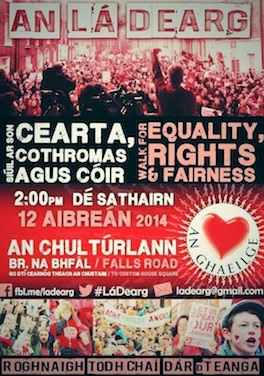
Another walk is being organised for the Northern Capital which will be entitled "An Lá Dearg" (The Red Day!).
This follows the successful "Lá Mór na Gaeilge" in Baile Átha Cliath on 15th February 2014 with up to 10,000 people, and the tribute to the resigning Language Commissioner, Seán Ó Cuirreáin in Conamara (23/2/2014) attended by up to a thousand people. 

Will you be with us?


A hastily arranged meeting in Dublin’s Liberty Hall gave expression to this anger and one of the results was the decision to hold a demonstration in Dublin on the 15th February 2014. Spontaneous meetings sprung up throughout the country, north, south, east, west to discuss how best to support this day and also to allow the expression of the feelings of those unable to attend the initial Liberty Hall meeting.

This writer attended the meeting in South Conamara, held in the historic Sean Scoil Sailearna, an old school building which has been imaginatively transformed into a wonderful theatre. Many grievances were aired but the one which made the greatest impact on me was the anger at the lack of understanding of the education needs of an Irish speaking area.

IAFL (Irish as a Foreign Language)
I was unaware just how unsuitable the uniform syllabus foisted on our schools is. Pupils in Rathfarnham, Carlow, An Spidéal or an Bun Beag have exactly the same linguistic programme. A pupils in an English speaking school in English speaking Dublin has a curriculum in Irish and in English which is exactly the same as a pupil in an Irish speaking school in Irish speaking Indreabhán. In other words the Irish curriculum is being taught as a foreign language even where it is the language of the community.

A study some years ago found that the schools in the Gaeltacht were excellent at teaching English but not Irish. Perhaps we have unearthed the reason why. This is understandable when one realizes that the Department of Education admits that only 1.5% of its personal have sufficient knowledge of Irish to conduct the business of administrating the educating the children of Ireland in what our constitution defines as the National Language.

Speak Irish among yourselves, but don’t speak it to us!
It does not help when one experiences that the state agencies, almost without exception, are unable to conduct business in the Gaeltacht in the language of the people. The Government have not  provided assurances to ensure that it will communicate in Irish with Gaeltacht communities without terms and conditions and that it will have adequate staff in public administration with proficiency in Irish to serve those excercising their constitutional right to deal in Irish with the state. In the words of the resigning Language Commisioner, '..the State sector is effectively saying to Gaeltacht communities: “Speak Irish among yourselves, but don’t speak it to us!”.'

The courageous decision of Seán ó Cuirreáin highlights the situation as he sees it after ten years, "The choice I had was to stand aside from my appointment as Coimisinéir Teanga on principle to draw attention to these matters or to continue in my role and, consequently, to participate in a pretence."

One is amazed at the unprecedented speed with which the Government has acted in appointing a successor to this position. The method of selection is of course clouded in secrecy, as is the wont of this "open" administration. The thought has occurred to more than one that it is an attempt to appease those who will be walking the streets of Dublin on Saturday. Certainly the appointment of Rónán Ó Domhnaill is universally welcomed. He appears to be a good choice but one wonders if he will have any greater success than his successor if securing the respect for his office in the ranks of the civil services where, in the words of one of their members, "passive inaction on their part now seems to have moved up a notch or two to one of active undermining."

If that is the case one wonders how long his term of office will last or will he too be forced to resign on principle?

Seán Ó Cuirreáin stated our choices succinctly: "We have two simple choices – to look back at Irish as our lost language or to move forward with it as a core part of our heritage and sovereignty."

Thursday, January 23, 2014

Floccinaucinihilipilification! The State attitude to the National Language & its speakers!

"The choice I had was to stand aside from my appointment as Coimisinéir Teanga on principle to draw attention to these matters or to continue in my role and, consequently, to participate in a pretence". (Seán Ó Cuirreáin)

This is a translation of the remarks made by Seán Ó Cuirreáin to the Oireachtas Sub-Committee on the 20-Year Strategy for the Irish Language on Thursday 23rd January 2014.In light of what he is saying here is it not significent that no member of either Government party, Fine Gael or Labour, thought it worthwhile to attend?

We have taken our title from a letter which propitiously appeared in the Irish Times that morning (and reproduced in the box below right) with a new old word for "the action or habit of estimating as worthless!" The use of such a word to describe the States attitude to the National language and those who use it regardless of where they are is I think justified in light of words of the first Comisinéir Teanga before his resignation takes effect!

This translation has been edited lightly, breaking certain paragraphs to allow for ease of reading and puting in some headings which do not appear in the official translation.This is available in pdf format on the website of the Office of the Coimisinéir Teanga!

The text in its original language may be found here in html format! 
Irish language ‘being driven to margins of society!' (Irish Times, 24/1/2014)
‘Irish language policy risks being seen as a sham’ (Irish Examiner 24/1/2014)
Gross Insult to dedicated servant (Irish Examiner 28/1/2014)


<<
I would like to thank you for your invitation here today. When I addressed another joint committee of the Houses of the Oireachtas at the beginning of last month, I hadn’t expected to be back here today and it’s an honour and a privilege to have received your invitation. I announced here at the beginning of December that I had decided to stand aside from the position of Coimisinéir Teanga in a
month’s time, on 23rd February, when I will have completed 10 years in that capacity. I would like to take this opportunity to thank all of those people who have contacted me in the meantime; I appreciate very much all of the messages of goodwill which I received locally, nationally and internationally.
A Letter in the Irish Times 23rd Jan 2014
Sir, – The longest word in the English language, writes Patsy McGarry (In a Word, Time Out, January 20th) is antidisestablishmentarianism, unrivalled. It has 28 letters. But it does not appear in my admittedly ancient Shorter Oxford English Dictionary (1955). What does appear is the word that used to delight us as children: floccinaucinihilipilification. It has 29 letters. Dating from 1741, it means the action or habit of estimating as worthless. – Yours, etc,
HILARY WAKEMAN,
Skeagh,
Schull, Co Cork.


Reasons for Resignation
Before I focus on the theme for discussion today – the 20-year Strategy for the Irish language – I would like to mention the main reason that I decided to resign as Coimisinéir Teanga. I had, in essence, come to the firm belief that in the two years which remained in my term of office, there would be little else that I could personally achieve in relation to language rights for Irish speakers and Gaeltacht communities.

Marginalisation of Irish
I believe that the language is continuously being edged aside, pushed towards the margins of society and that includes much of the public sector. I would not support the premise that the fault lies primarily with politicians but it appears to me, notwithstanding those within the State sector who support the language, that there are stronger and more widespread forces in place who have little or no concern for the future of our national language. 

Some progress has been made over the past 10 years since the introduction of the Official Languages Act – particularly in the use of Irish on public signage, in stationery and in publications. There is a greater awareness of language rights and our Office supports this. The neglect in promoting the language scheme element of the Act has resulted in severe restrictions on the progress which might have been made.

• I believe there is no possibility that the new system being introduced to increase the number of civil servants fluent in Irish will succeed.  A commitment that State service through Irish be provided in Gaeltacht areas without terms and conditions is not forthcoming  and consequently, the practice will persist where the State sector is effectively saying to Gaeltacht communities: “Speak Irish among yourselves, but don’t speak it to us!”.

• More than two years have elapsed since a review of the Official Languages Act began, yet at this stage, the very first step in amending the legislation – the publication of ‘heads of a bill’ has not been taken. A new deadline was announced last week for the publication of the amendments – before summer.

• A decision to merge the functions of my  Office with the Office of the Ombudsman was made without reference to me or to the then  Ombudsman, yet again more than two years later, no details are available publicly of the  proposed new arrangement or how it is thought it might work.  It was announced last week that the merger will happen by next September. 

• I believe that the Office was never given adequate resources to fully perform its statutory  obligations in a satisfactory manner. 

• For those who believe in language rights for Gaeltacht communities and for Irish speakers in general this is a time of great uncertainty. I have always held the opinion that the support required for the Irish language within this country’s public service should not and could not be viewed as an optional extra. Language rights are permanent rights; they are not concessions or privileges granted at
times of prosperity.

• If the State cannot provide assurances, when the language legislation is being amended, that it will ensure that it can communicate in Irish with Gaeltacht communities without terms and conditions and that it will have adequate staff in public administration with proficiency in Irish, then I believe that its policy will be viewed as a sham.

• The choice I had was to stand aside from my appointment as Coimisinéir Teanga on principle to draw attention to these matters or to continue in my role and, consequently, to participate in a pretence.  I am absolutely certain that I made the correct decision.  The process of appointing a new commissioner has now begun and I would like to extend my best wishes to whoever is appointed as my successor.

The Strategy (The 20 Year strategy for the Irish Language published 2009)
I understand that as a subcommittee you have a particular focus on the 20-Year Strategy for the Irish language and that you wish me to direct some of my comments today to that matter.

I played an active part in the preparation of the Strategy – I published recommendations on the subject and I met with the group of international experts established to advise on the drafting of the Strategy.

I stated – when launching Ard-Fheis Chonradh na Gaeilge in 2008 – that the implementation of the strategy could be amongst the most important actions for the future of the language since the foundation of the State.  I also gave a very clear warning at the time: “It is important that we do not forget that any strategy is worthless unless it is implemented.  The agreement and publication of the strategy must be a starting point on a new journey and not the destination.”

The following year, I stated that it was necessary to begin the implementation of the strategy effectively and without delay, and,  if that were not to happen, and if it were to be treated in the same manner as countless other commendable reports, then it would be preferable to discard it immediately to avoid further cynicism.  I stated at that time that actions in accordance with the commitments were required rather than empty promises.

So, is the Strategy being implemented?  I don’t know.  And with all due respect to you as a subcommittee, I believe that you don’t know either as there is no independent audit or review being conducted on the implementation of the Strategy.

It is self-assessment only and from the experience of my Office in auditing the language schemes of State bodies over the past 10 years, little value or importance can be attached in reality to self-assessment.

In any area of life, it is difficult to depend on any review by stakeholders with vested interests, but, on the other hand, research based evidence is of immense value. We have also learned a valuable lesson over the years – that there is a basis for the phrase “what gets measured gets done!” Unless audits and independent assessments are carried out I don’t believe anyone can give any guarantees as to implementation.

Expert opinion
But a person may have an opinion: here is an opinion from an expert. Seosamh Mac Donnacha from the National University of Ireland, Galway, was (with Conchúr Ó Giollagáin) one of the authors of “The Comprehensive Linguistic Study of the Use of Irish in the Gaeltacht” - research work which prompted the Strategy.

Speaking at Tóstal na Gaeilge last year, he said that the 20-Year Strategy for the Irish Language no longer existed. “I am aware that we have a document which we call The 20-Year Strategy for the Irish Language 2010-2030. But a document and a Strategy are not one and the same. We do not have a live Strategy that is being implemented in a consistent systematic manner...” (trans.)

Dr John Walsh, another expert, had the following to say in this month’s edition of the magazine Comhar: “The 20-Year Strategy is now like a corpse and the Irish language is more marginalised than ever in the Civil Service.”(trans.)

“A dead document”
Seosamh Mac Donnacha described the Strategy as ‘a dead document’ and he also said that the Department of the Gaeltacht no longer exists – “we merely have a sub-section which deals with the Irish language and Gaeltacht issues – a sub-section of a department which is large and diverse... And that sub-section is located far from the centre of power (in Na Forbacha, Conamara); it is at the bottom of the internal power chain within its own department; and that parent department is at the bottom of the power chain to which all the Government Departments belong, which means that it is difficult for it to have any significant impact on policy formulation or on the implementation of the policies of those other departments which have a central role in the implementation of the 20-Year Strategy for the Irish language...” (trans.)

The core issue for him is that a sub-section which is operating in those circumstances could not protect or preserve what is left of the Gaeltacht, and that we are only fooling ourselves if we think it could.

It is a pessimistic assessment, but unfortunately, I am very aware that many in the Gaeltacht communities and Irish speakers in general share that view. The writer, Seosamh Mac Grianna, once said that the truth is "not just bitter but savage which is why it is avoided."

I firmly believe that if this debate is to succeed, it must be based on the truth, the whole truth and nothing but the truth. I have no wish to be negative about this, but I believe that the starting point must always be based on reality rather than on a presumption based on unfounded hope. Groupthink has no place in matters as important as the survival of a language.

Based on census figures from 2002, it was argued in 2007 that the Irish language would survive no more than 15-20 years as the predominant community language in the strongest Gaeltacht areas that remained. Of course, it will survive as a language, and the last native Irish speaker has not yet been born. But that in no way equates to its survival as the predominant community language, handed down in an unbroken chain, from generation to generation. As someone who cares about the future of the language and the Gaeltacht and as a person who has spent the most of his life living in the Gaeltacht, it doesn’t appear to me that significant actions or worthwhile, practical steps have been taken on the ground to address the scale of the language emergency in the Gaeltacht since that very clear warning was given seven years ago.

Tick-Tock
"Economic planning would not be left to such local communities nor would they be given responsibility to decide locally on matters concern housing, roads or the environment.  But when it comes to the language, well, that’s another story!"
A new Gaeltacht Act has been enacted, although the welcome it received could hardly be said to have resounded through the hills and glens of the Gaeltacht. It changed the structure of the board of Údarás na Gaeltachta and, in conjunction with the Údarás and Foras na Gaeilge, placed liability for language planning on Gaeltacht communities who never sought that responsibility. Economic planning would not be left to such local communities nor would they be given responsibility to decide locally on matters concern housing, roads or the environment.  But when it comes to the language, well, that’s another story!

Certain areas have been chosen and more will be chosen to prepare language plans; they will be given two years to prepare the plans and seven years to implement them. Meanwhile tick-tock, Tempus fugit and if, as is said in Irish, “God’s mills grind slowly” it appears the wheels of the state turn more slowly still, particularly in the case of the language.

When I see the sorry state of the system put in place to develop language plans or language schemes in State bodies because of ineffective implementation, it is unfortunately very difficult for me to have any confidence in the new language planning system envisaged in the Gaeltacht Act.

Indeed, I very much doubt if those who are officially responsible for directing the implementation of the Strategy and the language planning initiative, truly believe, in their heart of hearts, that there is any realistic hope that these policies will in fact succeed or bear fruit. And, certainly, if those charged with that responsibility don’t believe in it, then surely there is little reason for anybody else to have any faith in it either: no social legislation can be effectively implemented unless the public in general has confidence in it and supports it.

The Act and the Strategy
With regard to the Irish language in the State sector, I recently read an article by a retired senior civil servant who said, in his opinion, that there was “growing evidence that there is a strategy afoot to do away with what’s left of Irish in the public life of the county.” Seán Mag Leannáin spent 15 years as a principal officer in the civil service until he retired in December 2009. He said:

“The civil service establishment...are almost 100 per cent united in their view of Irish as an irritating thorn in the administration. The mandarins know there isn’t political consensus on the issue and they calculate that even to open a public debate on Irish would be to accord it a status it doesn’t deserve – far better to ignore it as if it didn’t exist and to starve the Official Languages Act of the resources to implement it. Let the whole thing wither on the vine...”

"It reminds me of a phrase used by our President Michael D Higgins, speaking at the biennial Tóstal na Gaeilge conference in Galway in 2010, when he referred to those 'for whom Irish was not half dead enough.'”
Furthermore he had this to say; “When the Official Languages Act was passed over 10 years ago the top civil servants adopted a minimalist, wait-and-see approach. They knew that without their active support the new legislation was never going to have much effect. But what started as passive inaction on their part now seems to have moved up a notch or two to one of active undermining.

It reminds me of a phrase used by our President Michael D Higgins, speaking at the biennial Tóstal na Gaeilge conference in Galway in 2010, when he referred to those “for whom Irish was not half dead enough.”


What an interesting perspective from a courageous man who was at the centre of the state sector.

A commitment was made in the Strategy that a system would be put in place whereby the number of staff in the public service who could conduct their business in Irish would be increased. I have already referred to this new system that is to be put in place on a pilot basis. Perhaps it is simply enough to say that research carried out on our behalf found that, based on official figures from the Department of Education and Skills, it would take this new system, if implemented fully and positively, about 28 years to double the percentage of administrative staff in that department with fluency in Irish, from 1.5% to 3%.

It was further promised on page 45 of the Strategy that language schemes would, in future, specify positions within State bodies where ability in Irish would be required. The Strategy was published in December 2010 – more than three years ago. A total of 26 new language schemes have been confirmed over those past three years but, to date, not even one position in one language scheme has been specified as one where ability in Irish was required!
"10 of these (16) officers who have responsibility for the language coordination in Government departments don’t actually have Irish themselves."

I should also point out that Government departments have nominated Irish language officers or other officials responsible for language affairs to implement the Official Languages Act and to liaise with my Office. These are all talented people who diligently carry out their responsibilities, nonetheless only six out of the 16 officers in question actually have Irish; in other words, 10 of these officers who have responsibility for the language coordination in Government departments don’t actually have Irish themselves.

A series of plans and policies were announced to reform and modernise the public sector last week; as far as I am aware, the words ‘language’ ‘Irish’ or ‘Gaeltacht’  were not mentioned once in these documents.

Education
The Strategy for the Irish language places great emphasis on the place of Irish in the education system and I welcome the decision of the Department of Education and Skills to review the provision of education in the Gaeltacht.


 Two cases
However, I am particularly concerned about this issue in the light of that Department’s attitude as reflected in two education related investigations carried out by my Office recently.

1. In one case, a Gaeltacht primary school complained to me that it had been directed by the Department of Education to appoint a teacher from a panel of surplus teachers although neither the teachers themselves, nor the school authority in question, believed that any of the available teachers had sufficient Irish to teach in a Gaeltacht school.

The following is a random sample of emails sent by the teachers on the panel to the school authorities:
  • “...With respect to you, your principal and your pupils, I feel that my standard of Irish would not reach the requirement needed for a Gaeltacht school and Gaeltacht life in general...
  • “... To tell the truth, I am rather worried because you are a Gaelscoil and there are native speakers attending the school.”(trans).
  • “I am sorry....I do not have sufficient Irish to work in the Gaeltacht.”(trans).
  • “Unfortunately I don’t think I would be the best person for the job and I’m sure there’s someone on the panel with more experience in Gaelscoileanna and fluency with Irish than I have.”
"Undoubtedly however, the root of our problem is that we have never made an adequate connection between the learning of Irish and its subsequent use. The State requires students to learn the languages but often the same State denies or obstructs the use of Irish by those people in their dealings with the State."
In spite of that – and despite the fact that some of the pupils would have better Irish than the teachers themselves in this situation – the Department put forward legal and practical arguments to say that there was no need for special arrangements for the Gaeltacht and that every primary school teacher in the country was qualified to teach in a Gaeltacht school. However, I found, as a result of that investigation, that certain provisions of the Education Acts were breached in this case and I made recommendations in line with that finding.

2. In another case, the Department of Education and Skills again put forward legal and practical arguments as to why it was not obliged to provide the option of studying the subjects of the curriculum through Irish up to Leaving Certificate level to students in one of the strongest Gaeltacht regions remaining in Co. Donegal. The school in question has an Irish language stream up to Junior Certificate level but few students opt for this as they would have to change their language of learning from Irish to English for the two final and most important years, the years of the Leaving Certificate.  The investigation by my Office found that the refusal of the Department of Education to provide education through Irish to Gaeltacht students breached its own statutory obligations and in this case also I made recommendations to remedy the situation.

I suspect that you will, in light of this, understand my concern about the educational element of the Strategy.

Undoubtedly however, the root of our problem is that we have never made an adequate connection between the learning of Irish and its subsequent use. The State requires students to learn the languages but often the same State denies or obstructs the use of Irish by those people in their dealings with the State.  There is a disconnect and a failure of joined up thinking there.

Stakeholders
I have referred already to the absence of any independent monitoring of the 20-Year Strategy for the Irish language. Efforts are being made for some time now to have the Irish language and Gaeltacht communities recognised officially as stakeholders by affording them a role in directing  the implementation of the 20-Year Strategy. However, for whatever reason, the State sector has  refused to concede to that proposal. I find this difficult to understand as I once again recall that social legislation cannot be effectively implemented without the confidence and support of the public in general.   

We do hear a lot of buzzwords about interdepartmental committees, bi-lateral talks and implementation plans, but do these amount to positive practical action?

This reminds me of the latest story brought to light by the journalist Breandán Delap from the files of the National Archive released under the 30 year rule. He discovered official documents concerning The Four Year Action Plan for the Irish Language, published in 1983, by the state organisation, Bord na Gaeilge. This was a substantial and significant document in which targets were identified in respect of every aspect of the State sector. However, when the political and civil service inputs had been taken into account all that remained of that ambitious plan were proposals to establish a framework of committees to make recommendations with regard to the use of Irish in public life.

This reminded the journalist of Séamus Mallon’s wry comment concerning the Good Friday Agreement as being “Sunningdale for slow learners.” Plus ça change, plus c'est la même chose. 
How unfortunate it would be if the same fate were to befall the 20-Year Strategy for the Irish language!

As I prepared to address you here today, I recalled statements made by two of our heroes who passed way in the last year, may they rest in peace – Nelson Mandela who said “If you talk to a man in a language he understands, that goes to his head. If you talk to him in his language, that goes to his heart.”

And Seamus Heaney, who said “Not to learn Irish is to miss the opportunity of understanding what life in this country has meant and could mean in a better future.  It is to cut oneself off from ways of being at home. If we regard self-understanding, mutual understanding, imaginative enhancement, cultural diversity and a tolerant political atmosphere as desirable attainments, we should remember that knowledge of the Irish language is an essential element in their realisation.”

Choices!
We have two simple choices – to look back at Irish as our lost language or forward with it as a core part of our heritage and sovereignty.

But I would say to you with certainty here today in the Houses of the Oireachtas, that it is with heavy hearts that the people of the Gaeltacht and the Irish speaking community in general will approach the centenary of the 1916 Rising in two years time if our national language is to be merely a symbolic language, and rather than being an integral part of our culture and heritage, that it is pushed aside, marginalised and left in the in the halfpenny place in the life of this nation.

Thank you for your invitation to address you today.
>>
The last heartbreaking paragraph in its original language is in given below. It is indeed tragic that these are the words that the first Ombudsmanin Ireland, Europe and perhaps the world to resign on a matter of principle leaves us as a parting message to legislature!




Friday, January 10, 2014

The slow strangulation of the language movement!

Here in the twenty six counties we sometimes forget about the six counties even in areas where we should be fostering our affinity with the people on both sides of the divide resulting from the policies and ideologies of another age.

This is evident in the attitudes towards language and has led to an independant and highly successful language movement there especially in urban areas of Belfast. The input from the "language establishment" in the South may perhaps be described as minimal. I don't know whether it was sought or not but in any case the result is a strong vibrant Gaeltacht in Belfast which has sprung not from the policies of the Government or even of public representatives, but from the people.

This people's movement had grown so strongly that eventiually Government funding was made available and this was used in further development of this courageous and vibrant community. The most visible signs of this may be seen in two wonderful facilities in Belfast and Derry cities.

Now this work appears to be in great jeopardy by the policy of Foras na Gaeilge, the body responsible for the promotion of the Irish language throughout the whole island of Ireland.

"In the Good Friday Agreement (1999), it was stated that a North/South Implementation body be set up to promote both the Irish language and the Ulster Scots language. Under the auspices of this body, Foras na Gaeilge will carry out all the designated responsibilities regarding the Irish language. This entails facilitating and encouraging the speaking and writing of Irish in the public and private arena in the Republic of Ireland, and in Northern Ireland where there is appropriate demand, in the context of part three of the European Charter for Regional and Minority Languages."

While this seemed like a good (indeed brilliant) idea at the time it has not been effective because its work depended on the willingness and encouragement of two Governments to ensure success. This has led to a snail-like progress as the policies of both jurisdictions on the matter have rarely been coincidental.

The policy at present is for this body to oversee a re-organisation of the distribution of its ever diminishing funds to organisations with an all Ireland distribution. In effect this means that the organisations and people responsible for what is arguably the most successful Irish language schemes since the foundations of the Irish State are being excluded from any discussions on the refunding from Foras na Gaeilge.

This article, in Slugger O'Toole, "Cuts and splits: How the Irish language community’s most effective advocates are being silenced!" tells how this policy is harming the language and the community not only in the six counties but also throughout the Island. It is no wonder that Seán Ó Cuirreáin commented when he announced his resignation, "For those generally involved with the protection or promotion of the Irish language, either professionally or voluntarily, we are in a time of great uncertainty. Never before have I seen in over 30 years’ experience - as a journalist or language commissioner - morale and confidence so low." See our article, Waiting for eggs for omelettes since 1892!  for full text!

The Irish Sate continues to pursue policies which are condemned as harmful by language experts. To my knowledge they have not produced one Language Planning expert of any calibre to justify what they are doing. Indeed the Government has ignored and failed to answer the two points the Coimisinéir Teanga has made repeatedly, that they use "...Irish in dealing with Gaeltacht communities and ensure an adequate Irish language capacity in public administration." Indeed on this latter point he states: "...there is absolutely no way that the most recent proposal in relation to the Civil Service will work."

The Stormont administration has, I think, been ambivalent at best and more often hostile to anything to do with the language. However when you look at it is there really that much difference between the two governments? One is more explicit than the other! Would it be more correct to say that  one is less hypocritical than the other?

One has great sympathy for those in Foras na Gaeilge in trying to administer their brief and indeed one has to ask how long more before people in that organisation will take the lonely road taken by Seán Ó Cuireáin, the road of conscience!

Monday, January 6, 2014

"...the Irish language is not worth knowing..." the real and present danger!

Several things stirred me during the Christmas period. Two interviews with poets, an article in the Irish Times and a blog article from the prolific keyboard of journalist Concubhar Ó Liatháin.

Irish fiction?
The first was a television interview conducted by Morning Ireland's Cathal Mac Coille with the vetern poet and writer, still happily with us, Máire Mhac an tSaoi. This was a delightful hour or so where both writer and interviewer truly understood each other and where, as far as one could see there a genuine but not restrictive respect, affection and understanding between the interviewer and interviewee. Difficult questions were asked and answered and there were some beautiful moments where this over eighty year old poet recited some of her poems as part of the programme.

The second interview was one of the late Nobel Lauriate, Séamus Heaney by Olivia O'Leary. Again this was a wonderful piece of radio this time in front of an audience and again the interviewer showed her knowledge and respect for the poet. One of her questions however pulled me up short. She was asking if he ever felt drawn into the English "niceness" (I think was the word she used!). This is the way in which she felt that the English tried to "own one." She then said that when she was a broadcaster with the BBC long ago, she was very conscious of the possiblity of loosing her "Irishness" which she identified as her accent. That she always insisted in pronouncing the "R" in "Arthur Scargill" the Irish way.

It struck me as sad that this intelligent woman would not have had this problem in asserting her Irishness had she been in full possession of that most identifiable and unique attribute of Irishness, the language. She would perhaps never have feared this sublimation into Englishness and been like, say the brodcaster from Llanelli's Hew Edwards, a stalwart of BBC News. I cannot imagine this would have occured to Máire Mhac an tSaoi in all her international appointments or to her interviewer.

Irish fiction?
An article in this weekend's Irish Times was on a visit to the Dublin Writers' Museum by Rosita Boland. She mentons that it is twenty years since she last visited the museum. She was puzzeled by one of the display cases. "There is the same seemingly random pairing of featured writers in certain display cases. Samuel Beckett and Máirtín Ó Cadhain share one such space. At first, I think it’s because they were both born in 1906, as the text panels note, but the audio guide informs me it’s because they both “chose not to write in English”.

That immediately struck a chord as Concuubhar Ó Liatháin in his iGaeilge blog, recently commented on a new laureate (Irish), which includes a payment of €150,000, to be be awarded to "what the Arts Council describes as “an outstanding fiction writer”, writing in the English language." I must say his somwhat acerbic comment expresses a view with which I wholeheartedly agree! Should the Irish taxpayers' money be spent in promoting English language fiction or is it possible that Irish fiction and fiction in Irish are not the same?

In a recent (and unique) hour-long interview on Raidío na Life (Irish) our Taoiseach stated that he asked the English Queen Elizabeth II, during her historic visit to Ireland, what she thought the greatest gift England had given Ireland. She replied, "The English language." The Taoiseach agreed with her and indeed, incredulously, admitted this in the broadcast. One wonders if he ever read the address delivered by Douglas Hyde, later first President of Ireland, in 1893. (Arguably without this address he would not be Taoiseach at all!) "I have often heard people thank God that if the English gave us nothing else they gave us at least their language. In this way they put a bold face upon the matter, and pretend that the Irish language is not worth knowing, and has no literature. But the Irish language is worth knowing, or why would the greatest philologists of Germany, France, and Italy be emulously studying it, and it does possess a literature, or why would a German savant have made the calculation that the books written in Irish between the eleventh and seventeenth centuries, and still extant, would fill a thousand octavo volumes."

Maybe we could all do with reading his short address to realise that "in Anglicising ourselves wholesale we have thrown away with a light heart the best claim which we have upon the world's recognition of us as a separate nationality."

Indeed the words of the Coimisinéir Teanga to the Oireachtas Committee last December (2013) could well be regarded as an echo: "As we begin to regain our economic sovereignty, it would be a travesty if we were to lose our linguistic sovereignty – a cornerstone of our cultural identity, heritage and soul as a nation. I believe this to be a clear and present danger." (Translation)


Monday, December 30, 2013

What about the 83%?

We re-published a letter response to an article by Sunday Times correspondent, Brenda Power recently, Coimisinéir not a child of Celtic Tiger! This Sunday a response to the letter has been published from a gentleman in Limerick.

We felt moved to write a response but the letter section was not published in last Sunday's edition- probably due to the Christmas holidays. The basic thoughts in our letter are below!


I fear that Mr Hugh O'Neill ("Outnumbered", 22/12/2013) misread my letter. I did not claim that 6000 people from the Gaeltacht had written complaints to the Commissionéir. Our letter did not claim that the 4.5million outside the Gaeltacht did not have language rights. Indeed had he interpreted the letter correctly he would have realised that almost 83% of the complaints received by the Coimisinéir's office were from outside the Gaeltacht.

I do not know how he knows that the total number of Polish Speakers exceeds the total population of the Gaeltacht. 

The Polish Language itself is, I understand, strong, and used extensively, even by their Government Departments, in their noble homeland. A situation, sadly, not replicated in the homeland of the Irish Language.

Yours etc
I have since learned that the Polish language is used by about 40 million people in Poland and in some of the adjacent countries. And that despite being subsumed and dissolved as a political entity throughout the 19th and early 20th century. 

Niech żyje język polski!

Niech żyje język irlandzki!

Friday, December 20, 2013

Long story on a short survey!

On the third of December the Coimisinéir Teanga announced that he was resigning because he was being supported by the government "...my heartfelt belief is, in view of the information I have presented to you today, that there is little else I can personally achieve in that timeframe in relation to language rights for Irish speakers and Gaeltacht communities. It is therefore with regret that I announce that I have decided to resign from my position as Coimisinéir Teanga on 23rd February next..." (Translation of his statement to an Oireachtas Committee 3/12/2013)

An alt seo as Gaeilge
There is so much misunderstanding out there that we decided to organise a simple short survey. I really was an experiment as we had never tried such a thing before. It is important to understand that we have no experience in this so it is hardly fair to regard it as a scientific statistical exercise.

As one of the participants remarked "Níl an tsuirbhé seo sách cuimsitheach le tuairimí reatha an phobail a mheas ó thaobh cearta teanga de. Ba cheart daoibh ceann eile a dhéanamh san Athbhliain." (This survey is not comprehensive enough to assess the current opinion of the public on language rights. Ye should do another one in the new year!) Of course he or was correct and we may consider doing this.

Publicity!
It was publicised in facebook, twitter and LinkedIn on the 9th December 2013 and from this more than 125 people answered the questions. A mention and the URL were also placed in a response to an article in The Journal.ie. We understand that there ar weaknesses in this survey but nonetheless the results are interesting and perhaps not that different from professional surveys on attitudes to the language.

Ceist 1: The resignation of the Choimisinéara Teanga!
The Coimisinéir Teanga announced his resignation recently stating that his office was not being supported by the Government. Do you agree with his decision?
82% agreed with his decision.lena chinneadh. 12% disagreed and 6% hadn't a clue!.

Ceist 2: Confidence in the Coimisinéir Teanga
Have you confidence in the Coimisinéir Teanga?
92% of the participents express confidence in him while 8% did not!

Ceist 3: Government policy!
Are you happy with the Irish Language policy of this Goverenment?
4% expressed satisfaction while 81% were not. Interestingly 15% of the respondents asked "What policy?"

Ceist 4: The cost of the Coimisinéir's office!
The answers here are interesting. The show that treality and perception among our participents do not always concur .

When the question was put, "How much does the Coimisinéir Teanga's Office cost?" they were invited to "Make an educated guess!)" there were startling differences in the answers. We knew that not everyone would have the exact figures which is whay we asked for an educated guess, . Some were unwilling to venture a response (7%). One (a reader of the Sindo?) said, "Too much!" and another stated, "Ní féidir a luach a thomhas ar airgead - ní mór don oifig a bheith ann, mar sin níl plé faoi chostais ina chuidiú!" (The value cannot be measured in money, the office must be there thus there should be now question of how much it costs!!)

These are the results:
"A budget of €650,000 was provided for my Office for 2012 and €606,784 of that money was 
drawn down." (Annual Report 2012!)
Ceist 5: Complaints from the Gaeltacht!!
Also interesting were the results from the question: "What percentage of complaints to the C.T. are from the Gaeltacht?" A choice was given to participents and only 21% knew the correct figure!
"Complaints … 6,089 up to 30 Samhain 2013, (28% from the Gaeltacht)." Ráiteas an Choimisinéara ós chomhair Coiste Oireachtais. 3 Dec 2013 
Ceist 6: Opinions
This was the are where participents were given the opportunity to express their opinions, whatever they were. Only fifty one did so, most not surprisingly in Iris but a few in English. We have not edited or translated them.  Every view point is expressed from "Good riddance!" go "Coinnigh an dóchas!" (Keep up te hope!)

Do you wish to say anything else?
is náireach an rud é gir mhothaigh sé go raibh air éirí as - lipservice á thabhairt ag an Rialtas don Ghaeilge

Ní bhíonn aon rud suntasach le tuairisciú ag an aire shóisearach nuair a chuirtear ceisteanna air faoi dhul chinn cinn... "Tógann sé am.." "Tá reachtaíocht le foilsiú amach anseo.." "Táimid ag obair air.." Leisce, easpa foirne, easpa acmhainní ó thaobh an rialtais, measaim... Maidir leis an bpobal - An bhfuil fíor-eileamh ann ar sheirbhísí trí mheán na Gaeilge? Déanann cuid againn iarracht, ach is beag an slua sinn, de réir cosúlachta. Caithfidh muid an fód a sheasamh agus cruthú go bhfuilimid ann. Caithfidh muid an fhreagracht a ghlacadh orainn féin, seachas bheith ag brath go síoraí ar oifig an choimisinéara

The cost of the office is offset by tourists visiting Ireland to study Irish and spending money into the Economy, especially in western areas!

Ta dioma orm I ndiadh an cinneadh ach tuigim me e

I nÉireann amháin ...

Tá cearta daonna ag lucht labhartha na Gaeilge ach ní ghéileann an stat go fírinneach go bhfuil na cearta sin ann.

Tá scrios á dhéanamh ag an rialtas seo ar an Ghaeilge.

Tá an rialtas seo ag plúchadh Na teangan

Ba léir ón chéad lá go mbeadh an rialtas seo go dona don Ghaeilge, nach é an chéad rud a rinne siad deireadh a chur leis an ngá na dlíthe a fhoilsiú sa dá theanga ag an am chéanna? Ina dhéidh sin is uile, bhí beagnach gach fadhb a luaigh an Cuirreánach ann nuair a bhí Ó Cuív fós ina Aire. Cibé tacaíocht bheag a fuair an Ghaeilge ón rialtas FFach, d'imigh sí le sruth nuair a thit an tóin as an gheilleagar.

Coinnigh an dóchas.

Tá mé eachtrannach. Fhoghlaim mé an Ghaeilge. Ach nach bhfuil an scéal seo ag cabhrú.

Caithfear an deannach a shéideadh de na polasaithe...ní hionann briathar agus beart.

Sílim gur fearr dúinn ann ná as é ach tuigim cad chuige a ndearna sé a chinneadh. Agus táim chóir a bheith buartha caidé bheidh in ann dúinn tar éis an méid atá feicthe agam ón Taoiseach, ón Leas-Aire Dinny McGinley agus ón Aire Oideachais Ruairí Quinn. Ní amháin go bhfuil siad ag díol an tír leis na comhlachtaí ilnáisiúnta ach tá siad ag marú na teanga agus ag déanamh 'Airstrip 2' amhail is dá mbeadh fís George Orwell a chomhlíonadh acu. Ní Éire Shaor go hÉirinn Gaelach!

Good riddance!!!

Tá Sé in am againn dul i mbun agóide

Bhí sé chomh maith an Straitéis 20 Bliain a chur sa tine mar nach bhfuil moltaí ón Staidéar Cuimsitheach Teangeolaíoch ann. Níl ann uilig ach cur i gcéill agus is mór an náire iad O Cuiv agus Dinny nach raibh in ann cinneadh ciallmhar a dhéanamh maidir le teorainneacha na Gaeltachta. Níltear ach ag breathnú amach do riachtanais na bhfoghlaimeoirí. Tá gach duine ag tabhairt suas ar an nGaeltacht.

Ní chuireann iontas Orm nach bhfuil morán tacaíocht a ar fáil ón Rialtas

Tabhair ar ais an Coimisinéir! Agus cuir polasaí ceart earcaíochta i bhfeidhm láithreach mar chomhartha dea-thola.

feall eile

Níl faoi láthair

Fair play don Chuirreánach, ach tá faitíos orm go dtiocfaidh leibide eicínt i gcomharbacht air.

Scannal amach 's amach go raibh ar dhuine chomh cumasach, ciallmhar le Seán Ó Cuirreáin seasamh siar. Mo náire an rialtas

Níl an tsuirbhé seo sách cuimsitheach le tuairimí reatha an phobail a mheas ó thaobh cearta teanga de. Ba cheart daoibh ceann eile a dhéanamh san Athbhliain.

Teaching a second language isn't rocket science. People shouldn't leave school unable to speak it, that's a ridiculous situation. Teaching and exams aren't being done according to best international practice. If that was changed then kids would come out of school speaking Irish, and wouldn't have a problem providing a service tré Ghaeilge. Those internationally accepted ways of teaching 2nd languages could also be used to upskill older people, who could then also provide a service in Irish easily. The data is out there, but it's being ignored. Talk to the people in TEG, NUI Maynooth.

Cé nach maith liom Acht na dTeangacha Oifigiúla mar go bhfuil an iomarca béime ann ar mhaorláthas gan úsáíd, is cinnte go bhfuil dualgas ar an Stat é a chur i bhfeidhm. Ní maith liom Acht na Gaeltachta 2012 ach an oiread mar gheall ar an sceannairt a rinne sé ar an nGaeltacht, ach creidim go gcaithfidh an Rialtas bheith macánta mar gheall ar an nGaeilge agus an nGaeltacht seaachas bheith de shíor ag labhairt an 'cúpla focal' agus ansan ag cur scian sa teanga ar chúπ téarmaí.

Dún an doras i do dhiaidh!!

Níl, go raibh maith agat.

faic

Níl barúil agam fá na ceisteanna a bhaineann le costas nó le céadatain. Tâ drochbhail ar an teanga istigh sa Ghaeltacht agus taobh amuigh di - ar fud na tíre. Níl meas madaidh ag na meáin ná ag oifigigh an rialtais ar an teanga ná orainne, Gaeilgeoirí. Tá fearg agus díomá orm mar shaoránach de chuid na tíre seo mar gheall air seo. Éire ghallda an sprioc atá acu de réir chosúlachta.

Níl.

Níl an fhreagairt ar eolas agam do cheist a 5. Fear iontach onórach é Seán - rinne sé an rud ceart le haird a tharraingt ar an scéal.

Suas an gealge !

Tá neamh-suim níos contúirtí ná ain-suim. Ar a laghad tá gráin oscailte le sonrú ag an ain-suim!

Bhí an ceart ag gCoimisinéar éirí as Agus gan tacú leis an cur i gcéill a thuilleadh. Táim tinn tuirseach den chur i gcéill i leith na teanga. Ní caitheamh aimsir í an Ghaeilge.

Tá an praiseach ar fuaid na mias ag an Rialtas Gallda seo ó thaobh na Gaeilge de.

ní féidir a luach a thomhas ar airgead - ní mór don oifig a bheith ann, mar sin níl plé faoi chostais ina chuidiú. Gaeilgeoirí a líonfaidh isteach é seo, meas-tú an bhféadfaí an Ghaeilge a chur ar dtús sa chéad cheann eile? é an-deacair teacht ar an Ghaeilge agus é seo á dhéanamh ar an ghuthán póca!

Dhein a oifig idirghabháil ar mo shon chun seirbhís ghaeilge a fháil ó na coimis. ioncaim. D'oibrigh sé.

Níl

Gaeilge abú

Meas ollmhór agam ar an gCoimisinéir Teanga. Is trua liom go bhfuil sé tagtha chuige seo. Ní fheicim go mbeidh aon athrú suntasach dearfach déanta leis an Rialtas reatha.

Fear cróga misniúil is ea Seán Ó Cuirreáin, fear prionsabáilte. Tá sé tar éis leas na teanga a dhéanamh lena chinneadh, cé gur rud é a ghoilleann orainn ar fad. Tá sé in am dúiseacht agus corraí.

Is trua gur éirigh sé as ach tuigim dó. Fear ionraic cumasach díograiseach é Seán Ó Cuirreáin agus ghoill easpa toile agus gníomhaíochta an Rialtais i leith na Gaeilge agus cearta teanga phobal na Gaeltachta agus na Gaeilge go mór air.

Go mbíonn feidhmeanaigh an stáit frith-gaelach sa lá inniu mar a raibh siad go deo.

Níl inti ach teanga, níor chóir níos mó ná sin a chur uirthi. Ní faoin rialtas amháin atá sé an teanga a bheathú.

Muna bhfuil sé ann, beidh an rialtas iontach sasta. Ní bheidh siad freagrach. D'eist mé le Dinny ar R na G ar maidin. Tá náire orthú roimh an Gaeilge.

Níl

Tá an Rialtas ag sárú an dlí agus an Bhunreacht.

Teastaíonn CT le cinntiú nach dtitfidh an Ghaeilge i léig.

Dá dtarlódh sé seo do Emily O Reilly, An Ombudsman , bheadh eirí amach ann . Ba cheart go mbeadh náire ar an rialtas seo leis an chaoi ina bhfuil siad ag caitheamh le muintir na Gaeltachta & daoine ina bhfuil suim acu an Ghaeilge a labhairt agus scríobh.